Kathleen Spivack - Unspeakable Things
Здесь есть возможность читать онлайн «Kathleen Spivack - Unspeakable Things» весь текст электронной книги совершенно бесплатно (целиком полную версию без сокращений). В некоторых случаях можно слушать аудио, скачать через торрент в формате fb2 и присутствует краткое содержание. Год выпуска: 2016, Издательство: Knopf, Жанр: Современная проза, на английском языке. Описание произведения, (предисловие) а так же отзывы посетителей доступны на портале библиотеки ЛибКат.
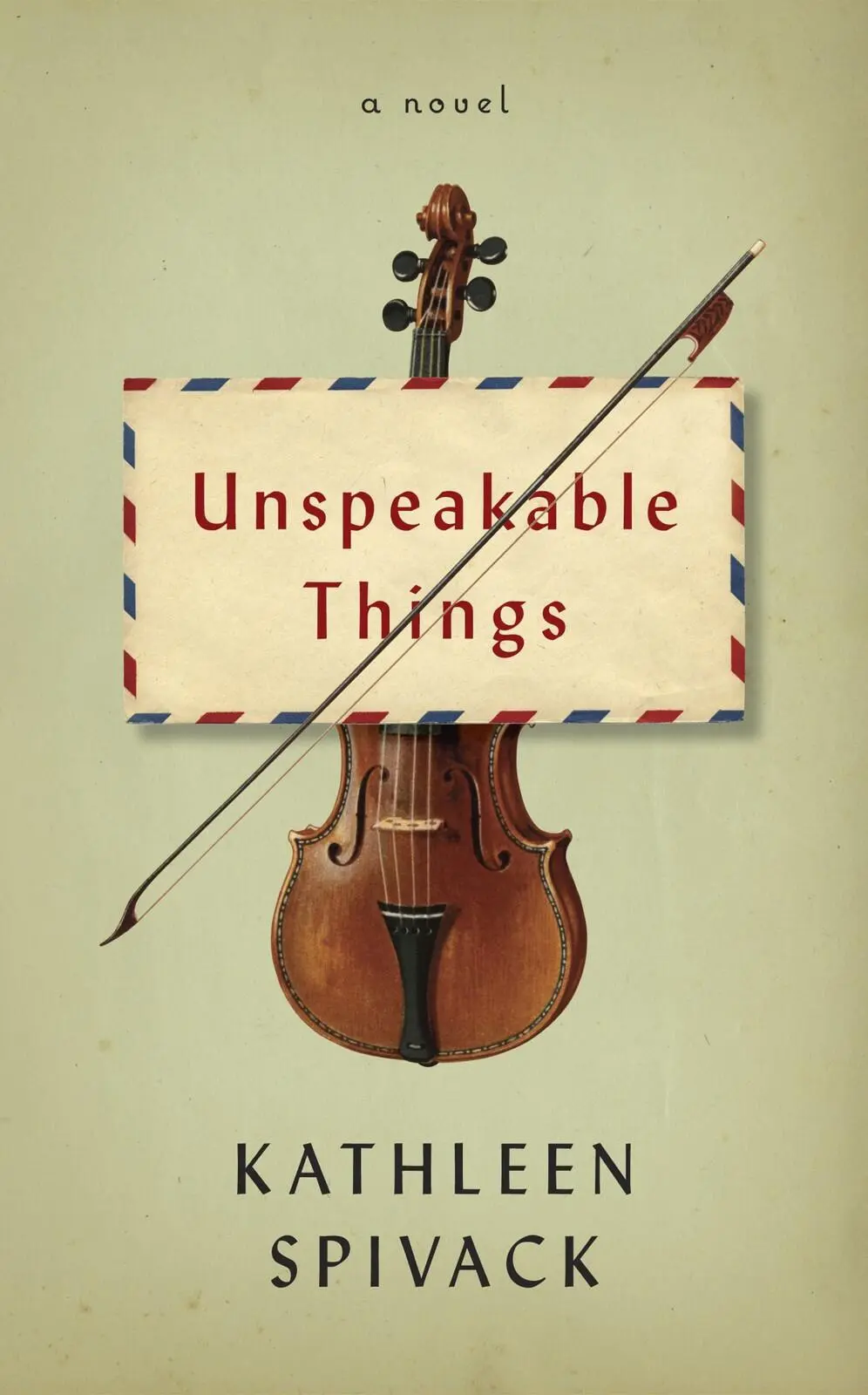
- Название:Unspeakable Things
- Автор:
- Издательство:Knopf
- Жанр:
- Год:2016
- ISBN:нет данных
- Рейтинг книги:4 / 5. Голосов: 1
-
Избранное:Добавить в избранное
- Отзывы:
-
Ваша оценка:
Unspeakable Things: краткое содержание, описание и аннотация
Предлагаем к чтению аннотацию, описание, краткое содержание или предисловие (зависит от того, что написал сам автор книги «Unspeakable Things»). Если вы не нашли необходимую информацию о книге — напишите в комментариях, мы постараемся отыскать её.
and
. A strange, haunting novel about survival and love in all its forms; about sexual awakenings and dark secrets; about European refugee intellectuals who have fled Hitler’s armies with their dreams intact and who have come to an elusive new (American) “can do, will do” world they cannot seem to find. A novel steeped in surreal storytelling and beautiful music that transports its half-broken souls — and us — to another realm of the senses.
The setting: the early 1940s, New York — city of refuge, city of hope, with the specter of a red-hot Europe at war.
At the novel’s center: Anna (known as the Rat), an exotic Hungarian countess with the face of an angel, beautiful eyes, and a seraphic smile, with a passionate intelligence, an exquisite ugliness, and the power to enchant. . Her second cousin Herbert, a former minor Austrian civil servant who believes in Esperanto and the international rights of man, wheeling and dealing in New York, powerful in the social sphere yet under the thumb of his wife, Adeline. . Michael, their missing homosexual son. . Felix, a German pediatrician who dabbles in genetic engineering, practicing from his Upper East Side office with his little dachshund, Schatzie, by his side. . The Tolstoi String Quartet, four men and their instruments, who for twenty years lived as one, playing the great concert halls of Europe, escaping to New York with their money sewn into the silk linings of their instrument cases. .
And watching them all: Herbert’s eight-year-old granddaughter, Maria, who understands from the furtive fear of her mother, and the huddled penury of their lives, and the sense of being in hiding, even in New York, that life is a test of courage and silence, Maria witnessing the family’s strange comings and goings, being regaled at night, when most are asleep, with the intoxicating, thrilling stories of their secret pasts. . of lives lived in Saint Petersburg. . of husbands being sent to the front and large, dangerous debts owed to the Tsar of imperial Russia, of late-night visits by coach to the palace of the Romanovs to beg for mercy and avoid execution. . and at the heart of the stories, told through the long nights with no dawn in sight, the strange, electrifying tale of a pact made in desperation with the private adviser to the Tsar and Tsarina — the mystic faith healer Grigory Rasputin (Russian for “debauched one”), a pact of “companionship” between Anna (the Rat) and the scheming Siberian peasant — turned — holy man, called the Devil by some, the self-proclaimed “only true Christ,” meeting night after night in Rasputin’s apartments, and the spellbinding, unspeakable things done there in the name of penance and pleasure. .
Unspeakable Things — читать онлайн бесплатно полную книгу (весь текст) целиком
Ниже представлен текст книги, разбитый по страницам. Система сохранения места последней прочитанной страницы, позволяет с удобством читать онлайн бесплатно книгу «Unspeakable Things», без необходимости каждый раз заново искать на чём Вы остановились. Поставьте закладку, и сможете в любой момент перейти на страницу, на которой закончили чтение.
Интервал:
Закладка:
“Put your hand right here,” Ilse told her daughter a few weeks after they had moved. “Can you feel the baby? Can you feel it kicking?”
Maria put her hand on her mother’s body. Nothing, and then a faint flutter trembled underneath her hand. “I feel it!” she said in wonder.
Philip, watching the two of them, ran across the small lawn to put his head, too, against his mother’s stomach. As he did so, he managed to butt Maria’s hand away. “Do you feel it?” Ilse asked her little boy tenderly.
“This is no time for another child,” David had groaned, raising his body from his wife’s after she had told him the news. “We are already overworked. I cannot manage even as it is.” He was exhausted, impatient. First the move, then this. He was still commuting, coming back once a month or so, irritated to find himself so quickly displaced and taken over by Ilse’s plans.
“Of course this is the time. This is exactly the time.” Ilse stroked her husband. “My darling, we will be so happy in this new country. You will see.”
“Where will we put it?” He meant the child. David was exasperated. Already his parents, with their loud squabbles and reconciliations, were dominating the small house. Was he never to have any peace?
“In our bedroom, of course.”
David groaned and fell back onto the pillow next to his wife.
Outside, on the lawn, Herbert and Adeline were reading the papers and arguing. The new Schatzie, called Mitzie now, lay beside them, thumping her two tails. “You are right. You are always right, my darling,” Herbert was saying mildly.
“Don’t be so irritating!” Adeline snapped.
Mitzie slobbered and rolled over.
“That dog! How could Ilse be so stupid as to take on a dog?” said Adeline. “With everything else she has to do.”
Herbert seemed not to be paying attention.
“I am sure those children are neglected,” continued Adeline fretfully. “What with their mother insisting on going to work every day. Totally neglected.”
Herbert did not bother to point out that it was Ilse’s job that was feeding them all, nor did he bother to mention that it was David, his precious son, who had brought the dog home in the first place. He put down his newspaper, leaned forward, and covered his wife’s hand with his. “My dearest girl, do not trouble yourself. You are right,” he soothed. “You are always right, my darling.”
Adeline stared into space, plucking at the ruffles around her neck with a thin hand. “I miss my piano.”
Herbert sighed. “Of course you do. We must be patient.” Already in his mind he was boarding the elevated train into Manhattan, where, later this afternoon, he had a series of appointments at the library.
“A baby.” Maria raised her hand from her mother’s lap and looked lovingly into Ilse’s face.
“I hope it’s a girl,” she said. “I can’t stand boys.”
Ilse laughed, brushing the hair back from her daughter’s face. “I know, little one.”
And at that moment, the War ended so quietly that the family hardly noticed. For a long time after, their lives did not change. Which is to say that their lives had already been changed, irrevocably.
The photographs and articles began to filter out of Europe, filling the newspapers and magazines of the American households. Suddenly, they were confronted with the starving faces of the now dead. Americans were shocked. But the refugees were not.
“I don’t want the children to see these,” Ilse said as she continually gathered up the old newspapers and discarded them. Although Adeline screamed at her, Ilse threw the papers away just the same.
“Nasty girl!” cried Adeline, her dark eyes quite mad.
“Shh,” said Ilse. She was determined that her children would not grow up with these nightmares.
In the face of the incoming materials, David spent more and more time in his basement office in Washington, clipping and sorting and examining documents and photographs. There was so much to understand.
Herbert, in the New York Public Library, pored madly over the newspapers hanging from their racks, searching the world press.
The thin bodies pressed against barbed wire, yearning for liberation. Many died before they could live again, but their faces and bodies stood before the world, a reproach.
No one told the Gypsies the War was over. They stayed in the death camps, longing for liberty, within the open gates. No nation wanted to take them, although they now could go free. After the treaties, the Gypsies, uninformed, still stayed imprisoned, their wills broken, waiting for what, they did not know. They died in droves, mouths pressed close to the open air.
“My brother.” David rubbed his tired eyes and put down the magnifying glass. Then he picked up the glass again and turned to another stack of materials.
“Bless you, Herr Hofrat. Thank you.” Though petitioners fell to the floor in front of Herbert, seizing his hand and pressing their lips to his ring, there was no one who could help Herbert himself. No one. “Michael, where are you?” Herbert searched and searched.
But Michael was gone. They were never to find him among the other faces.
And now there was so much to do. So many petitioners, so many people needed to be resettled. The work of getting on with life, now that the War was over. Hooray. Information must be falsified. Perhaps now there would be no more wars.
Several months later, David decided to commit himself to this new life, this new country, and his place in it. A new house. A third baby. It was time, he told himself as he took the train back from Washington to spend the weekend with his family. Time to become “American.”
When he arrived, it was morning, a cool, fresh morning after a night rain. No one saw him arrive. He walked anonymously down the sidewalk to where the house stood, identical to all the other houses on the street. But it was his.
The smell of newly cut grass rose to David’s nostrils as he stood outside the house that Saturday. It was a clean smell, clear and acrid and lemony at the same time, rising from the street directly toward his appreciative nose. He could see his neighbors already outside. There were no fences here, no barriers. David looked at all the other tiny houses, the driveways, the plots of furry lawn being mowed. American front yards, neat and open and squared off for everyone to see. Nothing to hide. If he wanted, David could look right into the other windows on the street, identical to his own.
His parents were already carefully smoothing open the latest New York Times, drinking coffee in their dressing gowns. They would have ironed the pages open first to make the newspaper more readable, arguing all the time. He could hear his mother’s voice rising, querulous.
The front door opened, and his children ran down the steps, laughing. They didn’t even see him, a drab man standing at the end of the walk. Between them, they were hauling Mitzie, now dressed in a baby’s little nightgown, with a lace-edged baby bonnet tied around her head, from which her floppy ears protruded. Mitzie’s two tails wagged from the skirt of the baby’s nightgown, at the same time as her mournful, wrinkled face scrunched up, seeming to say, “Yes, I am ridiculous. But love me anyway.”
“Mmmm. My baby!” Maria cried ecstatically, leaning down to plant a big kiss on Mitzie’s nose.
“My baby!” echoed Philip, imitating his big sister. Mitzie did not protest. Her tails just thumped a little faster.
“I will have to teach them both to play chess,” David thought.
Somewhere, far away, another garden, walled, hummed in his memory, and music poured into the space under the linden trees. An enclosed garden, full of music and happiness. Two brothers. The memory held no sting. His language stayed in his mouth like butter and honey.
Читать дальшеИнтервал:
Закладка:
Похожие книги на «Unspeakable Things»
Представляем Вашему вниманию похожие книги на «Unspeakable Things» списком для выбора. Мы отобрали схожую по названию и смыслу литературу в надежде предоставить читателям больше вариантов отыскать новые, интересные, ещё непрочитанные произведения.








Обсуждение, отзывы о книге «Unspeakable Things» и просто собственные мнения читателей. Оставьте ваши комментарии, напишите, что Вы думаете о произведении, его смысле или главных героях. Укажите что конкретно понравилось, а что нет, и почему Вы так считаете.