Kathleen Spivack - Unspeakable Things
Здесь есть возможность читать онлайн «Kathleen Spivack - Unspeakable Things» весь текст электронной книги совершенно бесплатно (целиком полную версию без сокращений). В некоторых случаях можно слушать аудио, скачать через торрент в формате fb2 и присутствует краткое содержание. Год выпуска: 2016, Издательство: Knopf, Жанр: Современная проза, на английском языке. Описание произведения, (предисловие) а так же отзывы посетителей доступны на портале библиотеки ЛибКат.
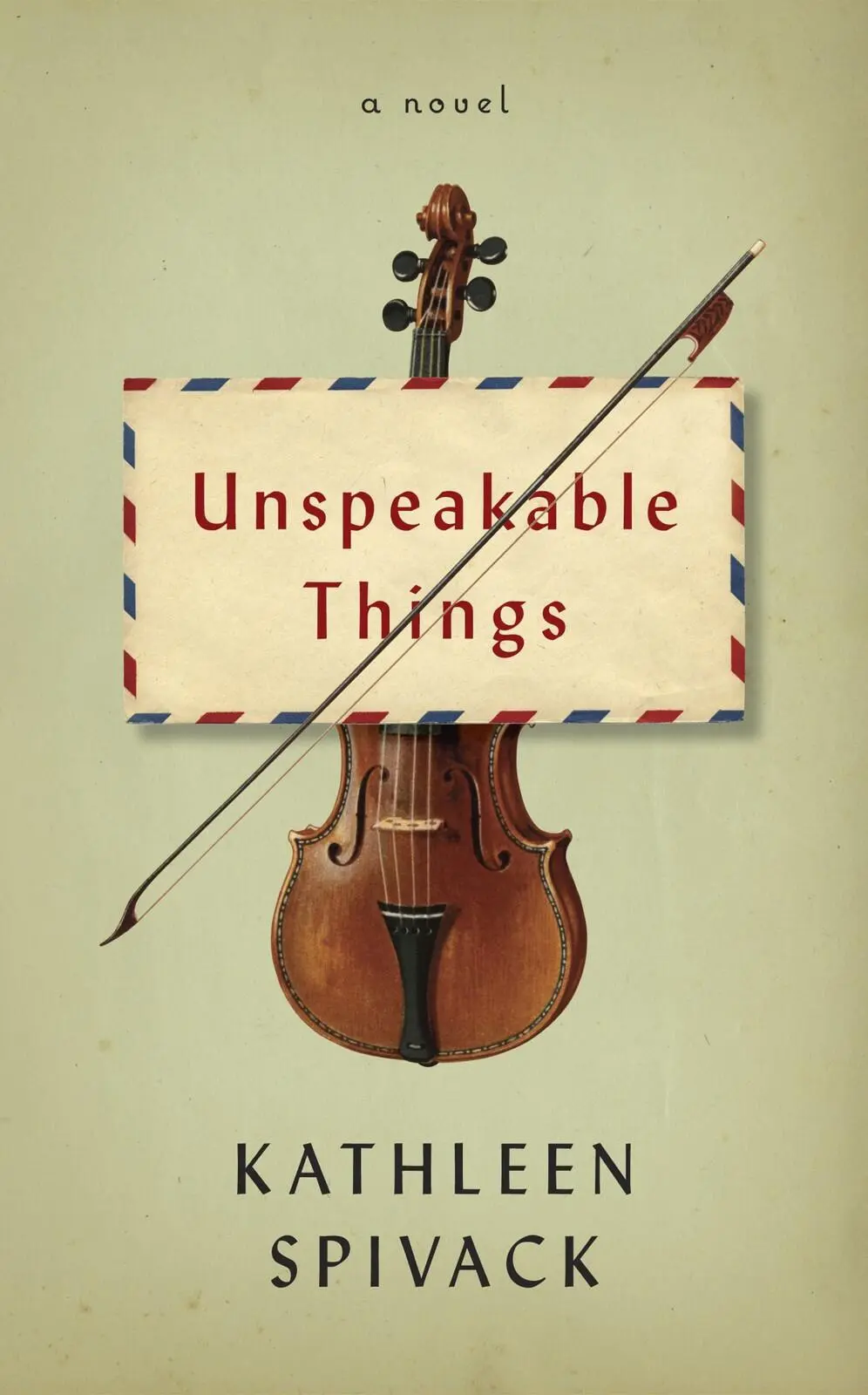
- Название:Unspeakable Things
- Автор:
- Издательство:Knopf
- Жанр:
- Год:2016
- ISBN:нет данных
- Рейтинг книги:4 / 5. Голосов: 1
-
Избранное:Добавить в избранное
- Отзывы:
-
Ваша оценка:
Unspeakable Things: краткое содержание, описание и аннотация
Предлагаем к чтению аннотацию, описание, краткое содержание или предисловие (зависит от того, что написал сам автор книги «Unspeakable Things»). Если вы не нашли необходимую информацию о книге — напишите в комментариях, мы постараемся отыскать её.
and
. A strange, haunting novel about survival and love in all its forms; about sexual awakenings and dark secrets; about European refugee intellectuals who have fled Hitler’s armies with their dreams intact and who have come to an elusive new (American) “can do, will do” world they cannot seem to find. A novel steeped in surreal storytelling and beautiful music that transports its half-broken souls — and us — to another realm of the senses.
The setting: the early 1940s, New York — city of refuge, city of hope, with the specter of a red-hot Europe at war.
At the novel’s center: Anna (known as the Rat), an exotic Hungarian countess with the face of an angel, beautiful eyes, and a seraphic smile, with a passionate intelligence, an exquisite ugliness, and the power to enchant. . Her second cousin Herbert, a former minor Austrian civil servant who believes in Esperanto and the international rights of man, wheeling and dealing in New York, powerful in the social sphere yet under the thumb of his wife, Adeline. . Michael, their missing homosexual son. . Felix, a German pediatrician who dabbles in genetic engineering, practicing from his Upper East Side office with his little dachshund, Schatzie, by his side. . The Tolstoi String Quartet, four men and their instruments, who for twenty years lived as one, playing the great concert halls of Europe, escaping to New York with their money sewn into the silk linings of their instrument cases. .
And watching them all: Herbert’s eight-year-old granddaughter, Maria, who understands from the furtive fear of her mother, and the huddled penury of their lives, and the sense of being in hiding, even in New York, that life is a test of courage and silence, Maria witnessing the family’s strange comings and goings, being regaled at night, when most are asleep, with the intoxicating, thrilling stories of their secret pasts. . of lives lived in Saint Petersburg. . of husbands being sent to the front and large, dangerous debts owed to the Tsar of imperial Russia, of late-night visits by coach to the palace of the Romanovs to beg for mercy and avoid execution. . and at the heart of the stories, told through the long nights with no dawn in sight, the strange, electrifying tale of a pact made in desperation with the private adviser to the Tsar and Tsarina — the mystic faith healer Grigory Rasputin (Russian for “debauched one”), a pact of “companionship” between Anna (the Rat) and the scheming Siberian peasant — turned — holy man, called the Devil by some, the self-proclaimed “only true Christ,” meeting night after night in Rasputin’s apartments, and the spellbinding, unspeakable things done there in the name of penance and pleasure. .
Unspeakable Things — читать онлайн бесплатно полную книгу (весь текст) целиком
Ниже представлен текст книги, разбитый по страницам. Система сохранения места последней прочитанной страницы, позволяет с удобством читать онлайн бесплатно книгу «Unspeakable Things», без необходимости каждый раз заново искать на чём Вы остановились. Поставьте закладку, и сможете в любой момент перейти на страницу, на которой закончили чтение.
Интервал:
Закладка:
But at this, Herbert protested, laying his hand upon the arm of his impetuous and wrongly informed son. “No, David, there are many. And, you will see, soon there will be many more. It is a world language. You will see. Like chess. A universal language for mankind.”
“Father,” said David, cutting in impatiently. He had heard this all so many times before. What did the old man know? Look at the state of things right now. Why did his father, his irritating, idealistic father, so insist on clinging to his idealism despite all evidence to the contrary? David swallowed his impatience. Let the old men carry on; the young would make the changes.
But Herbert would not be quiet. Toward his son, he poured all the humanitarian ire. Also, he was fueled by the humiliation of having his mail intercepted. And by his son, of all people. “To have been so careless, so confident,” he thought but did not say. His mind raced. Had there been anything implicating in the letter?
David regarded him, authority in his reddened, watery eyes. He was tired. “Father, please. We do not have time.”
“Time, David? If we do not have time for language, then we do not have time for the human race.”
“Yes, that’s exactly the point,” said David in an irritated voice. “There is no more time.”
“Always time for chess,” mumbled Herbert. “There is always time for chess, David. There is always time for a language like Esperanto, which will allow us to communicate with one another. Think of the Tower of Babel. Do you want a world like that?”
“We have a world like that,” groaned David. “Old man,” he thought. But instead, he said, “Father, I know. And,” he added slyly, “there will always be time for the ladies, no?”
“Exactly.” Herbert leaned back and beamed. A truce! “Now, dear boy, tell me where you got my little Spinkz move? You know, it was meant to reach the Rat.”
“Yes,” said David, “I managed to figure that out. But,” he continued, smiling at the old man, “you had all of Washington going out of its mind, trying to crack your code.”
“And did they?” asked Herbert.
“Well,” said David, “I was surprised. And you will be, too, when you hear how this paper came to me. But the code, no.”
David, hunched in his basement cubicle in Washington, had been shocked when the letter first appeared on his desk. “This is your specialty, old boy,” his boss had said. Almost immediately, David had recognized the chess, the Esperanto, his father’s writing. Then, of course, he had realized that the paper was meant for the Rat, his father’s cousin, the mad White Russian Countess. The king protecting the queen. The Spinkz move.
“It was that Spinkz move that gave me a hint,” David explained.
Herbert smiled. “Well, I didn’t know exactly what the next move would be,” he bragged. “I had to sacrifice the castle, the knights, everything. That was inevitable, but not before she had taken her turn at the board.”
“And if she hadn’t?” David asked.
“Well, my dear boy, you know this is just an exercise. I do it to keep myself sharp. In the end, chess is a game one plays against oneself.”
David laughed. He shook his head. The fox trying to hide.
“Don’t you remember?”
“Of course.” David remembered the chess game under the linden trees in summer. How many times he had cried with frustration. And yet, he had loved the game. Loved spending time with his father. “But I never won, not even once,” he reproved Herbert.
“Ah, dear boy.” Herbert sighed. “I know. Your mother used to scold me. ‘Humor the child,’ she said. ‘Let him win.’ But I thought you would never learn the game properly if I babied you.”
David did not agree with that philosophy. He had resented his father’s hardness with him.
“Now chess,” reminisced Herbert, “that was something your brother would never play.”
David heard his father’s stern voice in the garden. “Pay attention,” Herbert said as David frowned, looking away from the chessboard. The air smelled sweet, the branches swayed in a slight breeze, and the notes of Chopin floated out the garden doors; inside, perhaps tea was being prepared. With delicious mouthful-size cakes. “What kind of cakes?” David wondered. “The little chocolate ones with whipped cream? Or maybe the ones with the raspberries?” Cakes and music and perfume wafted toward David in his mind, all borne under a silver cover. “Pay attention, David,” Herbert warned in a strangely soft voice. He looked at the boy with piercing attention.
David forced himself to focus on what was, he saw, already a hopeless position.
“There is still time,” Herbert warned from under the linden trees. Time, time, time, the first notes of Beethoven’s Appassionata wafted, each note carrying its own weight toward David’s hungry ears. “Pay attention, my boy.”
What were the trees saying? What was the music saying? David looked at the squiggly figures, black and white, on the board in the garden. What was his father trying to tell him? In the background, the sounds of the tea service, and the sounds, farther away, of shouting, of cries, of each held breath, each breath of beauty, turning desperate. “Pay attention.”
David forced himself to return to the board, to return his gaze to the dark figures. What were they supposed to be telling him? Herbert drew on his pipe. In the distance, the shouts of terror, the sounds of beatings, a crowd being captured, herded somewhere. But for that sweet moment — sweet, how sweet, David realized in retrospect — he fastened his gaze on the board. “Try,” murmured Herbert.
“Try, dearest boy, to understand.” David hunched his shoulders. “Take your time,” counseled Herbert.
Time stood still in the garden, the late light of the autumn afternoon filtered through the linden trees, and Adeline’s clear voice wafted through the doors onto the terrace. “The lindens, the lindens,” she sang. And the joyous, girlish spirit of Michael, like a wraith, buried its face in her skirts, overcome by the unbearable beauty of the afternoon.
“Take your time. Your opponent will always wait,” Herbert whispered, his little eyes concealed in hooded elfin calm. Beyond the garden, in the streets of the city, in the secret squares, and even at the railroad station, the commotion was already mounting. If David could only understand the game, perhaps he could hold it all safe, at least for now. “It’s your move, dear child,” reminded Herbert.
David grasped the figure of a pawn and tentatively, then more firmly moved the black figure two steps ahead. He slumped back.
“Good.” Herbert approved.
Now, across the table, framed by the clangor of the steamy Automat, Herbert regarded his son through half-closed eyes. He waited. He could wait forever if necessary.
David shifted, exasperated. “So of course we wondered how your letter had happened to find its way to my office.”
Herbert waited. How tedious, all this chasing about.
“But it is only normal. All letters must be opened,” David said. Far away, he heard Adeline singing, her raucous fingers drumming on the counterpane.
David continued. “And then we put it together. Your contacts, somewhat unexpected. An agreement you made. Shipments from Germany; your letters intercepted. Spies in New York and Berlin. The Rat in that latest exchange. Safe passage. ‘In exchange for what?’ we wondered. We were able to trace it.”
Herbert raised one hand. “I don’t want to know. Better not to know. Secrets, David, should remain secret. Better to know as little as possible.”
David was determined to continue, pressing forward insistently. “We traced it to a certain person. A certain family friend. So-called. A trusted one. Be careful.” David hesitated. How could he hurt his father more than Herbert had already suffered?
Читать дальшеИнтервал:
Закладка:
Похожие книги на «Unspeakable Things»
Представляем Вашему вниманию похожие книги на «Unspeakable Things» списком для выбора. Мы отобрали схожую по названию и смыслу литературу в надежде предоставить читателям больше вариантов отыскать новые, интересные, ещё непрочитанные произведения.







Обсуждение, отзывы о книге «Unspeakable Things» и просто собственные мнения читателей. Оставьте ваши комментарии, напишите, что Вы думаете о произведении, его смысле или главных героях. Укажите что конкретно понравилось, а что нет, и почему Вы так считаете.