Nicola Gardini - Lost Words
Здесь есть возможность читать онлайн «Nicola Gardini - Lost Words» весь текст электронной книги совершенно бесплатно (целиком полную версию без сокращений). В некоторых случаях можно слушать аудио, скачать через торрент в формате fb2 и присутствует краткое содержание. Год выпуска: 2016, Издательство: New Directions, Жанр: Современная проза, на английском языке. Описание произведения, (предисловие) а так же отзывы посетителей доступны на портале библиотеки ЛибКат.
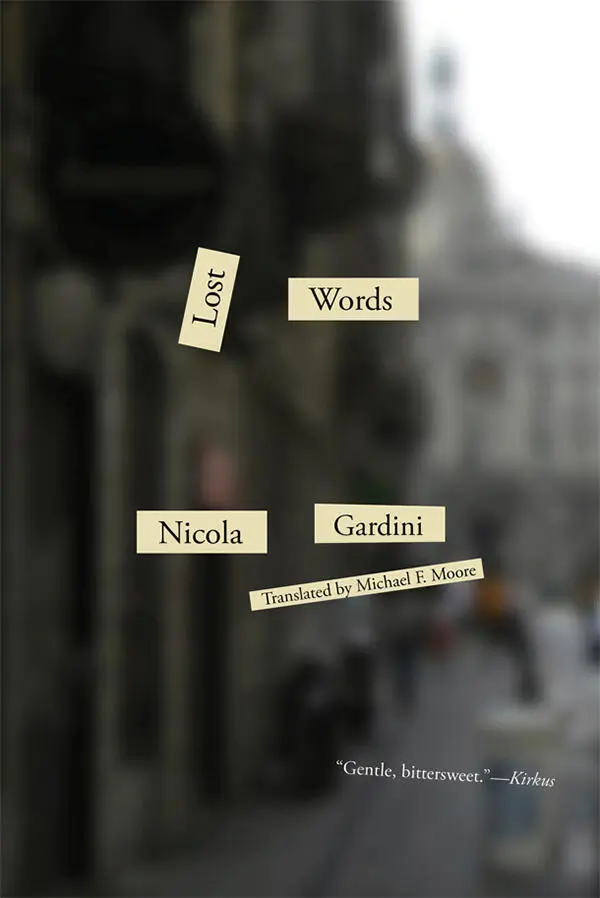
- Название:Lost Words
- Автор:
- Издательство:New Directions
- Жанр:
- Год:2016
- ISBN:нет данных
- Рейтинг книги:5 / 5. Голосов: 1
-
Избранное:Добавить в избранное
- Отзывы:
-
Ваша оценка:
Lost Words: краткое содержание, описание и аннотация
Предлагаем к чтению аннотацию, описание, краткое содержание или предисловие (зависит от того, что написал сам автор книги «Lost Words»). Если вы не нашли необходимую информацию о книге — напишите в комментариях, мы постараемся отыскать её.
Lost Words — читать онлайн бесплатно полную книгу (весь текст) целиком
Ниже представлен текст книги, разбитый по страницам. Система сохранения места последней прочитанной страницы, позволяет с удобством читать онлайн бесплатно книгу «Lost Words», без необходимости каждый раз заново искать на чём Вы остановились. Поставьте закладку, и сможете в любой момент перейти на страницу, на которой закончили чтение.
Интервал:
Закладка:
He was tall and thin, with his mother’s fine features — and while in her they hinted at the remnants of a former beauty, in him they revealed a protracted, indelible adolescence. He, too, smiled with a certain ease. Yes, he did look a lot like her. But there was also something in him of the Foschi who had given him his surname. I strained to recognize that other part. I felt as if I could identify it in the narrowing of his jaw, the quivering of his wide nostrils, the sudden iciness of his stare. (While she, even when she was railing against the world, conserved a warm light in her eyes.) Before him I felt as if I were in the presence of a Christ-like figure, in whom I had to distinguish between the godly and the human parts: the father and the mother.
Ippolito Foschi, the secret son, was the living, tangible symbol of the great mystery hidden in the life of Maestra Lynd. I looked at him with religious awe, as if the dead woman had decided to be reincarnated through him, to give me the extreme proof of her unimaginable, unquantifiable power, subjugating me, once and for all, to her dominion.
“Miss Lynd was such a good woman, such a civil woman…” my mother said to cheer him up.
“Really? I’m pleased to hear it…” he replied absently.
“She was the one who caused me the least amount of trouble…”
“Well, she didn’t cause me much trouble, either, to tell you the truth. We hadn’t seen each other for twenty years.”
My mother and I were paralyzed with dismay. On her creased forehead I could read a host of questions that were not transfigured into words. Foschi’s manner didn’t encourage questions or comments.
The three of us went up to the fifth floor. He only stayed for ten minutes.
My mother reported that he had looked around the apartment incuriously, gone to the balcony, and stuck his head out, without uttering a word or shedding a tear the whole time.
“He must be in shock, poor thing! We should put ourselves in his shoes…”
*.
Signora Dell’Uomo, in her role as the condominium representative, descended the stairs to interrogate the doorwoman. My mother cut her no slack, limiting herself to saying that the Professor — that’s the title she came up with — was a very proper person.
“Very smiley ,” Signora Dell’Uomo specified, “a little too smiley, wouldn’t you say? As if the tragedy had nothing to do with him… what does he say about his mother? I mean, she fell from the fifth floor. I’m sure she had her reasons!”
“The Professor is very reserved. Besides, why should he have to say anything? It was a tragedy. The time for words is over. What’s needed now is silence…”
“Of course, of course… but I think it’s absurd that the son had no comment about the suicide of his mother!”—she shuddered as she said the word—“What I mean is that she died right before our eyes. In the courtyard there’s a bloodstain that will disappear god knows when. We have a right to know, don’t we? If you ask me she had something weighing on her conscience… There was no sight or sound of him until yesterday. Why is it that he’s only now making an appearance? Where has he been till now? What kind of a son is he!”
Most of the building showed up at the Maestra’s funeral. At the mortuary in the Niguarda Hospital there were neither priests nor flowers, except a spindly wreath from the condominium. The coffin was closed, since there was so little left to see of Amelia Lynd.
The seamstress offered to accompany him to the cemetery, but the Professor refused: the coffin was going straight to the crematorium.
The malice began the second he got into the car. They had something to say about everything: there was no mass, the coffin was cheap, the body was cremated! What they disapproved of most of all was his composure. He didn’t shed a tear! Scandalous!
For days and days my mother repeated, as the commissioner himself had asserted, that the death of Miss Lynd had been an accident of the kind that happens to the elderly. She couldn’t sleep, she got up to get a breath of fresh air on the balcony, she lost her balance…
But they weren’t satisfied with this version of the incident. It failed to explain too many things. For example, why didn’t the Professor want a religious funeral for his mother? “Nowadays the church also accepts suicides, if indeed it was suicide,” Terzoli observed. And Vezzali, “Of course he shipped the body straight to the oven: what better way to get rid of the proof than a nice bonfire?…” And why hadn’t he wept? Why did he have nothing to say there, in front of the mortuary? Why didn’t he bother to thank the attendees and apologize? And those smiles? Who did he think he was fooling? And above all, if Lynd was washing the windows, why didn’t the police find a damp cloth or Windex? Not to mention there was plenty of space between the windows and the railings of the balcony. The Maestra would’ve needed to take a flying leap, which was impossible for a woman of her age.
*.
The summer smothered all this malice beneath its muggy dome. Now the hens had something else to keep their minds occupied. They complained that they were broke, although they were still unwilling to give up their vacations. Some were going to the seaside, some to the mountains, others to the countryside. The doorwoman had better keep an eye on their property! They even expected her, in their absence, to inspect — around the clock, on a daily basis — every lock, floor by floor, from cellar to roof.
“They’ve got me confused with a night watchman…” my mother grumbled.
As for tips, they were a lot more meager than in years gone by.
By the end of July we were the only people left in the building, apart from the Biondo’s, who hadn’t traveled for years because of her illness. Poor woman! So she might enjoy at least a little bit of summer, her husband would move her to the balcony after lunch, leaving her there for hours, propped up by mounds of cushions and sheltered from the sun by a straw hat with a brim as wide as a beach umbrella. I could see her from the courtyard through the foliage of the plane tree. More than once, even if I knew that paralysis prevented her from moving, I had the distinct sensation that she was wiggling her numb hand toward me in a vague signal of warning.
My father continued to go to the factory. He preferred to be a scab rather than deal with my mother’s moods.
“Can you feel the peace and quiet? This is better than the Riviera,” she would say. “I don’t envy the folks who are going away — no, not at all. What kind of a vacation is that, with all the noise and traffic? Everyone in cars like idiots! Beaches so crowded you can’t even walk… Now this is what I call a vacation. No one around, no more ‘yes signora, of course signora, right away, signora… Feel how peaceful it is! Smell the fragrance!”
In the morning and afternoon we would sit on the shaded steps, spending long hours — she observing, me reading. When it got too muggy we would stay inside. I would’ve been happy reading under the plane tree but she always wanted me by her side, using the same old excuse that it was too hot outside. “With this heat,” she would say, “the crazies sprout like mushrooms. It would be better not to be outside by yourself in the courtyard… With all the awful things we hear on the television… you don’t want to wind up like Paul Getty, do you?”
Inside or out, it was all the same to me. I read all day, without stopping. I even forgot to breathe, and when my eyes were too tired I would imagine what would happen in another month: I would soon be starting the Classical Lyceum, where I’d meet new people, learn ancient Greek, go downtown every day…
On the eve of the Feast of the Assumption, the Professor moved to Via Icaro. Unlike his mother, he brought a lot of stuff with him. Out of the moving van came an avalanche of boxes and suitcases of every size. The movers were two black men who spoke with him in English. My mother was mesmerized by them. She had only ever seen dark-skinned people on television.
Читать дальшеИнтервал:
Закладка:
Похожие книги на «Lost Words»
Представляем Вашему вниманию похожие книги на «Lost Words» списком для выбора. Мы отобрали схожую по названию и смыслу литературу в надежде предоставить читателям больше вариантов отыскать новые, интересные, ещё непрочитанные произведения.








Обсуждение, отзывы о книге «Lost Words» и просто собственные мнения читателей. Оставьте ваши комментарии, напишите, что Вы думаете о произведении, его смысле или главных героях. Укажите что конкретно понравилось, а что нет, и почему Вы так считаете.