Nicola Gardini - Lost Words
Здесь есть возможность читать онлайн «Nicola Gardini - Lost Words» весь текст электронной книги совершенно бесплатно (целиком полную версию без сокращений). В некоторых случаях можно слушать аудио, скачать через торрент в формате fb2 и присутствует краткое содержание. Год выпуска: 2016, Издательство: New Directions, Жанр: Современная проза, на английском языке. Описание произведения, (предисловие) а так же отзывы посетителей доступны на портале библиотеки ЛибКат.
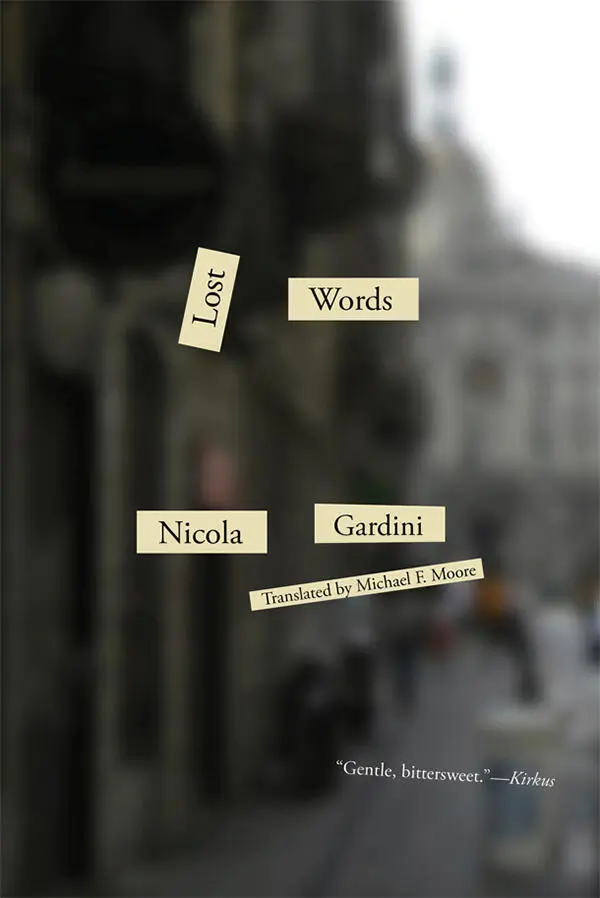
- Название:Lost Words
- Автор:
- Издательство:New Directions
- Жанр:
- Год:2016
- ISBN:нет данных
- Рейтинг книги:5 / 5. Голосов: 1
-
Избранное:Добавить в избранное
- Отзывы:
-
Ваша оценка:
Lost Words: краткое содержание, описание и аннотация
Предлагаем к чтению аннотацию, описание, краткое содержание или предисловие (зависит от того, что написал сам автор книги «Lost Words»). Если вы не нашли необходимую информацию о книге — напишите в комментариях, мы постараемся отыскать её.
Lost Words — читать онлайн бесплатно полную книгу (весь текст) целиком
Ниже представлен текст книги, разбитый по страницам. Система сохранения места последней прочитанной страницы, позволяет с удобством читать онлайн бесплатно книгу «Lost Words», без необходимости каждый раз заново искать на чём Вы остановились. Поставьте закладку, и сможете в любой момент перейти на страницу, на которой закончили чтение.
Интервал:
Закладка:
Saturday arrived. My father was getting ready to go to the movies. She was rinsing the dishes, her brow more furrowed than usual. She suddenly turned off the faucet and yanked off her apron.
“Get dressed,” she ordered me, “we’re going downtown…”
“What’s going on?” protested my father, who had almost finished combing his hair. “I’m about to go out…”
“Chino,” she replied while she was slipping on her shoes, “tell your father that it’s our turn to go out today. Every now and then he can give up something, too. The movies will still be there tomorrow… Lets go!”
The streetcar left us in Piazza Cordusio, where my mother had gone on walks a few times as a young woman, back when she was working for the doctor.
“Here we are,” she sighed in front of a jewelry shop.
“Can I help you?” asked the owner without much conviction.
“Well, to be honest,” my mother stammered, “I didn’t come here to buy anything. I only wanted, if possible, to get an estimate on this ring…”
She removed it from her jacket pocket and let it fall into the woman’s outstretched hand.
“Where did you buy it?” the jeweler asked while she was examining it under the lens.
In the grip of panic, my mother told her she had found it on the street.
“It’s a nice ring. The stones aren’t the greatest, but they’re pure. It’s probably worth about seven hundred liras. If you want, I’ll buy it from you. I can pay you right away…”
My mother grabbed me by the arm.
“No thank you,” she whispered. “Maybe someday, if I’m ever having difficulties…”
She took the ring back and dragged me out of the store. A few steps later she burst into tears, in the midst of the crowd. Not only was the ring authentic, but it was worth a lot more than it had cost her! Poor Baioni! She had been so unfair to ever doubt him!
On a wave of enthusiasm, she dragged me to the Rinascente department store — the moral sewer of the city, according to my father — where she bought me a pair of brand-name jeans and treated me to a Coke at the café on the top floor. For herself she ordered an espresso and asked the waiter for a cigarette.
As we walked across the Piazza del Duomo I told her what I remembered about the history of the cathedral, pointing up to the gold statue of the Madonna suspended in the Milanese sky. She started to sing “O mia bela Madunina,” but stopped after the first words. For a second we remembered the old lady’s visit.
“Is it really pure gold?” she asked me incredulously. Then, she sighed: “If only I could’ve had just the head…”
*.
It was time to let the rest of the building know about the diamond — then they would stop thinking that the doorwoman hadn’t bought an apartment because she was short of money. They had to understand once and for all that she hadn’t bought one because she didn’t want to live in that building…
She invited the seamstress down for a cup of coffee: if you wanted a secret to get out as quickly as possible, who better to start with?
Nowadays the seamstress was acting like a grand capitalist. Indeed, she was the only one who had bought two apartments, her own and the one next door, the Vignolas’ one-bedroom… She told us that in a year she’d knock down the wall, turning it into a five-room apartment. With two bathrooms! And four balconies! Two attics! And two front doors! She would have the biggest place on the block!
“We also have plenty of money,” my mother said, when the seamstress finally stopped long enough to take a breath. “But there were no more two-bedrooms left, so what was I supposed to buy? A one-bedroom? Where would we put the boy? The day we leave Via Icaro, we’re going to get a house with at least two-bedrooms. Chino can’t keep going without his own room. Especially now that he’s attending the Classical Lyceum…”
“If you move,” the seamstress said, “you’re gonna have bills to pay…”
“Signora Bortolon,” my mother reassured her, “it’ll take a lot more than an electric bill to ruin us! We’ve got so much money squirreled away that we don’t know what to do with it… You know just the other day, on a whim — it’s not like I needed it! — I bought myself the diamond…”
That’s how she said it, the diamond, the way she said the Classical Lyceum, like the Maestra.
The seamstress’s face turned bright red.
“You got yourself the diamond !”
And my mother: “A setting of fourteen little stones with a big rock in the middle…”
Letting her envy get the better of her, the seamstress shrieked: “You’re not scared someone’s gonna steal it?”
And my mother, growing more aloof by the minute: “What can I say? It is what it is. In the meantime, I’ll keep it well hidden. Oh, and please, don’t breathe a word to anyone, I know I can trust you.”
The seamstress was shaking with the urge to see the diamond, but she didn’t want to stoop to asking.
“What good’s a diamond if you’re scared someone’s gonna steal it all the time? It’s like you didn’t even have it.”
“There you’re wrong, my dear Signora Bortolon! There’s a big difference between having the diamond and not having it! I look at it, every now and then I try it on. I didn’t buy it to show off… the diamond is personal… if you could only see how shiny it is!”
“So show me the damn diamond already!”
With magnanimous reserve, as if she were granting an exclusive privilege, my mother invited the seamstress to follow her into the bedroom. She reached to the back of the armoire, rummaged through the winter clothes, and after a minute emerged somewhat ruffled, wearing her trophy.
“Ooooh, how pretty,” the seamstress murmured, and immediately followed in a higher-pitched tone, “Give it here so I can try it on.”
My mother removed the ring and handed it to her.
“It really is pretty…” she concluded, after regaining her sour expression. “But what good is a ring like that? I like simple things…”
Within two days, all of 15 Via Icaro knew that the doorwoman had bought a diamond. The diamond! Dell’Uomo tried to spread the rumor that we had won the lottery. But it didn’t take long for everyone to realize that, if that were the case, we wouldn’t still be living there.
*.
For my Italian finals I decided to write about freedom. While I was filling the exam sheet with words, I thought about my mother, who’d never had a taste of freedom. I thought about what I had learned from Miss Lynd: that the Italians didn’t know freedom because they’d almost always been dominated. I compared them to the Russians. Like the Russians, Italians were inclined to entrust everything to a leader, whether a king, dictator, or pope — anyone who knew how to raise his voice and promise happiness for the future. I wrote that Italians didn’t understand the concept of the present, at least not as well as other nations, for example the French. Italians postpone everything until tomorrow, and the next day they do the same thing, infinitely, and meanwhile they make do and try to manage with what they have. They wouldn’t know what to do with real freedom because it would require hard work, dedication, constant vigilance — and Italians are lazy, a little selfish, and concerned only with themselves and their families. They don’t care too much about their rights: they would rather break the law than fight to protect what was owed to them.
I wrote how true freedom gets attacked over nothing. True freedom cannot be partial, it can only be perfect. All it takes is one person, just one single member of our government, to misbehave — to disrespect the people — for freedom to become a travesty, a puppet that can be manipulated at will. I quoted a sentence by Gandhi that the Maestra had taught me: “No tyrant can govern without the active support of the people,” because when there is a dictator, freedom is trampled by everyone, not just the dictator. I wrote about South Africa, Palestine, Italian colonialism…
Читать дальшеИнтервал:
Закладка:
Похожие книги на «Lost Words»
Представляем Вашему вниманию похожие книги на «Lost Words» списком для выбора. Мы отобрали схожую по названию и смыслу литературу в надежде предоставить читателям больше вариантов отыскать новые, интересные, ещё непрочитанные произведения.

Обсуждение, отзывы о книге «Lost Words» и просто собственные мнения читателей. Оставьте ваши комментарии, напишите, что Вы думаете о произведении, его смысле или главных героях. Укажите что конкретно понравилось, а что нет, и почему Вы так считаете.