Nicola Gardini - Lost Words
Здесь есть возможность читать онлайн «Nicola Gardini - Lost Words» весь текст электронной книги совершенно бесплатно (целиком полную версию без сокращений). В некоторых случаях можно слушать аудио, скачать через торрент в формате fb2 и присутствует краткое содержание. Год выпуска: 2016, Издательство: New Directions, Жанр: Современная проза, на английском языке. Описание произведения, (предисловие) а так же отзывы посетителей доступны на портале библиотеки ЛибКат.
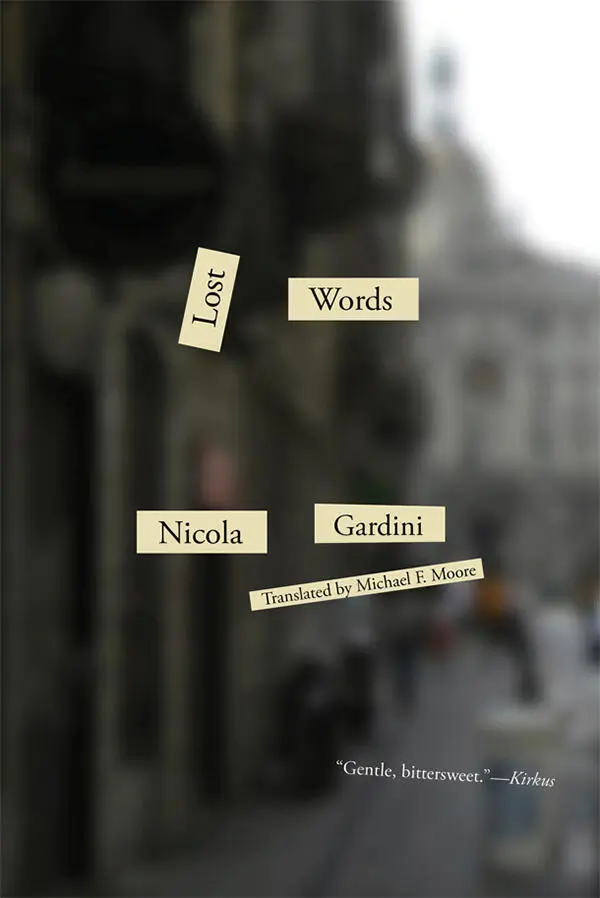
- Название:Lost Words
- Автор:
- Издательство:New Directions
- Жанр:
- Год:2016
- ISBN:нет данных
- Рейтинг книги:5 / 5. Голосов: 1
-
Избранное:Добавить в избранное
- Отзывы:
-
Ваша оценка:
Lost Words: краткое содержание, описание и аннотация
Предлагаем к чтению аннотацию, описание, краткое содержание или предисловие (зависит от того, что написал сам автор книги «Lost Words»). Если вы не нашли необходимую информацию о книге — напишите в комментариях, мы постараемся отыскать её.
Lost Words — читать онлайн бесплатно полную книгу (весь текст) целиком
Ниже представлен текст книги, разбитый по страницам. Система сохранения места последней прочитанной страницы, позволяет с удобством читать онлайн бесплатно книгу «Lost Words», без необходимости каждый раз заново искать на чём Вы остановились. Поставьте закладку, и сможете в любой момент перейти на страницу, на которой закончили чтение.
Интервал:
Закладка:
We sat down to the table. Her eyes had become as big as two lakes. She looked at me and in her gaze I saw a last heroic glimmer of determination. She waited for me to close and lock the front door. My father sat down in the armchair to watch television — but she turned it off. Paying no heed to his protests, she said with no ifs, ands, or buts, that it would cost six million to buy the house: six, not five.
He had a bemused expression, then he jumped to his feet. With a sweep of the hand he knocked all the knickknacks off the fold-out bed and started kicking the chairs.
“You thought you were going to fuck me over?” he gasped, as if he were about to cough, circling her like a maniac. “Me? For Christ’s sake…”
“Shut up! Do you want the whole building to hear you? Do you want us to become a laughing stock?”
He kept shaking his head and waving his arms around.
“Where did you think you were going to find the money, huh? Did you even think about what you were doing? DID YOU EVEN THINK ABOUT WHAT YOU WERE DOING? You wanted to ruin me! That’s what you wanted! And like an idiot I followed you! Where did you think you were going to get the money — growing on trees?”
With her back against the wall, my mother finally uttered the word that she had been struggling to avoid: “We could always apply for a mortgage. What’s wrong with that? Not everyone buys with cash on the barrel. Not even Signora Dell’Uomo, I hear, who is hardly hurting for money. For that matter she doesn’t even have children to take care of…”
At the sound of the word “mortgage” my father’s face turned to ash.
“Mortgages are the ruin of the world,” he hollered at the top of his lungs. “What the fuck do I have to say to make you understand?”
He panted, placing his hand over his chest. We thought he was having a heart attack. My mother helped him sit in the armchair, fanned his face with her hand, and asked him fearfully whether she should call the doctor.
He stood up in a sweat and very slowly made his way to the bedroom.
I spent the night trying to overhear any words that might’ve come from their room. But not a word was said. The only thing I could hear was the ticking of the alarm clock.
*.
More than anything, even more than defeat, she was oppressed by the thought that she had become an object of ridicule. She had brought universal disdain on herself: everyone knew of her failure and relished it. Now she saw the curled lips in their customary greetings as an affront or even a reprimand.
“They’re all laughing in my face! And they’re right! I couldn’t even buy my own house! They’re right to laugh! Ha-ha-ha! Very funny!”
And she wept like a fountain, her hands balled into fists, her mouth drooling uncontrollably.
She stopped speaking to my father. What was left to say? Nothing. Instead of words, gasps and sobs came out of her mouth. She couldn’t breathe. Out of the blue she would drop whatever she was doing and run to the window for air. Every day she became more listless — she wasted away.
Disappointment had aged her visibly and she suddenly looked ten years older. “What’s wrong, Elvira?” the signore would ask. “Are you tired?” So as not to give them any satisfaction, she would reply, “What do I have to be tired about? Elvira is never tired! She’s like a mule!”
Even my father asked her what was wrong, but she refused to answer him.
She would go out without telling me. She’d go to sit on a bench in the garden, under the willow tree, and stay there for fifteen minutes at a time. When people asked for her, I had to run and call her, and I’d find her motionless, in a daze. “Momma, they’re looking for you,” I would whisper, trying not to startle her. Not even the name “Aldrovanti” was enough to shake her out of it — the same name that had struck the fear of God into her a few days earlier now left her completely indifferent. “Tell her I’ll call back…” she would reply nonchalantly.
One day I ran almost all the way to the streetcar stop to get her. She’d decided to go to the Rinascente department store downtown to spend five hundred thousand liras in a single shot. What did she need the money for anymore? In the meantime, with no one keeping watch at the door, a couple of Jehovah’s Witnesses had snuck up the stairs. But Terzoli stopped them immediately, threatening to call the police. “What a bunch of creeps!” she told my mother. “They’d rather let a child die than give it a blood transfusion! We’d better not let management find out about these little visits…” My mother didn’t bat an eye. She didn’t give a damn about appearing infallible anymore. Nor was she worried about criticism, complaints, and threatening insinuations.
She had lost all desire to work. She’d also lost the physical strength she needed to clean so many floors. What she used to finish in a morning now took her a whole week. The bucket and the scrub-brush would be left forgotten in the lobby for days on end.
I was mad at my father — he had been unfair and selfish. But he needed some sympathy, too. He was waiting for a sign of reconciliation from her, a sign that never came. During supper he would stare at her, smile at her, studying her movements lovingly, convinced that the simple insistence of his gaze would induce her to give in. But nothing. She ignored him with a demented obstinacy, made even more monstrous in that it conveyed no anger.
*.
Now the building was in the hands of twenty owners.
All of them adopted an insufferable haughtiness, morning, noon, and night. Even I could feel it. They would walk by the loge with a sneer, giving long, smug looks, as if to say, “Did you hear? I’m an owner. I’M AN OWNER!”
Many of them stopped saying hello, and the signore started to expect the most absurd things from the doorwoman — like sweeping their doormats or polishing their doors. They all wanted an impeccable, refined building, and each of them, as an owner, felt they had the right to demand whatever they pleased, no matter how outrageous, and had no respect for either the doorwoman or their neighbors. Some didn’t even bother to throw their garbage bags down the chute, leaving their trash sitting on the landing.
Misbehavior doubled, as did complaints and fights. Rovigo and Paolini, old buddies, came to blows over a parking spot, even though in front of the apartment complex there were miles of empty land. Tension between the soccer fans was exacerbated, and on the balconies — despite a strict prohibition by the management — the flags of Milan’s rival clubs started to appear.
Dell’Uomo, who hadn’t been able to have children, told Vezzali that she had only been able to give birth after two miscarriages. Mortally offended, Vezzali spread the word that Dell’Uomo did indeed have a son, but she kept him hidden at the Asylum for the Disabled, with the armless and legless creatures.
An endless circuit of gossip brought to light the true ages of the various signore. It became known that Terzoli, for example, was only four years younger than my father. But she looked the same age as Mantegazza.
*.
My mother didn’t want to hear another word about letting the kittens loose in the field. This year we had to kill them, and quickly, before they strayed into the courtyard — otherwise we’d never hear the end of it from the building manager.
I went downstairs to look for them in the basement, but no luck.
Rita had noticed that the cat, after it licked the plate of leftovers, would run behind the building. We went looking for her there, where no one dared to venture because of the loose wall tiles, and found her at the foot of the magnolia tree.
“Here, kitty, kitty. Show me and Chino where you hid your little babies,” Rita sweet-talked her. “Take us to them… Come on!”
Читать дальшеИнтервал:
Закладка:
Похожие книги на «Lost Words»
Представляем Вашему вниманию похожие книги на «Lost Words» списком для выбора. Мы отобрали схожую по названию и смыслу литературу в надежде предоставить читателям больше вариантов отыскать новые, интересные, ещё непрочитанные произведения.









Обсуждение, отзывы о книге «Lost Words» и просто собственные мнения читателей. Оставьте ваши комментарии, напишите, что Вы думаете о произведении, его смысле или главных героях. Укажите что конкретно понравилось, а что нет, и почему Вы так считаете.