Nicola Gardini - Lost Words
Здесь есть возможность читать онлайн «Nicola Gardini - Lost Words» весь текст электронной книги совершенно бесплатно (целиком полную версию без сокращений). В некоторых случаях можно слушать аудио, скачать через торрент в формате fb2 и присутствует краткое содержание. Год выпуска: 2016, Издательство: New Directions, Жанр: Современная проза, на английском языке. Описание произведения, (предисловие) а так же отзывы посетителей доступны на портале библиотеки ЛибКат.
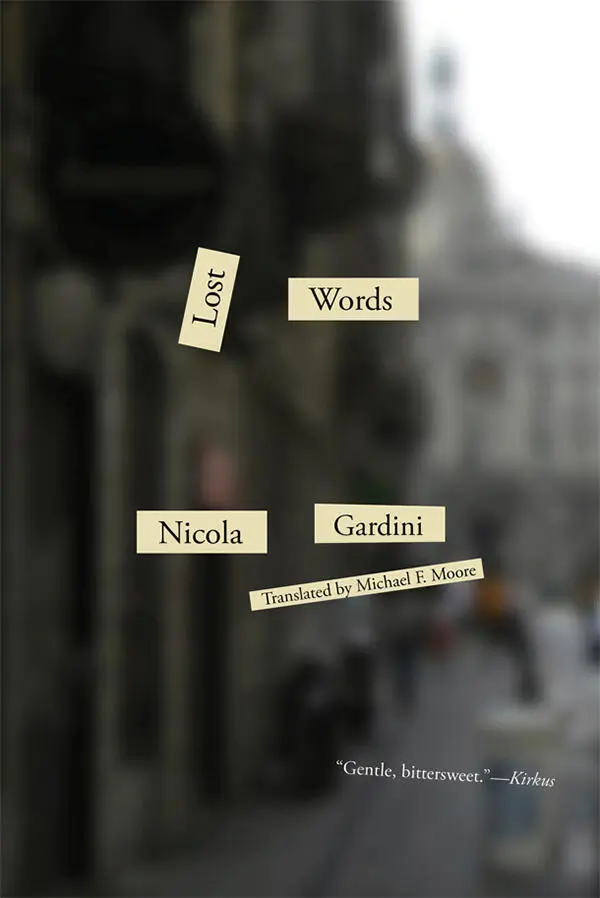
- Название:Lost Words
- Автор:
- Издательство:New Directions
- Жанр:
- Год:2016
- ISBN:нет данных
- Рейтинг книги:5 / 5. Голосов: 1
-
Избранное:Добавить в избранное
- Отзывы:
-
Ваша оценка:
Lost Words: краткое содержание, описание и аннотация
Предлагаем к чтению аннотацию, описание, краткое содержание или предисловие (зависит от того, что написал сам автор книги «Lost Words»). Если вы не нашли необходимую информацию о книге — напишите в комментариях, мы постараемся отыскать её.
Lost Words — читать онлайн бесплатно полную книгу (весь текст) целиком
Ниже представлен текст книги, разбитый по страницам. Система сохранения места последней прочитанной страницы, позволяет с удобством читать онлайн бесплатно книгу «Lost Words», без необходимости каждый раз заново искать на чём Вы остановились. Поставьте закладку, и сможете в любой момент перейти на страницу, на которой закончили чтение.
Интервал:
Закладка:
At my oral exam Signorina Salma took me to task.
“Where did this boy get all these crazy ideas?” she asked her colleagues indignantly. “You wouldn’t believe the idiocies he wrote about Italian colonialism! Well he didn’t hear them from me! We helped the countries we colonized — and that’s the truth! We were much — and I mean much —better than the English! And comparing us to the Russians! We Italians aren’t communists!”
She started in on a passionate defense of the greatness of the Italian people. She continued with a speech about the beauty of patriotism, the sweetness of our language, which forces us to turn around when we hear it echoed in a foreign country, prompting us to search for an unknown fellow Italian, unknown but not foreign , like the time that she, in Paris, during her honeymoon, overheard, in the midst of a crowd, a short sentence uttered in Italian — and she couldn’t identify where it had come from. But for the rest of the day the sound stayed with her, or rather in her, as if it had slipped under her skin, making that foreign city feel less foreign, where no one knew her, and where they ate the most absurd things, like pasta as a side dish instead of a first course!..
The geography teacher, Signora Marelli, who’d never hidden her sympathies for neo-fascism, said seraphically, “Don’t get so worked up, Salma. Ideas come and ideas go, but the good ones always stay!” And to me, before she started in with her questions on that year’s curriculum: “Graziosi, just for the sake of it, how does your father vote?”
“That will be enough,” ruled Barro, the technical applications teacher, barely concealing his anger. “The boy wrote what he thinks. What are we going to do, put him on trial? Is the composition well written? It is? So we’re going to pass him, and with a good grade. For my part I don’t have to ask him anything. And he’s right, Italian colonialism was shameful.”
I passed Italian, Latin, and English with distinction, and I did well in all the other subjects, too. I received compliments from the whole exam committee, including, at the end, Signorina Salma. But she gave me a strange look, as if she suddenly realized that she had been harboring a viper in her classroom for the past three years.
*.
Caselli, in a bathrobe, jittery as a junebug, kept repeating that she had only seen her in mid-air.
“So then tell me,” the police commissioner pressed on with the patience of a bureaucrat, “what did you see, in the exact order…”
And it was the same story.
“If I had seen her perched on the balcony I would have said something to her,” Caselli tried to justify herself. “I was smoking a cigarette. I couldn’t sleep… at five o’clock in the morning it was already so hot I couldn’t breathe.”
My mother was crying. She had been the first person to go down to the courtyard, after Caselli called her on the intercom.
“Poor Maestra!” she kept repeating.
I had made it just in time to notice, through the window blinds, the stretcher-bearers draping a sheet over the corpse and lifting it into the ambulance.
After Caselli came Terzoli, Miss Lynd’s neighbor. She hadn’t heard anything in particular, she said. Or rather yes, she did, the sound of the toilet being flushed, repeatedly. That’s what had woken her up. The sound of water got on her nerves. Miss Lynd had never made so much noise at night. She was one of the quietest people she had ever met. Yes, of course, she was a little crazy, greeting everyone with strange, incomprehensible words and never confiding in anyone — if only all neighbors were like her!
“You couldn’t tell whether she had any company?” the commissioner asked.
“I don’t think so.”
“Another voice…”
“Do you mean someone pushed her?” the spinster was already letting her imagination run wild. “Good God! Why?… you don’t think it was the gypsies, do you?”
“Signora, do you live with someone?”
“No, I’m single,” she replied, with her head held high.
“Thanks, you can go back home now…”
Disappointed that she hadn’t been questioned more at length, she tightened the belt of her bathrobe and took the elevator.
My mother poured the officer a cup of coffee.
“What about all that blood?” she wondered. “We can’t leave a stain like that where everyone passes by. Who knows how long before someone removes it. And it’ll take a lot more than ten bucketfuls of water. What do you think — you, an expert in these things?”
He said she would need ammonia.
“So do you think she was murdered?” my mother suggested.
“To your knowledge did Miss Lynd suffer from nerves? Was she ill? I mean, do you have any reason to believe she didn’t want to live anymore?… A reason to kill herself?… Why does everyone say she was crazy?”
“They’re the ones who are crazy!” my mother corrected him. “Miss Lynd was a great lady, a real signora… but if she was ill — I wouldn’t know…”
Now it was my turn.
I told him that Miss Lynd had taught me English, that she used to give me snacks, that she knew a lot of things…
“OK, that will do…” the policeman cut me short.
The next morning a letter arrived for me. It was postmarked five days earlier. Shaking, I folded the envelope in two and hid it in my pants pocket. I finished separating the rest of the mail, made three signs of the cross, and began to read:
My dear Luca,
I’m leaving. I was lucky to meet you. Thanks to you I was able to fool myself into thinking I had rediscovered my youth. I hope you will continue on your own what we started together. You definitely have the energy and the conviction. You once asked me what had happened to my English dictionary. When I told you that I had grown tired of working on it, I was lying. The truth is I had stopped believing in the possibility of giving precise meanings to words. That’s why I abandoned it. What a disaster! My whole life had been spent defining things. And all of a sudden… something in me stopped working, or maybe it finally started working properly. Who knows? I’d been so unhappy since the day my dictionary died. But you made me want to give it another try. Our lessons made it suddenly seem possible again. I could pretend that everything had a meaning and a purpose. To define! But it doesn’t — it isn’t like that. At least not for me. I wanted to instill in you a confidence that had forsaken me a long time ago. Please don’t accuse me of inconsistency or hypocrisy. With you I started to believe in language again. Or rather, I fooled myself into thinking I had started to believe again. But that wasn’t the case… Now all I see are the lies inside me. And when I remember what I used to be like as a girl! The faith I had in meanings, which I collected, just the way you do in your notebooks! Keep them close to you, these notebooks! And when, perhaps, you are tempted by doubts, take them out, reread them, don’t hide them the way I hid my own work.
Farewell,
Amelia
IV
My mother came looking for me under the wisteria tree.
“Miss Lynd had a son!”
She was huffing and puffing as if she’d gone up and down the staircase ten times.
My Latin book fell down off my knees and the letter from the Maestra, which I kept hidden between the pages, slipped out of the book and onto the gravel. Luckily my mother didn’t notice. I bent down to pick it up and hide it again.
“Did you hear? A son! He just called on the telephone. He’s coming by this afternoon. He’s the one who bought her apartment! His name is Ippolito Foschi!.. Ippolito… What the heck kind of name is that?… She certainly was a strange one, that Lynd! Are you sure she never told you anything about him?”
Читать дальшеИнтервал:
Закладка:
Похожие книги на «Lost Words»
Представляем Вашему вниманию похожие книги на «Lost Words» списком для выбора. Мы отобрали схожую по названию и смыслу литературу в надежде предоставить читателям больше вариантов отыскать новые, интересные, ещё непрочитанные произведения.

Обсуждение, отзывы о книге «Lost Words» и просто собственные мнения читателей. Оставьте ваши комментарии, напишите, что Вы думаете о произведении, его смысле или главных героях. Укажите что конкретно понравилось, а что нет, и почему Вы так считаете.