Nicola Gardini - Lost Words
Здесь есть возможность читать онлайн «Nicola Gardini - Lost Words» весь текст электронной книги совершенно бесплатно (целиком полную версию без сокращений). В некоторых случаях можно слушать аудио, скачать через торрент в формате fb2 и присутствует краткое содержание. Год выпуска: 2016, Издательство: New Directions, Жанр: Современная проза, на английском языке. Описание произведения, (предисловие) а так же отзывы посетителей доступны на портале библиотеки ЛибКат.
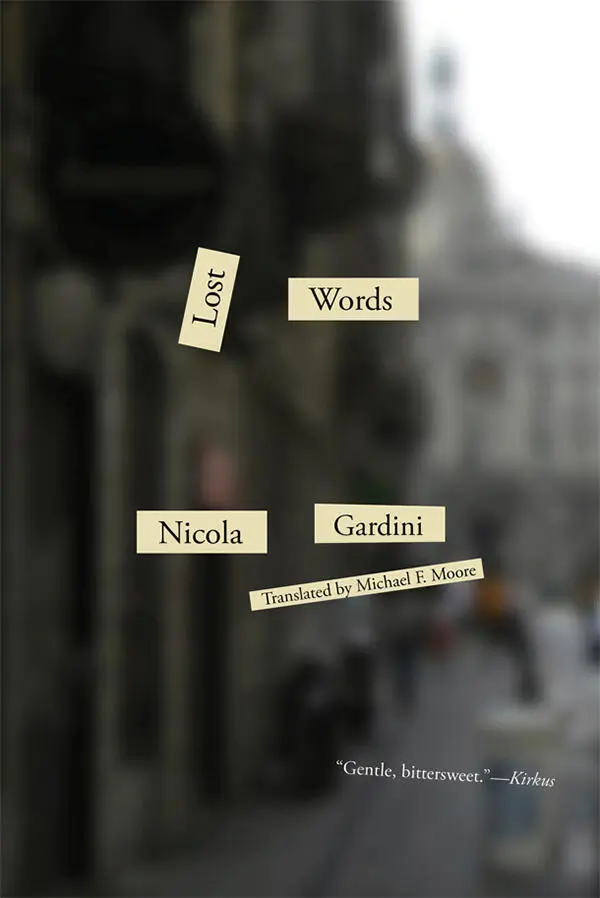
- Название:Lost Words
- Автор:
- Издательство:New Directions
- Жанр:
- Год:2016
- ISBN:нет данных
- Рейтинг книги:5 / 5. Голосов: 1
-
Избранное:Добавить в избранное
- Отзывы:
-
Ваша оценка:
Lost Words: краткое содержание, описание и аннотация
Предлагаем к чтению аннотацию, описание, краткое содержание или предисловие (зависит от того, что написал сам автор книги «Lost Words»). Если вы не нашли необходимую информацию о книге — напишите в комментариях, мы постараемся отыскать её.
Lost Words — читать онлайн бесплатно полную книгу (весь текст) целиком
Ниже представлен текст книги, разбитый по страницам. Система сохранения места последней прочитанной страницы, позволяет с удобством читать онлайн бесплатно книгу «Lost Words», без необходимости каждый раз заново искать на чём Вы остановились. Поставьте закладку, и сможете в любой момент перейти на страницу, на которой закончили чтение.
Интервал:
Закладка:
She was referring to Caselli and Dell’Uomo. The Professor nodded.
“They can write whatever they want on their name plates, if that’s what matters to them. I don’t care about titles. I think they’re a form of insecurity. Even at school, when I used to teach, the kids would call me by my name, Ippolito…”
“But that’s not right,” my mother protested, while piling his plate high with rice salad. “You need some distance. Otherwise the kids take advantage and lose respect…”
“That’s not true. My kids always respected me. Respect is a question of feeling, not of titles… What difference does a title make if we don’t associate it with what our feelings dictate to us? Otherwise it’s just a sound, a lie… I don’t need lies. We already hear enough of them from politicians, don’t you think?”
Lies! Lies! Lies! as the Maestra used to say.
“Can we please not talk about politics? I already hear enough about it from my husband! In my opinion, you, Ippolito, think people are better than they actually are. You don’t know how awful they can be, from the moment they’re born. They tease you, disobey you, treat you like a servant… Listen to me, I know a thing or two about it. People are cruel!”
“You’re exaggerating!.. sometimes they’re cruel, but only sometimes… Children know right from wrong — if we’re honest with them. If they don’t learn from their parents, they can learn somewhere else… At school, on the street, from anyone. We can’t give up hope…”
My mother placed a hand on his shoulder.
“Ippolito, you’re talking like a priest!”
He fidgeted in his chair. “You really need to label me, don’t you? And now you’re calling me a priest?”
“You’re not offended, I hope?”
“A little,” he said, ironically. “I have a hard time putting up with priests…”
“So I was wrong to think you were a good person… you’re better off the way you are! Every good deed is punished. Take me, for example.”
“Are you a good person?” he asked.
My mother was speechless. How dare he! Of course she was good! Wasn’t she feeding him? If she hadn’t been good, would she have spent the whole morning slicing hot dogs, opening cans of peas, and boiling rice? Couldn’t the professor see for himself?
“I think I am,” she replied. “I don’t hurt anyone. I’m good. Absolutely. And others take advantage of me…”
“What others?”
“What do you mean ‘What others’? The tenants, the folks who have turned into co-owners. They think I’m their servant…”
“And who lets them think that?”
“Don’t look at me!”
“Are you sure you’re not imagining things? That it’s not one of your fears?”
My mother was starting to fret. So was I. The Professor was enjoying twisting things around too much.
“Why should I be afraid? And of what? I’m not ashamed of who I am!”
“You’re confusing things. Fear is one thing. Shame is another. So let’s settle this by saying you’re a very proud woman…”
I recognized the Maestra in his love of making distinctions. It was an annoying argument, but I liked it.
“Yes, you’re right. I am proud ,” she conceded.
Thanks to that adjective, which sounded almost like a compliment, her good mood was restored. To celebrate she poured a little red wine into her own glass.
“Why isn’t Chino at the seaside like all the other children his age?” the Professor asked, suddenly shifting the conversation to me.
“Where would I send him? I don’t have any family.”
“There are summer camps.”
“Please. The camps are for poor children whose mothers don’t want them around. Or for the handicapped kids from the asylum! Luckily my son is healthy and intelligent. And I enjoy having him home with me. We get along great, don’t we?… Luca is used to staying in Milan. He keeps his mother company. By the way, his name isn’t Chino. His real name is Luca. That’s what the Maestra always called him. So it’s about time that the rest of us called him Luca, too. By now he’s almost a man…”
“Would you mind telling me who this Maestra is?”
“Your mother — Miss Lynd!”
The Professor turned his head toward me, giving me a severe look.
“Did you know the… Maestra?”
“Did he ever!” my mother responded for me. “He went upstairs to see her every afternoon. If I’d let him, he would’ve stayed there overnight!”
“She taught me English,” I explained.
“Do you know English?!”
“So-so…”
“Don’t be so modest! Tell the Professor how many words you know! He was so crazy about English! Day and night with his notebook open. Sometimes he’d even start speaking English with me, didn’t you, Chino? Do you remember?”
“How many words do you know?” the Professor asked me.
“Five thousand,” I said.
He swallowed his last gulp of wine. “Then you’re just the person I need, Luca.”
*.
I helped with the unpacking this time, too. I took out lamps, musical scores, fans, pitchers, cups, clocks, dozens and dozens of useless, bizarre objects that spoke of distant places and times, of long-gone days and occupations. And papers! A sheet of paper here, a card there, a little notebook. Those big boxes contained the last splinters of the glorious wreck!
How often I’d imagined what the Maestra’s dictionary might look like. Here was imagination transformed into reality, the coveted second chance… No, it was not lost, as she had wanted me to believe and — who knows! — maybe she herself believed. Her son had taken the trouble to rescue it! And I, by some twist of fortune — if my name really meant what the Maestra had wanted it to mean — found myself helping him in the final phase of the rescue.
I shook with emotion: that fundamental part of the Maestra had arrived, through countless roads, all the way here, to the sadness of Via Icaro, where I lived, and now, finally, at the end of its adventure, it was revealed to me.
Ippolito couldn’t imagine how happy I was, and I didn’t feel right in telling him about it. I pretended not to know the meaning of those yellowed pieces of paper, whose story, for that matter, he hadn’t even bothered to explain to me. In that final phase of his venture, I was a simple assistant, an extra: the triumph belonged to him, and to him alone, the true son…
Sitting in his living room, near the window, I started dictating. The definitions were written very clearly. Most of them were the work of copyists, but many had been written by the Maestra herself. Through my lips passed, one syllable at a time, some of the definitions that my second mother had conceived in a long-forgotten time, when she was in love with humankind and still fooled herself into thinking she could help humanity grow through certain definitions…
Some of the most beautiful lines from English and American literature passed through my hands: descriptions, portraits of real or imagined people, thoughts, examples… Every page was struck through with lines of various lengths, crossing out entire passages. Because of space limitations, the dictionary required short citations, only a few crumbs of the best bread of writers, as if literature was forbidden from entering into the world of everyday language, and could only glimpse it through the bars of a deletion.
I enunciated out loud, like a teacher to a pupil, and the fun of dictating brought forth a pride that I had never felt, not even when the Maestra had paid me her first compliments. But there was a huge difference between the Maestra and Ippolito: she treated me like a child, he like a man. A compliment from the Maestra was an award; the trust of Ippolito a recognition.
Читать дальшеИнтервал:
Закладка:
Похожие книги на «Lost Words»
Представляем Вашему вниманию похожие книги на «Lost Words» списком для выбора. Мы отобрали схожую по названию и смыслу литературу в надежде предоставить читателям больше вариантов отыскать новые, интересные, ещё непрочитанные произведения.
Обсуждение, отзывы о книге «Lost Words» и просто собственные мнения читателей. Оставьте ваши комментарии, напишите, что Вы думаете о произведении, его смысле или главных героях. Укажите что конкретно понравилось, а что нет, и почему Вы так считаете.