Sara Baume - Spill Simmer Falter Wither
Здесь есть возможность читать онлайн «Sara Baume - Spill Simmer Falter Wither» весь текст электронной книги совершенно бесплатно (целиком полную версию без сокращений). В некоторых случаях можно слушать аудио, скачать через торрент в формате fb2 и присутствует краткое содержание. Год выпуска: 2015, Издательство: William Heinemann, Жанр: Современная проза, на английском языке. Описание произведения, (предисловие) а так же отзывы посетителей доступны на портале библиотеки ЛибКат.
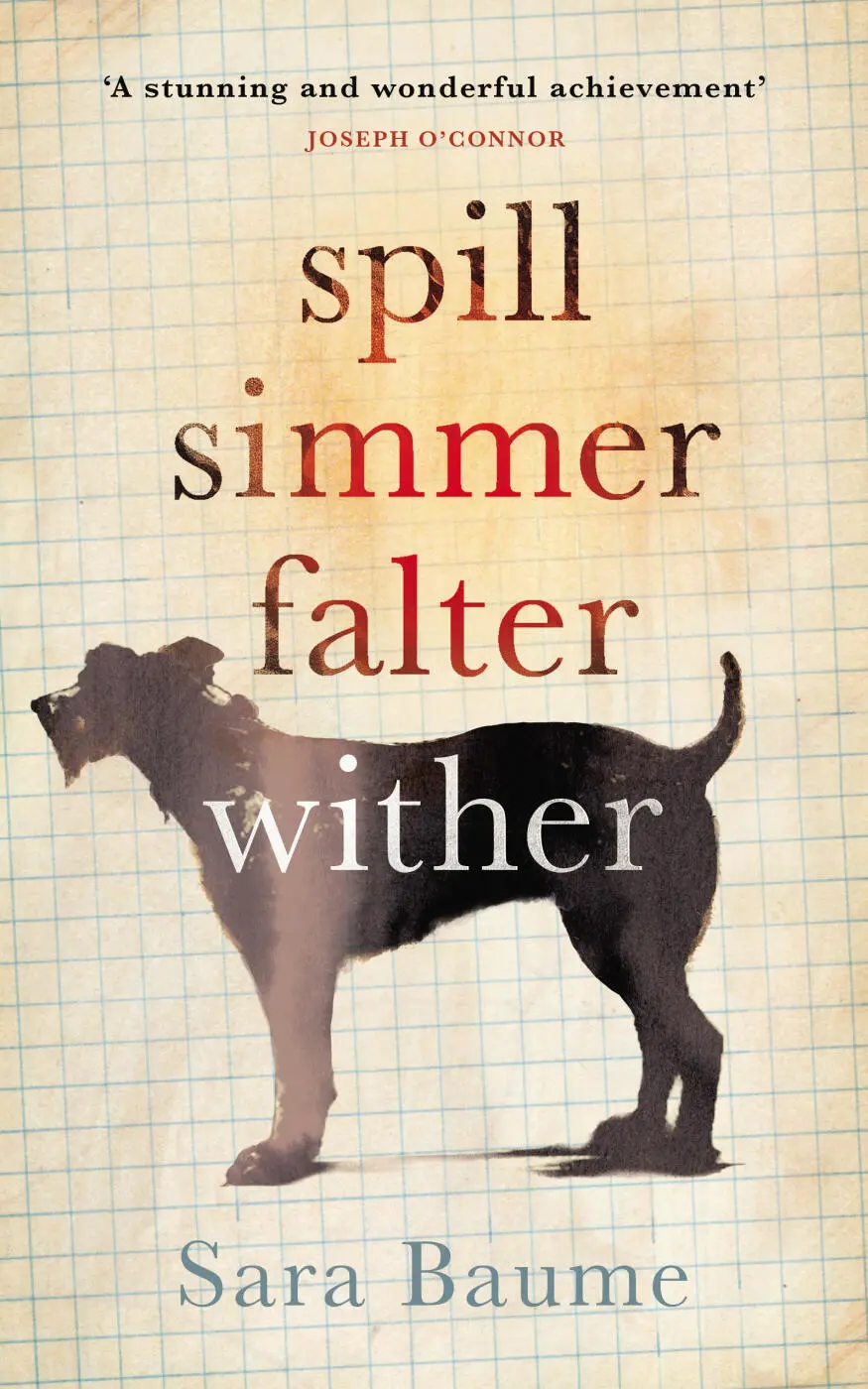
- Название:Spill Simmer Falter Wither
- Автор:
- Издательство:William Heinemann
- Жанр:
- Год:2015
- ISBN:нет данных
- Рейтинг книги:5 / 5. Голосов: 1
-
Избранное:Добавить в избранное
- Отзывы:
-
Ваша оценка:
Spill Simmer Falter Wither: краткое содержание, описание и аннотация
Предлагаем к чтению аннотацию, описание, краткое содержание или предисловие (зависит от того, что написал сам автор книги «Spill Simmer Falter Wither»). Если вы не нашли необходимую информацию о книге — напишите в комментариях, мы постараемся отыскать её.
Spill Simmer Falter Wither
Spill Simmer Falter Wither — читать онлайн бесплатно полную книгу (весь текст) целиком
Ниже представлен текст книги, разбитый по страницам. Система сохранения места последней прочитанной страницы, позволяет с удобством читать онлайн бесплатно книгу «Spill Simmer Falter Wither», без необходимости каждый раз заново искать на чём Вы остановились. Поставьте закладку, и сможете в любой момент перейти на страницу, на которой закончили чтение.
Интервал:
Закладка:
The shopkeeper is the landlord. He tells me it’ll take a minute and he’ll bring it out once the kettle’s boiled. I can tell he was butch as a youth, but now he’s sagged like a lumpy old sofa and the tattoos on his forearms are engulfed by body hair. I go back to the car and harness you. I tie the leash’s handle to the leg of a picnic bench and together we sit beneath the patio heater. The barman brings my drink and nuts and a cardboard mat printed with the picture of a beer I haven’t ordered. Tonelessly, insincerely, he wishes me well, and closes the door. It’s a soft night, rainless and calm.
I sip slow and you catch peanuts in your mouth. How smart you are not to miss a single one. I’d have though the partial eyelessness would affect your depth of vision, but apparently not. I sip, you chew and we watch the sycamore’s crashed helicopters dithering in the dirt, trying desperately to lift into the air again, ignoring their broken rotors.
The villages we pass through and sleep by, whose marrowfat peas and corned beef we purchase, whose pubs we sometimes sit outside; I read out their names to you. DYSSERT, the signposts say, SUCK, BINDADA, TOSSIT. They are, all of them, middle-of-nowhere countries, left-behind countries, dead-end countries, no countries at all, really. They are sad places. Don’t you think they’re sad? But then I suppose this is how I always expected them to be. But then I suppose I always expect everything to be sad until proven otherwise.

A boy, a waifish boy with prematurely skimpy hair, asks me to stand by the gate with my arms outstretched so his cows will know which way to go. He’s carrying a switch, twirling it between his fingers like a majorette’s baton. He caught us walking through his field, his father’s field. I thought he’d ask me where I came from, why I’m parting a path through his beet. Instead he asked if I’d help him herd.
They are black and white and mud caked. There are twenty, twenty-five. I can tell from the swollen udders that they’re milking stock, heifers.
I tie you to a fence post and stand beside the gate with my arms spread. From fingertip to fingertip, as long as my unstooped self. Now the cows come plundering toward us. They are disconcertingly fast for animals so thickset, so poorly streamlined. My role is to act as a human hedge, to bar the straight-ahead path so they’ll know to bear round the corner toward the parlour.
The leading heifer waits until her snout is inches from my chest to swerve. I smell a puff of hot fog from her nostrils. It is sort-of sweet, almost cidery. Do you smell it too? Behind me beside the fence post with your hindquarters backed into the ditch, you’re unusually abashed. Now all the other heifers follow. Feel the thunder of hooves as they pass.
The boy comes last, twirling his baton. He thanks me, locks the gate behind himself. Now he follows his cows along the field boundary toward the farm.
I untie you, and as I do, I don’t know why, but I feel euphoric. And you hop up and down in excitement, as though the cows were something we survived. You rush and skip into the beet again, as though you are euphoric too.
The radio plays, almost incessantly. I tune to the speaking station first thing. We listen to the news bulletin over and over, to the newsreader’s accentless voices. I wait for them to sneeze or sniff or clear their throats, but they never do. Every day there’s a succession of experts on the radio, telling us things. Today an expert is telling us how people choose pets they feel reflect the way they see themselves, and in time, the person and pet grow to resemble one another. After the speaking is ended, I turn the volume very low and switch to the classical station.
Your maggot nose intersects the rearview mirror. Your head’s held erect to catch smells breezing through the opened crack of the passenger window. Your ears have fallen back and open. Inside, they’re white and bald and twisted. What do you think of the classical music? Of the chimes and pops and strums and biffs, of the drum rolls which mount into grand cymbal smashes? You seem to be listening, but I can’t be sure.
Now I glance at the side of my own face in the mirror’s foreground, and I wonder have we grown to resemble one another, as we’re supposed to. On the outside, we are still as black and gnarled as nature made us. But on the inside, I feel different somehow. I feel animalised. Now there’s a wildness inside me that kicked off with you.
The sun’s out. It saturates the distant dual carriageway with watery quivers. Inside our shell of steel and glass, sheltered from the nipping autumn wind, warmed by the sun and lulled by the bump and sway, I can feel myself pitching toward sleep. Now our wheels err onto the cat’s eyes and the BONKbonk wakes me up. I roll the window down and hang my elbow into the cleansing car wind. I keep my hand poised to spring into a shield should you attempt to leap out at a pigeon or a cat or some other piece of prey, into the whoosh and crush of the speeding road.
We’ve already seen enough dead creatures since the driving began, of all shapes and phases. From creatures still drenched by internal fluids to creatures pancaked and sun-dried to a ship’s biscuit of their former selves. Do you see that neat little pile of mush, no more than a balled rag in a puddle of scarlet? It’s either a burly rat or a baby rabbit, impossible to tell. Now here comes a fox with both its eyeballs popped. See the peculiar angle of its dislocated tail bone and the place where a snapped rib has prodded free. Do you remember the tortoiseshell kitten, how it wore a dainty collar and the dainty collar’s dainty bell had been pressed into its throat like a dainty cookie cutter? Do you remember the badger, the badger who forgot to use its designated underpass? He was too sturdy for properly squashing; he lay supine on the side of the new dual carriageway, as though napping.
Hares and mice, wagtails and rooks, squirrels and mink. Every kind of creature every kind of killed. Eviscerated and decapitated, lobotomised and disembowelled. Sometimes the only remains are a puff of uprooted plumage, pale down dancing in the whoomph of air from passing vehicles, no sign of the bird from which it was bashed loose. The people inside the grim reaper cars don’t care, they have places to go, they keep going. Now we circle a roundabout and circle again, and as we circle, I watch the traffic. I wonder where everyone is going. And I wonder if any of the roadkill creatures actually wanted to die and threw themselves beneath the speeding wheels. A lethargic swallow who couldn’t bear the prospect of flying all the way back to Africa again. An insomniac hedgehog who couldn’t stand the thought of lying awake all winter with no-one to talk to.
I indicate, pull onto another dual carriageway. Up ahead, there’s an indiscernible thing obstructing the traffic. For at least a hundred yards, vehicles queue to pass the obstruction in single file. We creep closer. I squint into the sun, trying to make out what the fuss is. You press your face between front seats and squint with me. There’s a car and a motorbike pulled awkwardly into the hard shoulder. The car has its flashers flashing, its hazard-triangle propped inside the yellow line. Now we see it, lying in the middle of the road. A swan, a mute swan. It looks like an offcut of organza, crumpled around the edges, twitching. As we pass we see its long neck has buckled into its body like a folding chair. We see its wings are tucked back as if the tar is liquid and the swan is swimming.
Читать дальшеИнтервал:
Закладка:
Похожие книги на «Spill Simmer Falter Wither»
Представляем Вашему вниманию похожие книги на «Spill Simmer Falter Wither» списком для выбора. Мы отобрали схожую по названию и смыслу литературу в надежде предоставить читателям больше вариантов отыскать новые, интересные, ещё непрочитанные произведения.











Обсуждение, отзывы о книге «Spill Simmer Falter Wither» и просто собственные мнения читателей. Оставьте ваши комментарии, напишите, что Вы думаете о произведении, его смысле или главных героях. Укажите что конкретно понравилось, а что нет, и почему Вы так считаете.