Sara Baume - Spill Simmer Falter Wither
Здесь есть возможность читать онлайн «Sara Baume - Spill Simmer Falter Wither» весь текст электронной книги совершенно бесплатно (целиком полную версию без сокращений). В некоторых случаях можно слушать аудио, скачать через торрент в формате fb2 и присутствует краткое содержание. Год выпуска: 2015, Издательство: William Heinemann, Жанр: Современная проза, на английском языке. Описание произведения, (предисловие) а так же отзывы посетителей доступны на портале библиотеки ЛибКат.
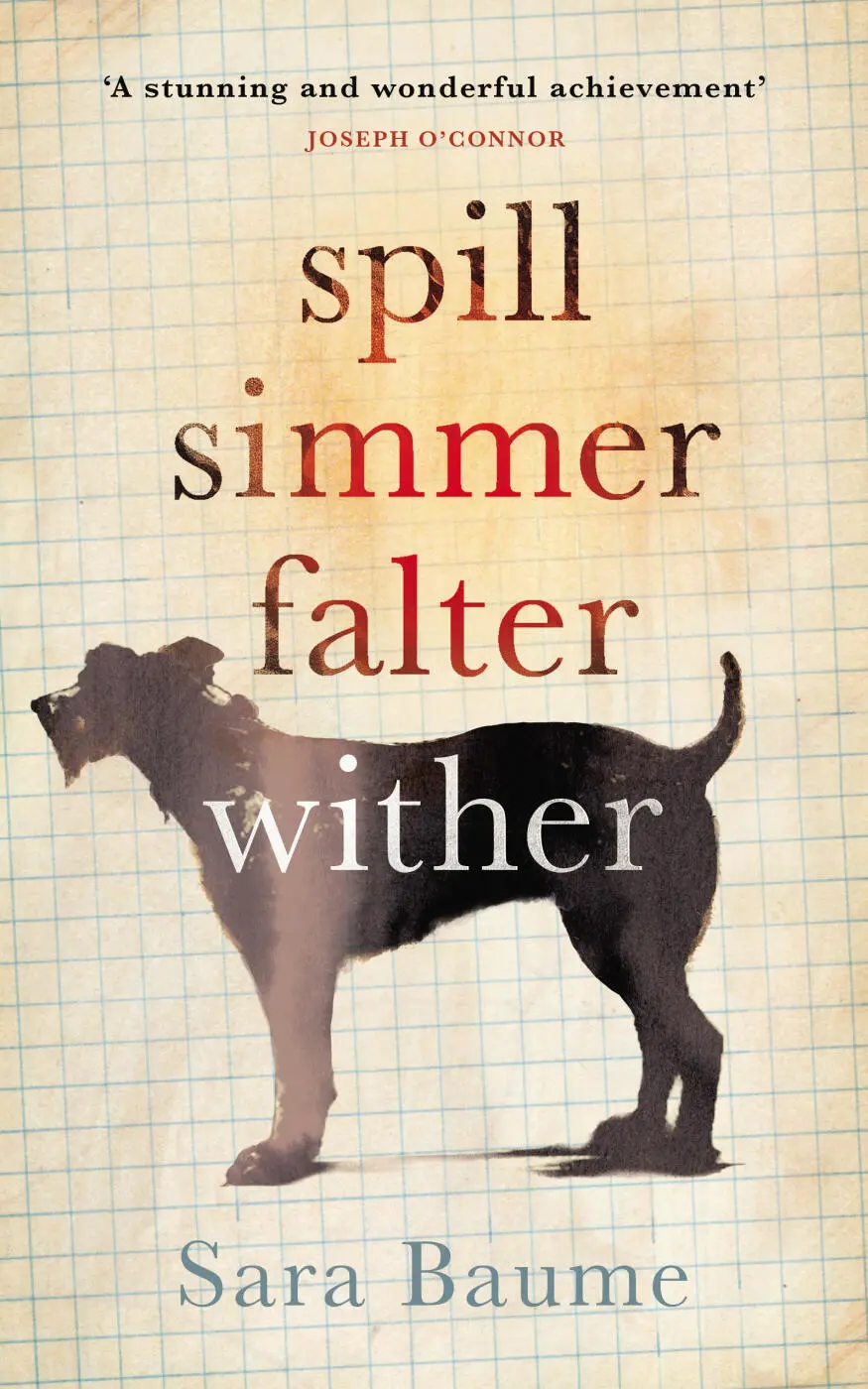
- Название:Spill Simmer Falter Wither
- Автор:
- Издательство:William Heinemann
- Жанр:
- Год:2015
- ISBN:нет данных
- Рейтинг книги:5 / 5. Голосов: 1
-
Избранное:Добавить в избранное
- Отзывы:
-
Ваша оценка:
Spill Simmer Falter Wither: краткое содержание, описание и аннотация
Предлагаем к чтению аннотацию, описание, краткое содержание или предисловие (зависит от того, что написал сам автор книги «Spill Simmer Falter Wither»). Если вы не нашли необходимую информацию о книге — напишите в комментариях, мы постараемся отыскать её.
Spill Simmer Falter Wither
Spill Simmer Falter Wither — читать онлайн бесплатно полную книгу (весь текст) целиком
Ниже представлен текст книги, разбитый по страницам. Система сохранения места последней прочитанной страницы, позволяет с удобством читать онлайн бесплатно книгу «Spill Simmer Falter Wither», без необходимости каждый раз заново искать на чём Вы остановились. Поставьте закладку, и сможете в любой момент перейти на страницу, на которой закончили чтение.
Интервал:
Закладка:
Now here are my bass lures. They look like fish-shaped toys except for the evil little hooks. Their plastic backs are psychedelic and their plastic bellies rattle like matchboxes. I cut them from great nests of weed wound up with cat-gut and threaded through with tiny, luminous beads. There’s something especially wretched about the washed-up lures. It’s like the plastic fish have been garrotted by their own line, poisoned by the lead of their own weight.
Best of all treasures, here are my glass pebbles. They’re descended from old bottles, shattered and frosted by millions of the water’s worker particles. They are mostly wine-bottle green, milk-bottle white and beer-bottle brown. Sometimes they are medicine-bottle blue, but the blues grow rarer by the year. At dawn I sit on the stones of Tawny Bay and sift the shale while you’re playing football. And on every afternoon the tide grants us our pebbled beach, I sit and sift again. At home, I fill my jars and stand them in the windows. When the sun shines through, it throws sea-coloured mosaics onto the sill, the walls, the floor. I know what you’re rolling about between your teeth. Come here, spit it out.
Now everything holds a diaphanous kind of potential. Now everything is so quiet and so nice and I feel ever so faintly less strange, less horrible. It makes me uneasy. It reminds me how I must remember to be distrustful of good fortune.

There is a little boy.
He has frilly hair, apricot skin, symmetrical features. He reminds me of the people in my picture frames, of the posing boys with sweet, smiling faces and a posing parent either side. Only this sweet face is snarled and gulping. This boy is staggering in distress, struggling to reach for his shih tzu and pressing, pressing, pressing his heartbeat into my outstretched palm. We are on the bird walk at last light, and I never meant to touch. I never wanted to touch. I’m only holding him back, with the front of my hand flat to the front of the boy’s red T-shirt. Red: the colour of warning, of admonition. But I’m only holding him. My other hand is on your mouth, my fingers pressed into your gums trying to lever your canine teeth from the tender skin of the shih tzu’s neck. And there is blood now. On me, on you. But mostly on the shih tzu, because it’s mostly the shih tzu’s blood.
The boy’s mother must have been all the way back as far as the power station. It takes her forever to catch up with her son. She is fat, too fat for hurrying, and her voice is fat too. A torrent of verbal abuse bulges and rolls from her bulges and rolls. Now she screams and sledgehammers a fist between animals. Her graceless karate chop does the trick. In an instant, I wrench you from your quarry and the little boy scoops his shih tzu back.
I stride away. With you under my arm, I walk as fast as I can without blatantly running. My hips are swinging like a woman’s, my bad leg is being left behind. My hands are trembling and the trembles travel through my elbows and shoulders, into my chest. The sighted side of your head is twisted back and you’re digging your claws deep into the flesh of my waist, the pork of my gut. Now I lose my grip and drop half of you to the ground. Your front feet are dangling, so I must drag. And as I drag, I stutter angry whispers at the back of your satiny head. ‘Ssssstop.’ I stutter, ‘sssstop ssstop ssstop.’
But you can’t hear me, and you don’t stop. You’re braying, braying, braying a bloodthirsty bray. It seems to come out through every pore of your bandy body. So this is your kill noise, I’ve heard it only in murmurs before but now here it is at its furious zenith. Perhaps in a different situation I’d appreciate its eerie melodiousness, its piercing resonance. I’d notice how it’s like some hopeless, haunted, strangulated form of singing, singing, singing. Out of tune, out of time.
Now the boy’s mother is gaining on us. She’s just a few paces behind, puce-faced and perspiring. She buys the low fat cheese, I think. She has a treadmill which stands immoveable as a marble bust in the corner of the spare room. She decides things for her husband and is not worth disagreeing with. Now a sweat mark has appeared at the neckline of her blouse and is creeping down toward the crevasse of her mountainous breasts. The things she shouts, the things she threatens, are clearer now. No longer slurred by shock but whetted by rage.
‘VET’S BILLS!’ she shouts, ‘DOG WARDEN! MUZZLE! PUT TO SLEEEEEEP!’
We pull well ahead, pass the information board and cross the road.
‘I KNOW WHERE YOU LIVE!’ she shouts, ‘I KNOW, I KNOW!’
And even if she is lying it doesn’t matter now, for she’s about to see us disappear behind the blue metal gate, our gate. The last of her shrilling is carried off on the wind, quenched by bigger noises. By the refinery siren, a passing cargo lorry full of freshly filled cylinders, a curlew calling his buddies to roost.
We fall into the laneway. I slam the gate. Even though you’ve stopped singing, your song’s still reverberating in my head. I bend down to remove the harness. You wag your tail in expectation of approval. You lick your chops in request of a treat, just like before. And I smack you hard across the muzzle, so hard that the bone at the back of my palm makes a sharp, clicking sound as it strikes.
Your eye waters. You shy away. You crumple like a tin can stamped beneath a hobnail boot.
I should never have adopted you. You bring trouble and then just when I think the trouble has passed, you bring trouble again. Caring for you is like keeping a nettle in a pretty porcelain flowerpot, watering its roots and pruning its vicious needles no matter how cruelly it stings my skin, until I’m pink and puffy all over yet still worrying the old welts back to life.
I find the key and open the front door. I step into the hall, but you don’t follow. You stay where you are. You cringe into the coarse brush of the mat.
And now I think of how I was my father’s nettle. His big lump of an embarrassing son. A son with no life of his own, no apparent trace of intelligence, of personality. A son fit only to be kept indoors, away from people and from light. Where there’s nothing to sting but himself.
I’m sorry. I didn’t mean it. Come in and let me clean the blood from your beard. It’s almost time for supper.
At certain stages of the summer, the bay is fringed by a phlegm of dirty white weed. The top gets crusted by the sun, but underneath, it’s soup. Parsnip, no, cream of mushroom soup. On hot days at low tide, the soup smell steeps the village. Do you get it? Of course you do, you can smell everything. You can smell feelings; you can smell time.
Now we sit behind the window. You on the sill, me in the armchair. Outside it’s dark. The tide’s coming in and all the birds are gone; gone wherever it is they go at night-time and high tide. Out to sea, the bird book says, as though ‘Out To Sea’ were some immense country unfastened and cast off to drift alone between continents. In the mud still barely visible below the wall, see the traffic cone buried to its third luminous band. See the golf umbrella wasted to its contorted joints. That’s my father’s golf umbrella; there’s the spot where I threw it. See what is maybe the blunt bow of his doorbox and maybe just a bow-shaped hump of bedrock. See the concrete cavity block. Inside it’s brimming with common crabs preparing to shed their softened shells. And across the bay, see the lights of a livestock ship pulling out of harbour. Inside there are hundreds of individual crates, and inside each crate, there’s a calf. I picture the calves are tan, white, black, mottled, and the ones with window cabins are staring out across the bay. But they can’t see as far as the bird walk. They didn’t notice what went on while they were watching. They don’t understand what’s happening to them and they are mooing, even though we can’t hear them from here, they are mooing tragically for their mothers, for solid earth beneath their hooves.
Читать дальшеИнтервал:
Закладка:
Похожие книги на «Spill Simmer Falter Wither»
Представляем Вашему вниманию похожие книги на «Spill Simmer Falter Wither» списком для выбора. Мы отобрали схожую по названию и смыслу литературу в надежде предоставить читателям больше вариантов отыскать новые, интересные, ещё непрочитанные произведения.











Обсуждение, отзывы о книге «Spill Simmer Falter Wither» и просто собственные мнения читателей. Оставьте ваши комментарии, напишите, что Вы думаете о произведении, его смысле или главных героях. Укажите что конкретно понравилось, а что нет, и почему Вы так считаете.