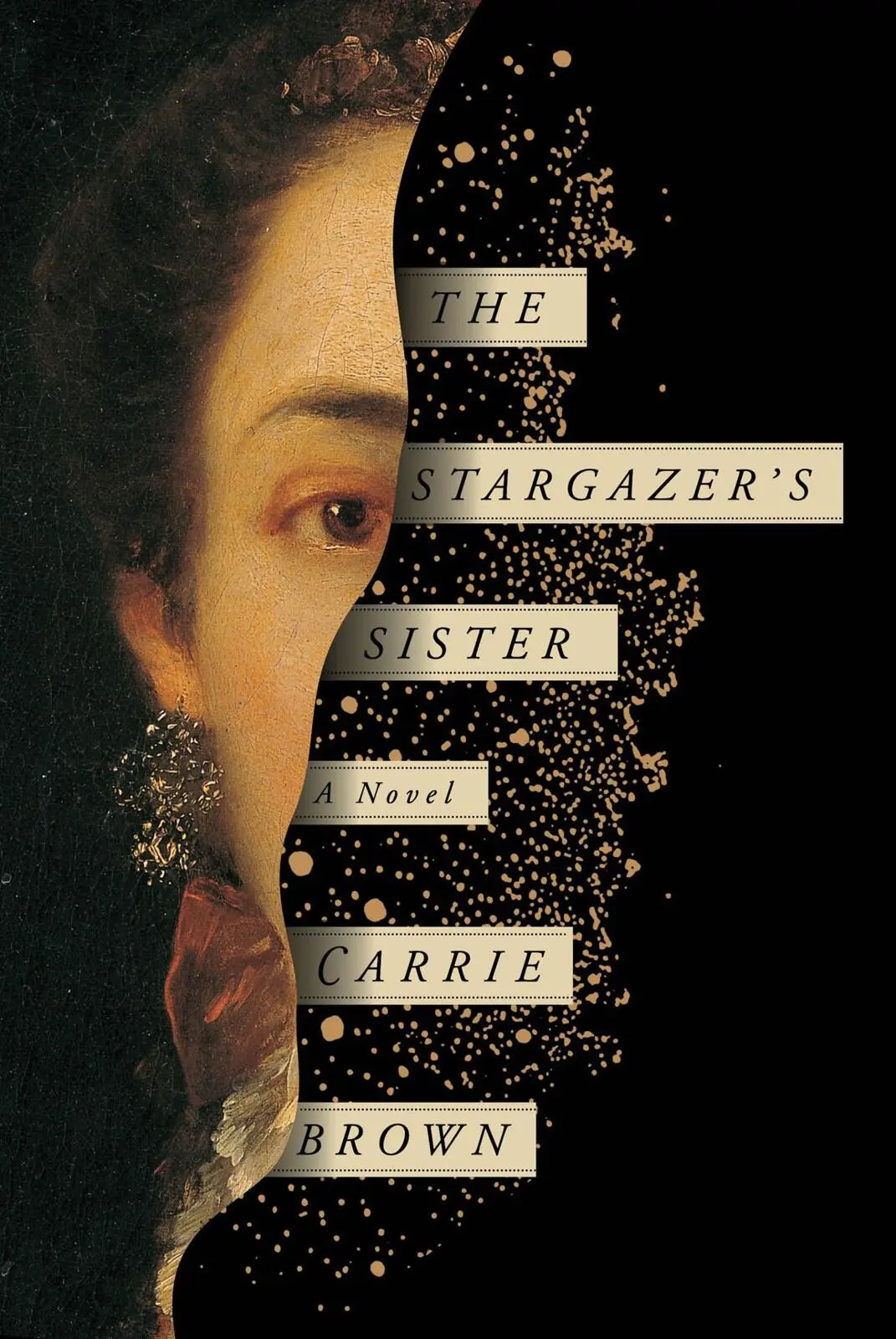
Carrie Brown - The Stargazer's Sister
Здесь есть возможность читать онлайн «Carrie Brown - The Stargazer's Sister» весь текст электронной книги совершенно бесплатно (целиком полную версию без сокращений). В некоторых случаях можно слушать аудио, скачать через торрент в формате fb2 и присутствует краткое содержание. Год выпуска: 2016, Издательство: Knopf Doubleday Publishing Group, Жанр: Современная проза, на английском языке. Описание произведения, (предисловие) а так же отзывы посетителей доступны на портале библиотеки ЛибКат.
- Название:The Stargazer's Sister
- Автор:
- Издательство:Knopf Doubleday Publishing Group
- Жанр:
- Год:2016
- ISBN:нет данных
- Рейтинг книги:5 / 5. Голосов: 1
-
Избранное:Добавить в избранное
- Отзывы:
-
Ваша оценка:
The Stargazer's Sister: краткое содержание, описание и аннотация
Предлагаем к чтению аннотацию, описание, краткое содержание или предисловие (зависит от того, что написал сам автор книги «The Stargazer's Sister»). Если вы не нашли необходимую информацию о книге — напишите в комментариях, мы постараемся отыскать её.
a beautiful new period novel — a nineteenth-century story of female empowerment before its time — based on the life of Caroline Herschel, sister of the great astronomer William Herschel and an astronomer in her own right. This exquisitely imagined novel opens as the great astronomer and composer William Herschel rescues his sister Caroline from a life of drudgery in Germany and brings her to England and a world of music-making and stargazing. Lina, as Caroline is known, serves as William’s assistant and the captain of his exhilaratingly busy household. William is generous, wise, and charismatic, an obsessive genius whom Lina adores and serves with the fervency of a beloved wife. When William suddenly announces that he will be married, Lina watches as her world collapses.
With her characteristically elegant prose, Brown creates from history a compelling story of familial collaboration and conflict, the sublime beauty of astronomy, and the small but essential place we have within a vast and astonishing cosmos. Through Lina’s trials and successes, we witness the dawning of an early feminist consciousness, of a woman struggling to find her own place among the stars.
The Stargazer's Sister — читать онлайн бесплатно полную книгу (весь текст) целиком
Ниже представлен текст книги, разбитый по страницам. Система сохранения места последней прочитанной страницы, позволяет с удобством читать онлайн бесплатно книгу «The Stargazer's Sister», без необходимости каждый раз заново искать на чём Вы остановились. Поставьте закладку, и сможете в любой момент перейти на страницу, на которой закончили чтение.
Интервал:
Закладка:
She will have wine every day, if she likes. Their uncle’s vineyard has been fruitful.
“Can you come and thank William?” Lina says. “William has arranged it all.”
Hilda holds her apron over her face, begins again to cry.
“It will be all right, Hilda,” Lina says. “Now we are both free.”
William calls from the courtyard, and she knows she must leave.
She embraces Hilda, kisses her. For a moment they cling together. Then Hilda turns away.
Lina puts her hands over her face. If she does not go now…
She climbs back up through the orchard, holding her skirts, but her legs are shaking.
How quickly it has happened, after all, their joint emancipation.
The apples in the willow baskets are shades of pink and red and gold flecked with brown spots. The leaves shine darkly in the morning’s gray light. A little white stone glints in the grass. She bends to pick it up.
The horse died long ago, but at the stable she steps inside before going into the house. She remembers the coarse hair of the horse’s mane, the bones of his back from when she lay across him, her cheek resting on the prickly velvet of his thick coat. She realizes she had expected that the grief accumulated during her childhood would leave with the promise of her departure.
She sees now that it will be with her forever, no matter where she goes.
From her pocket she takes the pebble she picked up in the orchard and places it on the windowsill.
She thinks of Margaretta, the little string tied to her finger in her grave. She looks out over the orchard, thinks of its beauty in blossom and in snow. She remembers her father humming while he worked, transcribing the scores left for him by the concertmaster. She remembers the sound of her brothers’ voices through the wall, remembers being a child, running across the courtyard to meet William.
Now she will never again have to be without William. She will be with him always.
The carriage is in the street. William calls to her.
From the courtyard, Lina waves a last time at Hilda, a small figure in a white apron down among the trees by the river. From this distance, Lina cannot see her clearly, but she thinks that the fluttering she detects is Hilda’s apron, flapping in farewell.
In the carriage, Lina turns for a last look at the house. Though they had called upstairs, their mother never came down to say goodbye.
England 1772–1776
SIX Storm
That first night on the packet that will take them to England, as she and William stand side by side on the deck under the stars, the damp air makes her ears ache. Traveling from Hanover to the coast she had been uncomfortably hot in her black silk, but now on the sea the night is cold. A yellow lantern at the far end of the ship is the only human light for miles and miles, but the sky glitters with uncountable numbers of stars. The luminous island of the Milky Way floats overhead.
The ship had moved away from shore that afternoon with surprising speed. She’d felt the ship’s collision with the waves in her body — in the soles of her feet, in her thighs, pelvis, breastbone, teeth, in a tickling buzzing across the bridge of her nose. The force of the wind against her face had made her eyes stream, but she had not wanted to retreat from the rail. Everything around her had made a sound, she realized: mast, rope, sail, straining board and joinery, wave and wind. Yet somewhere beyond all the noise she had sensed silence, too. Emptiness.
The ship had seemed so substantial when they came aboard, the sails filling with air and snapping above their heads. Now, in the darkness, it seems absurdly small for the venture on which they have embarked, this journey to England. She has never been on the sea before — never even seen the sea — never been out of sight of land. She had watched the expanse of flickering waves around them as they had pulled away from Hellevoetsluis. She knows that water obeys the same physical laws as solid objects, but how infinitely strange it seems to her now that the ocean’s waters remain obediently in their place on the globe, instead of sluicing off the curved shoulder of the planet in a giant waterfall. One has only to cup a palm full of water to see how readily it trickles away through one’s fingers.
It was William who told her about gravity, of course, lifting her when she was six or seven years old into the branches of one of the apple trees in the orchard. She had dropped an apple, a pebble, a green acorn, and then the acorn’s hat, and finally a feather, which caught on the breeze and swung to and fro on its downward path.
Indeed, everything falls.
The rates of descent depend on the object’s mass and shape, William had explained. One day he would teach her the mathematical formula by which these rates were calculated.
He had held up his hands— jump— and she had followed the feather into his arms.
Yet despite every demonstration of gravity’s force — every day the unchanging example of its power — the astonishing idea that human beings stand on the surface of a globe rotating in space by slow degrees yet do not fall off still confounds her imagination. It confounds her even more at this moment.
She feels the ship shift course and the deck tilt slightly beneath her, though the sea has quieted considerably since their departure. She looks across it now as if at a frozen black lake. Clearly, she thinks, she has been deceived into absurd complacency by the material things of the world. Surrounded as one is — after all, one cannot help it — by trees and houses and shops, by cart horses, paving stones, and castles, by beds, tables, chairs each with their four solidly planted feet…by every example of the world’s manifest presence, it has been possible for her to forget the extraordinary fact that the earth, as well as the sun and moon and every other planet, hovers unsupported by any visible method. She thinks of the planets rolled (but from where ?) into place like boulders, stopped here and there (with a touch of God’s finger?), the stars scattered like fistfuls of shining grain among them, sometimes a comet escaping the arrangement.
Yet the world and her place in it feel precarious now only in her mind, not in her body. William’s presence beside her, holding her arm, is real, and the hard planks of the deck are solid beneath her feet. That she is earthbound is something she knows in her bones. Her struggle with the idea of gravity is only a cognitive difficulty, as William has said — one cannot see it except by proof of its force — but it is so much more difficult to wrestle with the mind than with the body, where everything is more or less irrefutable. The mind is in every way a more troublesome instrument.
She has been cocooned by the physical world, she thinks, protected, even fooled by it. Despite the steady seas now, the ship around her groans. Far away from what is near at hand — water, mast, rope, and sail — she senses the deep, dark cathedral of the universe, both terrifying and wonderful to consider. She feels…as small as a snail. Smaller. A little seed. A bit of chaff.
An atom. She feels as small as an atom.
The ship shifts course again, a slight adjustment. She is learning and redistributes her weight from one foot to the other, hands tightening on the rail.
The waning moon has risen just above the eastern horizon in the deep, dark blue of the sky. Its appearance now — that shadowed face — comforts her. Everything is in its place.
Читать дальшеИнтервал:
Закладка:
Похожие книги на «The Stargazer's Sister»
Представляем Вашему вниманию похожие книги на «The Stargazer's Sister» списком для выбора. Мы отобрали схожую по названию и смыслу литературу в надежде предоставить читателям больше вариантов отыскать новые, интересные, ещё непрочитанные произведения.










Обсуждение, отзывы о книге «The Stargazer's Sister» и просто собственные мнения читателей. Оставьте ваши комментарии, напишите, что Вы думаете о произведении, его смысле или главных героях. Укажите что конкретно понравилось, а что нет, и почему Вы так считаете.