T. Boyle - Water Music
Здесь есть возможность читать онлайн «T. Boyle - Water Music» весь текст электронной книги совершенно бесплатно (целиком полную версию без сокращений). В некоторых случаях можно слушать аудио, скачать через торрент в формате fb2 и присутствует краткое содержание. Год выпуска: 1983, ISBN: 1983, Издательство: Granta Books, Жанр: Современная проза, на английском языке. Описание произведения, (предисловие) а так же отзывы посетителей доступны на портале библиотеки ЛибКат.
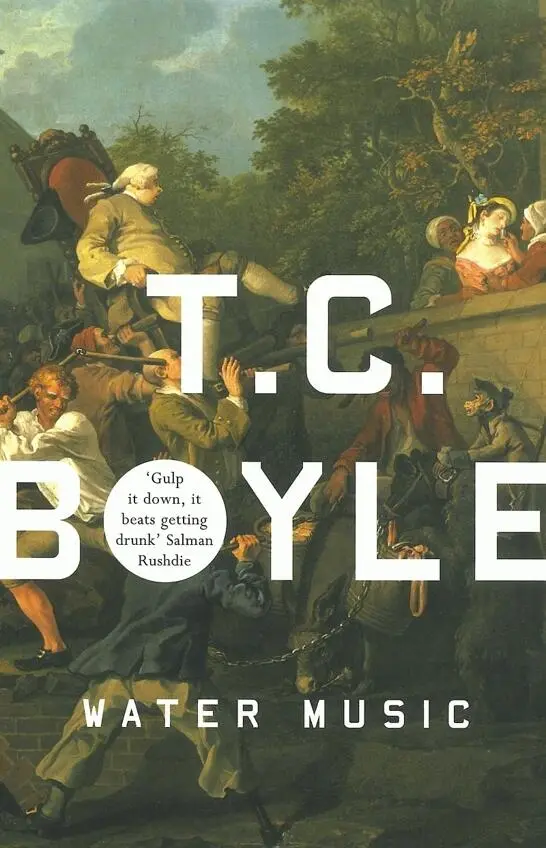
- Название:Water Music
- Автор:
- Издательство:Granta Books
- Жанр:
- Год:1983
- ISBN:9781862071551
- Рейтинг книги:3 / 5. Голосов: 1
-
Избранное:Добавить в избранное
- Отзывы:
-
Ваша оценка:
Water Music: краткое содержание, описание и аннотация
Предлагаем к чтению аннотацию, описание, краткое содержание или предисловие (зависит от того, что написал сам автор книги «Water Music»). Если вы не нашли необходимую информацию о книге — напишите в комментариях, мы постараемся отыскать её.
Water Music — читать онлайн бесплатно полную книгу (весь текст) целиком
Ниже представлен текст книги, разбитый по страницам. Система сохранения места последней прочитанной страницы, позволяет с удобством читать онлайн бесплатно книгу «Water Music», без необходимости каждый раз заново искать на чём Вы остановились. Поставьте закладку, и сможете в любой момент перейти на страницу, на которой закончили чтение.
Интервал:
Закладка:
Mungo rolls out of his damp blankets, wincing at the roar, and is shocked to see that they are no longer gliding through the endless tangled groves of arching trees and clawing vines that have walled in both banks of the river since they left Sansanding. Stunned, he looks round him full circle, then pulls out his telescope and looks again. There is no hint of green over the water, no vegetation, no shoreline in fact. Then it hits him: during the night they must have passed into Lake Dibbie, that vast inland sea reputed to lie between Djenné and Kabara. He gazes out over the shifting surface, happy in his surmise. Immense, shoreless, the lake slaps at the hull beneath his feet, its waters churned to brown sudsing waves in the hot wind.
The explorer consults his compass. They are heading north by northeast. Toward Timbuctoo — and the great desert. He swallows hard, hoping that what old Djanna-geo and Amadi told him is true, that thereafter the river loops toward the south. But he looks down at the insistent needle of his compass, and doubts assail him. Could Rennell and the others have been right? Does the river in fact run out of steam in the Sahara? Does it roar down an endless hole in the earth? Evaporate in Lake Chad?
Disturbed by these reflections, Mungo makes his way toward the front of the canoe, where Amadi Fatoumi and his retainers are seated. The four men are hunched down over their ankles, feet splayed, tossing bits of carved bone against the concave hull of the canoe and redistributing piles of cowries according to the outcome. As the explorer comes up, Amadi ceremoniously pours a thin stream of black tea into a cup the size of a thimble and hands it to him with a nod and a smile.
“So,” Mungo says, swaying with the boat, “we’ve made Dibbie, have we?” Hunched in the prow, Fred Frair fixes him with a brief vacant look and then gazes dolefully out over the water. Amadi looks up at the explorer as if he hasn’t heard.
“I say: Dibbie, isn’t it?” All at once the explorer realizes he’s shouting. He can’t help himself, what with all this noise. There is the maddening tinkle of spoon and plate somewhere in the rear of the boat, M’Keal’s drunken snores booming out from beneath the canopy, the screech of distant gulls, hum of gnats — all of it as loud as if it had been amphfied a hundred times. Exasperated, he bends to his guide. “What is all this bloody racket?”
Amadi looks surprised. He points to the sky. “The wind,” he says. “Very dry.” In answer to the explorer’s next question — a rhetorical one: does the Niger move southward past Timbuctoo and is he quite certain? — the guide merely points again, but this time to a spot just off starboard.
It must be said that the attack at Sansanding — led as it was by his archenemy — has had an unsettling influence on the explorer. He’s been jittery, his stomach has gone sour on him, a mysterious nervous rash has settled in his groin and between his toes. Like the hypochondriac who discovers a tumor under his arm with a surge of fatalistic joy, he has had his worst suspicions confirmed: they are out there, lurking behind every tree, camouflaged by the meanest village hut, out there lying in wait, just as he always knew they would be. And so, more than ever and with a single-mindedness that verges on monomania, he has determined to avoid any and all human contact. Against the protestations of his crew, he eschewed the cities of Silla and Djenné as if they were the abode of demons and basilisks, coming to anchor just above the farthest cluster of outlying huts and coasting down under cover of darkness. The men wanted to stop for fresh supplies — milk, produce, bread — but he wouldn’t hear of it. No: he wouldn’t stop at even the rudest native village hacked out of the bush, wouldn’t stop for beer, fresh meat, to feel solid ground under his feet for five precious minutes. He wouldn’t stop for anything.
Now, the sight of this spot on the horizon, this black speck, this nothing, fills him with terror. Out here in the middle of this oceanic lake, it can mean only one thing: people. Renegades, fanatics, murdering Moors. His first cry is stifled by the shock and disavowal that catches in his throat like a ball of phlegm. But then he shouts out like a sentry taken by surprise in a cold black night: “Attack! We’re under attack!”
The response is instantaneous. Amadi and his men leap up from their piles of cowries, and Fred Frair, languishing just a moment before, springs to his feet as if someone had spilled a bowl of hot soup in his lap. Martyn is there in an instant, and M’Keal, in boots and underwear, is up and cursing. “Moors!” Mungo cries, raising the telescope to his eye at the very moment that Fred Frair, galvanized by the first terrible call to arms, shoots past him howling like a dog. The result, viewed in scientific terms, is as simple as action and reaction, force and counterforce: the explorer’s elbow is jostled and the telescope flies from his hand to vanish instantly in the brown murk at his feet.
No matter. It doesn’t require magnification to see that that blemish on the horizon is a party of hostile Moors. The men, their faces flat with panic, are ready to take their leader at his word. Martyn and M’Keal are already counting out the muskets — twenty-five, thirty, thirty-five — while Frair scuttles back and forth from the enclosure with barrels of powder, ramrods and wadding in the event that reloading should be necessary. Only Ned Rise, at the tiller, seems composed. With sextant and compass, and the makeshift sail he’d rigged up during the night, he steadies the Joliba in the slackening current, running for Timbuctoo, Hausa and beyond, running for London.
The explorer, meanwhile, has gone rigid, poised in the bow like a prize pointer. Dripping sweat, squinting till his facial muscles begin to quiver, he stares off at the horizon as if he could set it afire from the sheer force of ocular concentration. A long moment ticks by, then another. And then, in a sudden dark moment of revelation, he realizes that a fearful conjugation is taking place out there on the perimeter: not one dot but three ! Three slick and swift native canoes packed to the waterline with bloodthirsty Moors!
“Three of them,” Martyn says at his shoulder, and his voice is cold as a lancet. Yes. Bloodthirsty Moors. Savages. Animals. He can see them now — can’t he? — their headgear flashing in the sun. Suddenly a feeling of calm comes over him, the feeling ascribed to soldiers in the heat of battle. Firm and fatalistic, he lifts the musket to his shoulder and sights down the tapering barrel. “Prepare to fire,” he hisses.
Twenty minutes he stands there, a drawing-room actor in a tableau vivant. The three canoes, in formation, draw closer, closer, cutting an angle that will inexorably intersect the path of the Joliba . He can see them quite clearly now, their black hulls in relief against the great ball of the sun rising like a tired old beast from the lake behind them. When they drift within range, he gives the order to fire.
The first barrage overturns the lead canoe with a sudden sharp slap. Distant arms flail in the air, there are confused cries, shrieks of pain. Eight muskets fire, are, flung down and replaced by eight more. Another roar, another flash of light, and the second canoe is blasted from the water. What with the sun and the smoke the explorer can barely make them out, but certainly they’re Moors — in jubbahs and baggy trousers — little matter that their faces are black and the cries those of women and children.
After the second barrage, the occupants of the final canoe take to the water, abandoning their craft to its fate. It is then that the crew — Amadi Fatoumi and his blacks included — begin firing at random, blazing away at a featureless head in the glitter of sun on water, cutting loose at the merest suggestion of a swimmer’s wake. In the heat of it, the explorer draws a bead on a dark form clinging to the side of an overturned canoe, only to have his arm arrested as he squeezes the trigger. He whirls round on Ned Rise. Guns pop and roar, smoke hangs over the Joliba like a thunderhead touching down. “Tell them to hold their fire,” Ned shouts, “it’s a mistake — can’t you see that?”
Читать дальшеИнтервал:
Закладка:
Похожие книги на «Water Music»
Представляем Вашему вниманию похожие книги на «Water Music» списком для выбора. Мы отобрали схожую по названию и смыслу литературу в надежде предоставить читателям больше вариантов отыскать новые, интересные, ещё непрочитанные произведения.








Обсуждение, отзывы о книге «Water Music» и просто собственные мнения читателей. Оставьте ваши комментарии, напишите, что Вы думаете о произведении, его смысле или главных героях. Укажите что конкретно понравилось, а что нет, и почему Вы так считаете.