T. Boyle - Water Music
Здесь есть возможность читать онлайн «T. Boyle - Water Music» весь текст электронной книги совершенно бесплатно (целиком полную версию без сокращений). В некоторых случаях можно слушать аудио, скачать через торрент в формате fb2 и присутствует краткое содержание. Год выпуска: 1983, ISBN: 1983, Издательство: Granta Books, Жанр: Современная проза, на английском языке. Описание произведения, (предисловие) а так же отзывы посетителей доступны на портале библиотеки ЛибКат.
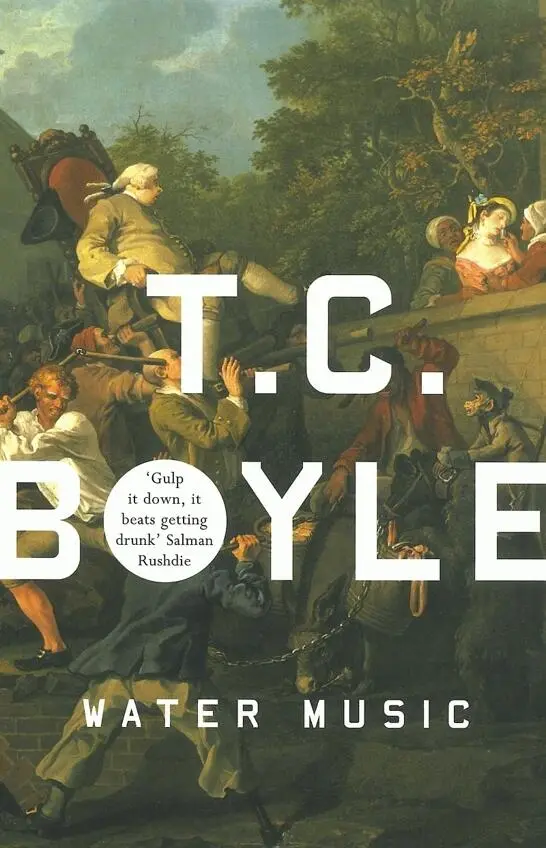
- Название:Water Music
- Автор:
- Издательство:Granta Books
- Жанр:
- Год:1983
- ISBN:9781862071551
- Рейтинг книги:3 / 5. Голосов: 1
-
Избранное:Добавить в избранное
- Отзывы:
-
Ваша оценка:
Water Music: краткое содержание, описание и аннотация
Предлагаем к чтению аннотацию, описание, краткое содержание или предисловие (зависит от того, что написал сам автор книги «Water Music»). Если вы не нашли необходимую информацию о книге — напишите в комментариях, мы постараемся отыскать её.
Water Music — читать онлайн бесплатно полную книгу (весь текст) целиком
Ниже представлен текст книги, разбитый по страницам. Система сохранения места последней прочитанной страницы, позволяет с удобством читать онлайн бесплатно книгу «Water Music», без необходимости каждый раз заново искать на чём Вы остановились. Поставьте закладку, и сможете в любой момент перейти на страницу, на которой закончили чтение.
Интервал:
Закладка:
It is awesome. Terrifying. Overwhelming.
Could this be the end? the explorer is thinking, his vital organs curling up like hedgehogs, while Martyn reaches for his musket and Ned Rise rams the tiller hard right to send the canoe angling out from the spit. Arrows hit the canopy with a thunk-thunk-thunk, a rock cuts Martyn’s cheek. They are staring into the faces of five hundred enraged savages, and another two hundred are hurtling toward them in quick low-slung canoes. They’ve been caught with their pants down, and it looks bad, looks as if they’re whipped before they started.
But then things begin to fall into place: Ned gives them some breathing room, the sweet stink of the gunpowder fires their nostrils and before you know it they’re rising to the occasion. Snatching up their weapons like the true-blue stout-hearted fighting men they are, saturated to the very clefts of their chins with true grit, blazing away like champions, like murderers. Once the boat is out of arrow range, it is easy. A shooting party. Potting ducks in the Cotswolds. They fire on their adversaries with a modulated rage, with the no-quarter-given, absolutely merciless absorption that possessed them on Lake Dibbie; they fire until the flotilla is destroyed, and then turn on the fine of dugouts blocking their path downriver.
The blacks hold their ground. A hundred yards out, Ned swings the Joliba broadside and the men line up like a firing squad — Mungo, Amadi and the slaves on one end, Martyn, M’Keal and Ned on the other — and pour volley after volley into the dark line ahead of them as they drift down to meet it. One of their antagonists, in ostrich plumes and coral, looks to be a chief or a king maybe. He stands firm in the bow of the foremost canoe, a scepter clenched in one hand, the other solemnly raised in a commanding gesture, a gesture that says lay down your weapons and give up hope, lay down your weapons and surrender in the face of royal omnipotence and superior numbers. When Martyn knocks him flat with a single shot, it seems to take the heart out of the opposition. A moment later Ned brings the Joliba round again, rams the final canoe barring their way, and that’s that. Child’s play.
The only casualty is M’Keal. In the heat of the action, someone fired a musket at him — yes, a musket. A Moor, it looked like, seated in the prow of one of the pirogues—”a big sucker, in black.” The ball excised the upper portion of his left ear and trimmed back his hoary locks an inch or two. A minor wound, by all accounts. But when he was hit, something snapped. He went berserk. Frothed like a rabid dog, wrote a new book of racial epithets, stamped and stammered and shook his fist. Then, muttering all the while, he began to fling things at the astonished black faces across the water. First he flung muskets, six or eight of them, then a keg of powder. The battle raged round him: no one noticed. He heaved a sack of rice overboard, a regimental sword, the sextant. The bloody aborigine buggers, he’d show them. Next to go was a box of ammunition, and then the explorer’s duffel bag: compass, notebooks, half-finished letters to Ailie and all. Cursing, growling, beating his breast, the red-faced old soldier chucked over his shoes, his underwear, his Panama hat, the teapot, a barrel of salt beef and a crate of rotting yams. By the time the danger was past and they were able to subdue him, the stringy old veteran of the West Indian campaign had lightened their load by half, and put an end to any further plotting of latitude and longitude or worries about alignment with magnetic poles.
It hardly seemed to matter.
♦ ♦ ♦
Without chronometer, without compass, without sextant, the geographical missionaries of the H.M.S. Joliba look at the sun and know it is noon, forever, and that they are heading north, into the desert, into the glare, into the very maw of mystery. Their hair, thick with grease and dust, trails down their shoulders, their beards reach their waists. The proud red uniforms have long since degenerated to tatters — to loincloths — and the once-glistening boots have fallen to pieces. Unwashed, undisciplined, underfed, thin of rib and cloudy of eye, their skin blotched and sunscorched, their bare feet blistered, they could be the last remnant of some ancient tribe emigrating to a new homeland, they could be cave dwellers, scavengers, eaters of offal and raw flesh. Only Amadi and his three slaves are unchanged. Alert and watchful, they sit beneath their broad-brimmed hats and throw their carved bones. They are not men of the nineteenth century, they are men of the millennia, men whose gait and gaze and quick clever hands prefigure Europe and all of written history. They know the river will bend. They know that maps and trousers and salt beef are irrelevant, and that white men are fools. They are patient. They are content. Their eyes are open.
Meanwhile, the big black canoe drifts with the current. By day there is the blinding flash of sun on water, the whole earth set ablaze, white-hot, the hills consumed in flame. At night the banks reverberate with ghostly echoes — muffled snarls, startled cries, the eerie gloating snigger of hyenas — and the water boils with heart-stopping explosions as of strange gargantuan beasts cavorting in the deeps or stretching their great horny tails across the river to trap the unwary.
One night, under a moon so brilliant it varnishes the surface of the river and throws a cool dispersed glimmer over trees and shrubs and broken tumbles of rock, they are awakened by a sudden shattering burst of shrieks and growls somewhere up ahead. Primordial, cacophonous, chilling, it is the sound of pack frenzy, of snarling snapping furious jaws, the sound of wolves fighting over scraps of meat. But not only that: there is the hint of something else too, something far more excruciating. As they draw closer, they begin to realize what it is: human voices crying out over the clamor.
Everyone is awake now — even M’Keal — staring off into the darkness transfixed with horror. The sounds of tearing flesh, bones cracking, the garbled cries for help: they flay the nerves like salt and nettles, unbearable, as inadmissible as the image of one’s own death and mutilation. Ned turns away, the explorer’s stomach churns. They can see nothing. A terrible minute passes, then another, the night enveloped in demonic snarls and torn gasping sobs, as if somehow, poor sinners, they’d passed the invisible barrier and descended the long swirling tributaries of Acheron and Lethe. Suddenly one of the men cries out: “There! On the right bank, just ahead!”
The moon shifts, everything indefinite and insubstantial, there and not there. Then the shadows begin to take on motion and life and the snarling swells to a raging crescendo that ebbs in a single breath and a sudden explosion of light: a torch flaring out against the darkness. Flickering and unsteady, it illuminates the black humped forms of a hundred frothing, toothy demons: hyenas. Claws and shoulders and raging black mouths, hyenas, kid killers, graverobbers, choking on their own spittle. Against them, a single man — a traveling merchant perhaps — backing away from the gutted carcass of his camel, flailing the torch like an archangel’s sword, while a woman and child cower at his back, caught up in a bad dream.
Hunched low, the graverobbers close in, foaming at the carcass like fish after chum, snapping down glistening gray loops of intestine, jockeying for position, while others lumber in out of the shadows, their eyes bright with greed and a hunger no amount of feeding can satisfy. The man backs off, circling, while the woman, clutching the child as if it were already in pieces, feints with a length of firewood. For a moment, the contest looks even. But then in a sudden unforgiving instant, the torch dies out and the seething wave of muzzle and mane closes over them, their torn shrieks already lost in the rising volume of contentious growls and the percussive clash of jaws.
Читать дальшеИнтервал:
Закладка:
Похожие книги на «Water Music»
Представляем Вашему вниманию похожие книги на «Water Music» списком для выбора. Мы отобрали схожую по названию и смыслу литературу в надежде предоставить читателям больше вариантов отыскать новые, интересные, ещё непрочитанные произведения.











Обсуждение, отзывы о книге «Water Music» и просто собственные мнения читателей. Оставьте ваши комментарии, напишите, что Вы думаете о произведении, его смысле или главных героях. Укажите что конкретно понравилось, а что нет, и почему Вы так считаете.