T. Boyle - Water Music
Здесь есть возможность читать онлайн «T. Boyle - Water Music» весь текст электронной книги совершенно бесплатно (целиком полную версию без сокращений). В некоторых случаях можно слушать аудио, скачать через торрент в формате fb2 и присутствует краткое содержание. Год выпуска: 1983, ISBN: 1983, Издательство: Granta Books, Жанр: Современная проза, на английском языке. Описание произведения, (предисловие) а так же отзывы посетителей доступны на портале библиотеки ЛибКат.
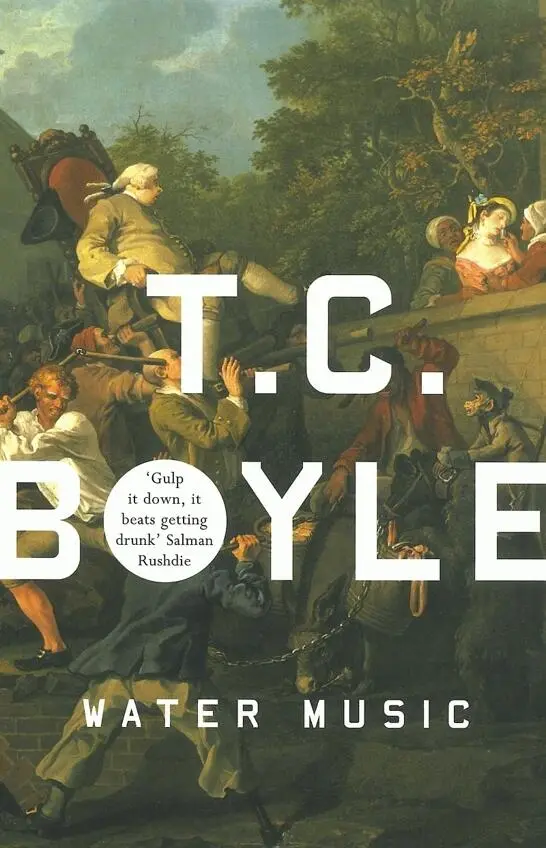
- Название:Water Music
- Автор:
- Издательство:Granta Books
- Жанр:
- Год:1983
- ISBN:9781862071551
- Рейтинг книги:3 / 5. Голосов: 1
-
Избранное:Добавить в избранное
- Отзывы:
-
Ваша оценка:
Water Music: краткое содержание, описание и аннотация
Предлагаем к чтению аннотацию, описание, краткое содержание или предисловие (зависит от того, что написал сам автор книги «Water Music»). Если вы не нашли необходимую информацию о книге — напишите в комментариях, мы постараемся отыскать её.
Water Music — читать онлайн бесплатно полную книгу (весь текст) целиком
Ниже представлен текст книги, разбитый по страницам. Система сохранения места последней прочитанной страницы, позволяет с удобством читать онлайн бесплатно книгу «Water Music», без необходимости каждый раз заново искать на чём Вы остановились. Поставьте закладку, и сможете в любой момент перейти на страницу, на которой закончили чтение.
Интервал:
Закладка:
If the words register they have no visible effect, except that the old fellow tilts his head to the opposite side, as if he were contemplating a listing ship or chinning an invisible violin. His lips are compressed, his eyes shuttered windows. Slowly, hesitantly, like a man who’s answered a knock only to find no one there, he begins to pull the door closed. To this point, Rorie Macphoon has remained in the background, holding the pony’s bridle; when he steps forward, the old cottager’s face undergoes a transformation: where before he’d looked puzzled or merely obtuse, now a whole range of human emotions plays across his features. Ailie watches his initial look of enlightenment realign itself into something harder, an expression of anger and resentment, which is in turn succeeded by a sly glimmer of avarice and finally a sort of hangdog look of obsequious resignation. Georgie Gleg, the Edinburgh physician, presses half a crown into the old man’s palm, and they enter the cottage.
Inside, an enormous brindled cat gazes up at them from the hearth, its eyes the color of cheddar cheese. Beside the animal, so still she could be made of wax, an old woman dozes in a chair carved from a treestump. A slab of oak balanced on two piles of paving stones serves as a bench, and a bedframe, set on the floor and heaped with heather, sags against the far wall. There is no other furniture in the room. In the glimmer from the hearth and the bleak gray light of the window Ailie can make out the shabby accouterments of the place: a crutch and a rusted hoe in the corner, sheaves of barley stacked on the floor, a mound of peat, string of onions, wooden washbasin. A wicker curtain cordons off the low cavelike back room, from which emanates a caustic stench of urine and the occasional unsteady caprine bleat. Sad, Ailie thinks. Pitiful. Better call it sordid than quaint. She shifts uneasily from foot to foot, listening to the goats make water and wondering why in God’s name Fiona sent them to this hole.
“So,” Georgie booms, warming his hands over the peat fire and turning to the old man, “you live here, do you?”
Startled, the cottager dips his head and steps back a pace. The turkey flesh under his neck has begun to quiver and Rorie is attempting some sort of explanation beginning with the phrase “Mr. Gleg” repeated three or four times and interspersed with “ums” and “ahs” and a good deal of foot shuffling and trouser tugging, when suddenly a discordant stream of language is washing over them from down below. The old woman, hunched and crippled, one eye dead, has come to life, treating them to a disquisition in Erse, the native tongue of the Highlands. And disquisition it is — she goes on and on, wound up like a mechanical gargoyle, her good eye leaping about its socket, delivering a regular lecture, every last word of which is entirely unintelligible. Finally, after what seems like a good five minutes, she ends with a wild stinging laugh like wind in the gutter, and then subsides in a spasm of coughing.
“What was that?” Georgie asks, turning to Macphoon.
Thomas, intimidated by the whole scene — the dimness, the stink, the unspoken threat — clings to his mother’s skirts, while Ailie bites her lip to keep from laughing. The idea of it: Fiona thinks this quaint ?
Rorie, hat in hand and shy as a sinner at the gates of heaven, clears his throat and looks at the ground. “She says she’s the happiest woman in the world.”
That does it. She can’t hold it any longer. Suddenly Ailie loses control, laughing out loud, beginning with a barely suppressed titter and building to a series of breastbone-pounding whoops. Nodding and grinning, the old housewife takes a pinch of snuff and laughs along with her, hysterical, high and keening, a laugh like knives grating against a whetstone. “Happiest. .” Ailie gasps, holding her sides, unable to complete the phrase.
And then the old woman is jabbering away again, her voice rasping and harsh, the strange musical language like something inexpressibly ancient and exotic, some Ur language, something you’d expect to find in Mesopotamia or Luxor or in the crumbling leaves of a faded parchment. When she falls silent, Ailie turns to Macphoon with an anticipatory grin: “Well? What did she say this time — more words of wisdom?”
Rorie goes through the same routine again — the foot shuffling, tugging at his trousers, turning the hat over in his hands — and then looks Ailie dead in the eye. “She says she’s got her husband right here by her side, and that’s all a woman could ever want.”
The words drive home like separate blows from a mallet, a stake sinking into her heart. The old man is nodding his head and smiling — an obscene, wet-lipped parody of a smile that shows his yellowed teeth and the dead white tip of his tongue. And his wife, the old hag, is cackling like an overworked clock and struggling to get up out of the chair. Ailie feels as if she’s caught in a dream, feels as if someone’s played a bad joke on her, feels the bad breath of the universe whistling in her face and is frightened. The smile is gone.
Georgie, sensing that something has gone wrong, takes her arm and leads her to the door, nodding to the old man and pressing another coin into his hand. Alarmed, Thomas clings to his mother as if someone were trying to snatch him away, and Rorie, flushing, concentrates on his shoes. Shaken, angry, bewildered, Ailie steps out into the rinsed gray air and takes a deep breath, wondering just what is going on and why she’s let an old crone’s banter upset her so.
All at once there’s a tug at her elbow. She turns. The old woman, bent over her crutch like an errant question mark, is looking up at her out of a sharp sly raptor’s face. The dull light is blinding. Something wrong with the hag’s lip, scarred, as if… as if had once been pierced through, like Seedy’s. Ailie draws back instinctively, and the woman’s hand snakes out to pat Thomas’ head, pinch his cheeks, the cracked grating voice having its final say.
Ailie’s face is burning. She looks at Rorie framed in the doorway, the white bulb of the old man’s head at his shoulder.
The bailiff wets his fingertips, smooths the cap across his crown. “She had a boy like him once, she says. Run off on her.” There are no trees, no bushes, the sky gone dark, the invisible loch in the deep glen roaring with a thousand voices. The old woman is rocking on her crutch, leering, rubbing the white bristle of her chin. “She says you ought to keep a watch on him.”
For a long while, wending their way through the darkening forest, saddles creaking, the silent mist tugging at their elbows and knees, they can hear the knife edge of the old woman’s laugh, cutting the night in two.
♦ ♦ ♦
The final day of their sojourn at Avis House dawns like an intimation of July, bright and cloudless, the air gravid with a slow penetrating warmth, as if somehow the seasons had advanced, the earth pitched forward on its axis, the sun flared up like a bundle of twigs set atop a mound of glowing coals. Ailie is up at first light, intoxicated by the texture of the air, by the odor of daffodils and the sound of honeybees. Standing at her window and looking out over the loch, she can’t help feeling a tug of regret, a resistance to the idea of leaving, of going back to the humdrum and the quotidian. Certainly she misses the children, and her father, and even in a way the staid domesticity of day-to-day life in Selkirk — but she’s not ready to go back yet. This is adventure, this is living, this is what she’s been looking for all her life. At home she has only her duty to husband, children, father, and her role as the constant wife of the absent saint and martyr.
There are sparrows and starlings on the lawn. Out over the loch a golden eagle coasts in the high thin air, luminous in the morning sun. She wants to go, she wants to stay. Wants to look into her children’s faces, and at the same time she wants to travel farther, to the Hebrides, the Arctic, up over Russia and down to Tibet. At that moment she comes closer to understanding her husband than she ever will: the adventure, the surprise, the frisson of chasing down the permutations of possibility, the purity of doing and experiencing — how could looking on the same bit of yard, the same black mare, the same four walls even touch it? It is the sixth of April. Mungo has been gone a year and a half. Today is hers and hers alone.
Читать дальшеИнтервал:
Закладка:
Похожие книги на «Water Music»
Представляем Вашему вниманию похожие книги на «Water Music» списком для выбора. Мы отобрали схожую по названию и смыслу литературу в надежде предоставить читателям больше вариантов отыскать новые, интересные, ещё непрочитанные произведения.





Обсуждение, отзывы о книге «Water Music» и просто собственные мнения читателей. Оставьте ваши комментарии, напишите, что Вы думаете о произведении, его смысле или главных героях. Укажите что конкретно понравилось, а что нет, и почему Вы так считаете.