T. Boyle - Water Music
Здесь есть возможность читать онлайн «T. Boyle - Water Music» весь текст электронной книги совершенно бесплатно (целиком полную версию без сокращений). В некоторых случаях можно слушать аудио, скачать через торрент в формате fb2 и присутствует краткое содержание. Год выпуска: 1983, ISBN: 1983, Издательство: Granta Books, Жанр: Современная проза, на английском языке. Описание произведения, (предисловие) а так же отзывы посетителей доступны на портале библиотеки ЛибКат.
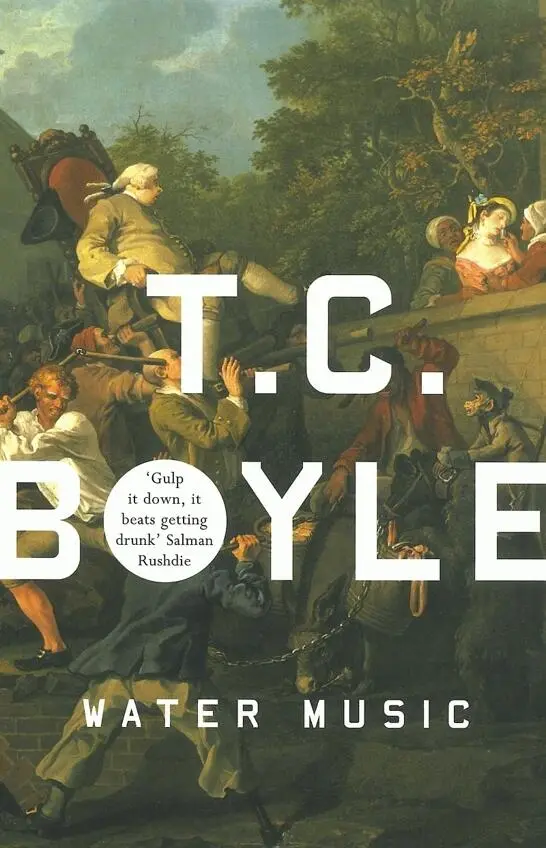
- Название:Water Music
- Автор:
- Издательство:Granta Books
- Жанр:
- Год:1983
- ISBN:9781862071551
- Рейтинг книги:3 / 5. Голосов: 1
-
Избранное:Добавить в избранное
- Отзывы:
-
Ваша оценка:
Water Music: краткое содержание, описание и аннотация
Предлагаем к чтению аннотацию, описание, краткое содержание или предисловие (зависит от того, что написал сам автор книги «Water Music»). Если вы не нашли необходимую информацию о книге — напишите в комментариях, мы постараемся отыскать её.
Water Music — читать онлайн бесплатно полную книгу (весь текст) целиком
Ниже представлен текст книги, разбитый по страницам. Система сохранения места последней прочитанной страницы, позволяет с удобством читать онлайн бесплатно книгу «Water Music», без необходимости каждый раз заново искать на чём Вы остановились. Поставьте закладку, и сможете в любой момент перейти на страницу, на которой закончили чтение.
Интервал:
Закладка:
Time has become an irrelevance. There is only the sun and the inexorable slide of the river, the long running slope to resurrection. And resurrection it will be: he is certain of it. Forget despair, futility, self-doubt. The cards are on the table, and they’re all aces: the Niger has swung southward. Just as he’d hoped and prayed it would, just as Amadi had predicted. For two months now they’ve been heading south, and it’s like an inoculation of confidence. South. To the Atlantic. To vindication. To glory.
A simple turn of the river. It’s done wonders for everyone’s attitude. Ned Rise has loosened his grip on the tiller, Martyn has begun to talk and even smile a bit, and M’Keal — though still troubled in his mind — has shown signs of coming around. And why not? They’re like prisoners on death row whose sentences have suddenly been commuted. Two months ago they were staring doom in the face; now they’re home free. All they have to do is hold on a bit longer — and who knows, it could be no more than a month, a week even — hold on and bask in a hero’s welcome in London, maybe even pick up a government pension. They’ll be drinking porter and punch before you know it, diddling the girls, sinking their teeth into great dripping pots of bubble and squeak, wheels of Cheshire cheese and craggy mounds of oysters. Oh yes: they’re going home.
Of course, it hasn’t been all singing around the campfire and Pollyanna at the dress shop. Even after the river began pulling them southward they had scare after scare, crisis on top of crisis. Hostile tribes lined the riverbanks — the Juli, the Ulotrichi, the Songhai and Mahinga — and squadrons of canoes regularly shot out to intercept them. One morning they woke to see an army of Tuareg — kissing cousins to the Moors — gazing down on them from a bluff. There must have been three thousand of them, mounted on camels, their indigo jubbahs rattling in the wind, beards bristling, double-edged swords glinting in the sun. They never moved. Not a one of them. It was as though they’d been carved from stone. And yet how terrible this silent presence was, how heinous, how insupportable — what were they doing there, what did they want? Another time, after a skirmish with a flotilla of native canoes, two black fanatics managed to board the Joliba in the confusion, and were about to rupture the blond bulb of the explorer’s skull when Martyn wheeled round and dispatched them with a flurry of saber strokes. For days afterward Mungo went round fingering his head as tentatively as a man stacking eggs in a basket.
But by far the most disturbing event of the meridional leg of the journey was the defection of Amadi Fatoumi. It had been agreed that Amadi was to be released from any further obligation on reaching Yaour in Hausaland. There he would be given the balance of his wages in muskets, powder and tradegoods (he’d been paid the first half, in cowries, at Sansanding), and he would attempt to hire a Hausa tribesman to guide the expedition the rest of the way. Fine. That was the agreement. No one liked it — what if they couldn’t find another guide? how could they land Amadi at Yaour without exposing themselves to attack? — but they would just have to live with it. That he would leave them was a given, but it was the way in which he was to do it that left them cold.
One evening four weeks back, Amadi and his slaves rose in a group, tucked away their carved bones, cowries, teapots and pipes, and shuffled their way to the stern, where Mungo stood beside Ned Rise, reminiscing about Bond Street and Drury Lane. Amadi spoke in Mandingo. They were three days out of Yaour, he said, but they would have to anchor for the night because there was a dangerous rapids just ahead. He would guide them through the rapids in the morning, and then begin making preparations for a landing at Yaour. Could he, he wondered, look through the things the explorer meant to give him in payment?
The slaves watched Mungo’s face as if it were something to eat. He didn’t want to think about Amadi’s leaving him, didn’t want to deal with it. He even thought of welshing, of holding a pistol to the guide’s head and forcing him to go on. But no, he couldn’t do that. His relations with the natives — insofar as he had any — had always been based on mutual trust. Amadi had fulfilled his part of the bargain, Mungo would stick by his. “All right,” he said finally, “we’ll hate to see you go, but I suppose there’s nothing to be done about it.” He looked at the guide hopefully, but Amadi’s face was signed, sealed and delivered. “Well. There’s no harm in your picking out what you want now — but remember, when we get to Yaour you’ve promised to find us a guide. Right?”
Amadi made a sign of obeisance, and then, shadowed by his slaves, ducked beneath the canopy to sort through the things that had survived M’Keal’s fit at Gotoijege. For a long while the explorer could hear them mumbling over this object or that, whistling in awe, debating in a low murmurous dialect he couldn’t understand. After an hour or so Mungo ordered Ned to drop anchor, and Amadi and his men retired to their customary spot in the bow of the boat. As it grew dark, the slaves huddled beneath their jubbahs and dozed off, but Amadi sat there, still as a corpse, his eyes scanning the shore, the glowing bowl of his pipe like a beacon in the gathering night.
In the morning he was gone.
Mungo couldn’t beheve it. He awoke to mist, the discourse of birds, M’Keal’s snores, and made his way to the front of the boat to heat some water for tea over the brazier they’d erected there. But something was wrong. The bow of the boat was empty, the curled black forms that had been propped there these past four and a half months until they seemed a part of the ship — knots in the wood, human anchors, furled sails — were gone. Vanished. As if someone had taken an eraser to the corner of a familiar portrait. It was disturbing. Deeply disturbing. Frantic, Mungo roused the men and hurriedly inventoried the supplies.
Three-quarters of the muskets had disappeared. Kegs of powder, bullets, every last scrap of broadcloth, every trinket and trifle — about the only thing they hadn’t taken was the clarinet Ned had inherited from Scott. Martyn was seething. “Damned aborigines, black coon Hottentot nigger thieves. They’ve swum off with it all, haven’t they?”
They had. Crocodiles or no crocodiles. And now the men of the Joliba were left without a guide, without goods for barter, and very nearly defenseless, their arsenal decimated and their number reduced by half. It looked bleak, but not so bleak as it would look five minutes later. Because by then a carefully orchestrated attack would be under way, an attack that would feature tooth-champing Maniana cannibals and weapons rendered useless by sabotage (Amadi had wet the powder in each of the muskets he was unable to carry off, and had almost certainly made some sort of nefarious compact with the Maniana). Later, Mungo would think back on the incident and realize that the guide must have planned it from the first, must have been communicating with the ghouls all along, must have sold them out as casually as one might auction off goats or chickens. Amadi was cold-blooded. Wicked. He’d stabbed them in the back.
Fortunately, however, at the first gastronomic howl from the bush, Ned Rise had had the presence of mind to sever the anchor rope, and the Joliba —wet muskets and all — was able to drift down out of danger just as the ochre-painted savages stormed out of the bushes with their skewers and carving knives.
♦ ♦ ♦
And so, here they are — guideless, cowryless, goodsless, anchorless, their clothes in rags and bodies devastated with disease, sunburn and culinary fatigue, the current carrying them where it will, the water level dropping as the dry season advances, sandbanks lapping at them like tongues, humped white rocks protruding from the sickly wash of the current like picked ribs, mites, flies, ticks, chiggers and mosquitoes biting, the odor of dead fish and exposed muck so rancid and oppressive they can hardly breathe — here they are, overjoyed, celebrating, heading south.
Читать дальшеИнтервал:
Закладка:
Похожие книги на «Water Music»
Представляем Вашему вниманию похожие книги на «Water Music» списком для выбора. Мы отобрали схожую по названию и смыслу литературу в надежде предоставить читателям больше вариантов отыскать новые, интересные, ещё непрочитанные произведения.












Обсуждение, отзывы о книге «Water Music» и просто собственные мнения читателей. Оставьте ваши комментарии, напишите, что Вы думаете о произведении, его смысле или главных героях. Укажите что конкретно понравилось, а что нет, и почему Вы так считаете.