T. Boyle - Water Music
Здесь есть возможность читать онлайн «T. Boyle - Water Music» весь текст электронной книги совершенно бесплатно (целиком полную версию без сокращений). В некоторых случаях можно слушать аудио, скачать через торрент в формате fb2 и присутствует краткое содержание. Год выпуска: 1983, ISBN: 1983, Издательство: Granta Books, Жанр: Современная проза, на английском языке. Описание произведения, (предисловие) а так же отзывы посетителей доступны на портале библиотеки ЛибКат.
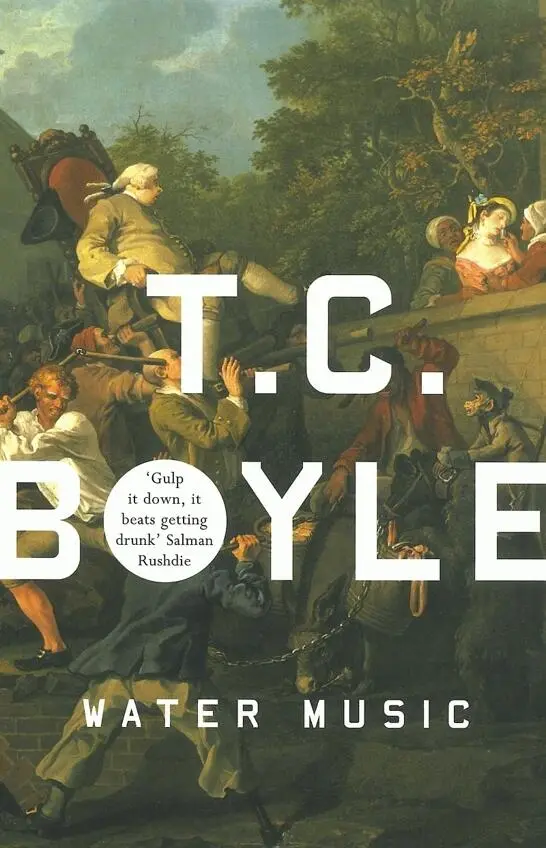
- Название:Water Music
- Автор:
- Издательство:Granta Books
- Жанр:
- Год:1983
- ISBN:9781862071551
- Рейтинг книги:3 / 5. Голосов: 1
-
Избранное:Добавить в избранное
- Отзывы:
-
Ваша оценка:
Water Music: краткое содержание, описание и аннотация
Предлагаем к чтению аннотацию, описание, краткое содержание или предисловие (зависит от того, что написал сам автор книги «Water Music»). Если вы не нашли необходимую информацию о книге — напишите в комментариях, мы постараемся отыскать её.
Water Music — читать онлайн бесплатно полную книгу (весь текст) целиком
Ниже представлен текст книги, разбитый по страницам. Система сохранения места последней прочитанной страницы, позволяет с удобством читать онлайн бесплатно книгу «Water Music», без необходимости каждый раз заново искать на чём Вы остановились. Поставьте закладку, и сможете в любой момент перейти на страницу, на которой закончили чтение.
Интервал:
Закладка:
But these birds. They cloud the picture, they complicate things. Suddenly a gunshot snaps out behind him, and he wheels round at the quick sharp surprise of it. It is Martyn, nearly on top of him, a musket smoking in one hand, the other clenched in a fist. Almost instantaneously a vulture slaps down on the deck. Stunned, bleeding, one wing askew, the bird scrambles to its feet and lifts its gleaming beak with a hiss. The lieutenant is grinning. He closes in, swinging the stock of his gun like an executioner’s axe, M’Keal cheering him on. The bird leaps once, twice, like a rooster dodging a cart, and then Martyn catches it across the back. Bones crack, the claws rake reflexively at the floor of the canoe, and Martyn hits it again. There is a moment of silence, the bird motionless, and then M’Keal plucks up the carcass, a splash of feathers, blood and excrement, and presses it to his chin. “Look at me,” he crows, “look at me. I’ve sprouted feathers!”
No one is looking. Something far more arresting than a swarm of carrion birds has suddenly caught their attention. A distant, moaning roar, the sound of white water beating at rock, the sound of waves and surf and the dead man’s tide. Rapids. Mungo glances down at the crude map Amadi had etched for him in the burnished wood of the hull, then looks up at Ned with a cold flat helpless expression, the expression of a fettered prisoner in the hands of his enemies. His voice is hushed, barely audible over the approaching roar — one word, a whisper: “Boussa.”
♦ ♦ ♦
It closes in on them, this din, it boxes them in, booming with a hollow deep-throated resonance, exploding with sudden startling claps and peals, until it seems as if they’re being swept into a battle at sea. Within minutes the river’s surface has begun to tilt forward, stretching its neck, tapering, while the high-walled banks are suddenly askew, out of plumb, rearing back at a crazy angle. Ahead the channel is seething and white, great strips of rock moving beneath the surface like bone under skin. And almost imperceptibly, a new sound has begun to emerge from the muddled roar, a sucking, rushing sound, as of some unfathomable volume of water — a lake, a sea — sucked down a drain.
There is no time to fight it. No question of easing into shore, no hope of backing out. The only recourse is to lash down the movables — guns, powderkegs, foodstuffs — and ride the chute. Meanwhile, the river gets rougher by the second, tearing at them from every direction, tossing the boat like a twig, hauling it back down as if it were petrified. Ned jerks the tiller right and left, impossible to see over the bow, the flimsy stick all but useless in his hands, while Mungo scrambles up and down the deck, lashing things across the gunwales, muttering to himself, shouting out unheeded commands. Martyn, the tough and unshakable twenty-year-old, the bloodspiller, looks frightened, and M’Keal — buffoon, drunkard, madman — has flung down the dead bird in favor of lashing himself to the nearest canopy strut. High above, safe, placid, patient, the vultures hover like a swarm of monstrous gnats, like harpies, keeping watch.
“The paddles!” Mungo shouts. “Take up your paddles, men!” The men ignore him, the banks grow higher, the Niger heaves and bucks like a furious animal. They hold on, spray flying, the ceaseless racket of water impacting on rock all but swallowing them, the river pitching dizzily, snags and riprap raking like claws at the bottom of the boat. And now — in a quick running blur — the clay banks give way to walls, sheer rock faces pocked with geologic acne, rough as sandpaper above, smooth as the mythic glass mountain below. The canoe angles right past a single boulder big as an atoll, then jerks left again around a pair of scoured pillars, and there, up ahead — what is it? The glancing light, the froth and mist, the roar — it could be anything from a series of riffles to a second Niagara. “Hold on!” someone shouts, and they lock their jaws, bracing for a quick flight into eternity.
But once again the Niger defies their expectations: the roar derives from neither falls nor rapids. Six hundred yards ahead the river seems to stop cold, cut off by a monolithic wall of rock that stretches across the horizon like a felled giant. The banks pull back, the current slows a notch or two, and then they see the passage — a single channel gaping like a mouth in the center of the wall. The explorer goes cold at the sight of it — they’ll be swept down like rats in a sewer, dashed against the rocks and drowned. . but no, wait. . that tunnel must be thirty feet high, forty! A sudden heady rush of elation sweeps over him: spared, spared yet again! “Look!” he calls back to Ned, “it’s big as the portals under London Bridge — we’ll clear it easy!” Yes, of course. And isn’t that daylight on the far side?
It is. And in fact the great arched vault of the tunnel, abraded through the eons, is easily lofty enough to accommodate the Joliba —or a ship twice its height for that matter. But there is another factor involved here, a crucial and perhaps decisive factor that the explorer has not yet had an opportunity to take into account. It is this: what appears at this distance to be some sort of exotic growth darkening the rock wall ahead — it could be a dense thicket, fur bristling along the spine of some Mesozoic beast, clots of algae like skin — is in fact something very different, something animate, intelligent, hostile.
“Wait a minute!” Martyn is perched in the bow of the canoe now, straining his eyes toward the oncoming monolith like a lookout in a crow’s nest. “There’s. . there’s people on those rocks!”
People indeed. Mungo looks, M’Keal looks, Ned — his heart sinking: new life, purpose — hah! — it’s Rise’s Law all over again — Ned looks. As the river bowls them closer, everything becomes clear, as clear as a verdict of guilty, a sentence of death. An army is deployed along the cliff — so thick in places that the individual warriors seem to congeal in solid black masses like lumps of tar — an army big as the Czar’s, big as Napoleon’s, endless, as if all of Holborn had turned out in blackface and armed with spears and bows and hammered knives. All along the Africans have known this moment must inevitably come, all along they’ve assuaged their disappointments, nursed their stepped-upon toes, swallowed their ravaged pride in the certainty that ultimately they would have their revenge.
Check and mate.
The river pushes them, irresistible. Paddles are useless against it, the anchor lost. As sure as gravity exerts its force and planets tug round the sun, they will be pulled through that grim stone mouth ahead, pulled — like filings to a magnet — onto the spears of their enemies, fatal appetency. The explorer can see them clearly now — the Tuareg army that had looked down on them from the bluff, the Hausa tribesmen in their jubbahs and turbans, a contingent of Maniana, ocher limbs and filed teeth. There — those are the Soorka, and there, the nameless savages from Gotoijege, hot to avenge their king. Every prerogative ignored, every snub, every wound given and drop of blood spilled, has come back to haunt them. It is a day of ironies. Even sitting here now, watching his own death played out like a pageant, Mungo can see the bleached high-water mark of a second passage that neatly skirts the cliff ahead, wide and unencumbered and dry as a bone — navigable only during the monsoon.
Dreamlike, this moment before death. Fame, glory, wife, family, ambition — they’re equally irrelevant. He is some big-horned buck in the grip of a predator, stunned beyond pain, his guts spilled in the grass, eyes glazing, the crack and drool of mastication like a dirge. He looks around him, detached, absent. Martyn is fooling with the weapons, Rise frozen at the useless tiller, M’Keal crossing himself. One hundred yards, the water sucking and seething. What can he do? Shoot one of a thousand? Take yet another life? No. Better to sit here and wait for the forest of spears, the jagged boulders, the cauldrons of bubbling oil.
Читать дальшеИнтервал:
Закладка:
Похожие книги на «Water Music»
Представляем Вашему вниманию похожие книги на «Water Music» списком для выбора. Мы отобрали схожую по названию и смыслу литературу в надежде предоставить читателям больше вариантов отыскать новые, интересные, ещё непрочитанные произведения.




Обсуждение, отзывы о книге «Water Music» и просто собственные мнения читателей. Оставьте ваши комментарии, напишите, что Вы думаете о произведении, его смысле или главных героях. Укажите что конкретно понравилось, а что нет, и почему Вы так считаете.