T. Boyle - Water Music
Здесь есть возможность читать онлайн «T. Boyle - Water Music» весь текст электронной книги совершенно бесплатно (целиком полную версию без сокращений). В некоторых случаях можно слушать аудио, скачать через торрент в формате fb2 и присутствует краткое содержание. Год выпуска: 1983, ISBN: 1983, Издательство: Granta Books, Жанр: Современная проза, на английском языке. Описание произведения, (предисловие) а так же отзывы посетителей доступны на портале библиотеки ЛибКат.
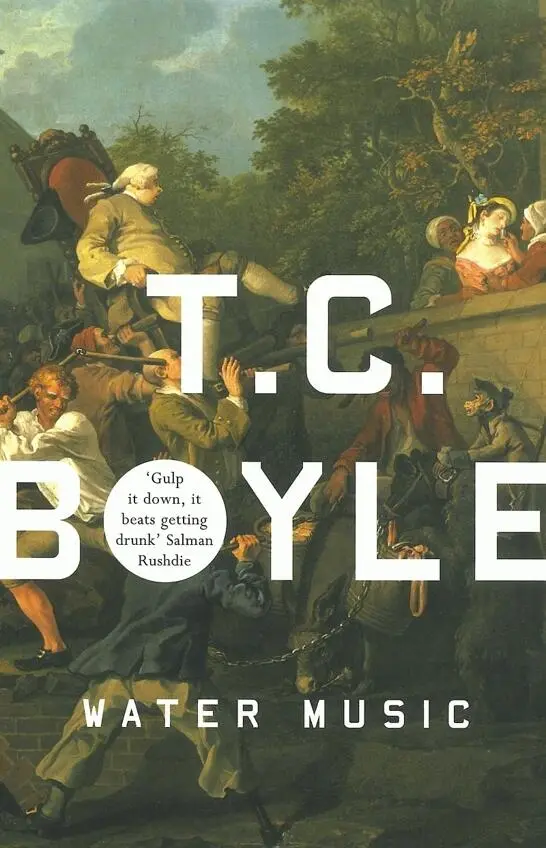
- Название:Water Music
- Автор:
- Издательство:Granta Books
- Жанр:
- Год:1983
- ISBN:9781862071551
- Рейтинг книги:3 / 5. Голосов: 1
-
Избранное:Добавить в избранное
- Отзывы:
-
Ваша оценка:
Water Music: краткое содержание, описание и аннотация
Предлагаем к чтению аннотацию, описание, краткое содержание или предисловие (зависит от того, что написал сам автор книги «Water Music»). Если вы не нашли необходимую информацию о книге — напишите в комментариях, мы постараемся отыскать её.
Water Music — читать онлайн бесплатно полную книгу (весь текст) целиком
Ниже представлен текст книги, разбитый по страницам. Система сохранения места последней прочитанной страницы, позволяет с удобством читать онлайн бесплатно книгу «Water Music», без необходимости каждый раз заново искать на чём Вы остановились. Поставьте закладку, и сможете в любой момент перейти на страницу, на которой закончили чтение.
Интервал:
Закладка:
But as 1807 became 1808, and there was still no conclusive word of husband or brother, she began to hunger for rumors, rumors that might reinforce what she so passionately believed: somehow, somewhere, Mungo was out there. In 1810 the Colonial Department contacted the guide Isaaco through Lieutenant Colonel Maxwell, Governor of Senegal, and delegated him to look into the circumstances surrounding the explorer’s disappearance. Twenty months later the elderly Mandingo emerged from the bush with a document inscribed in Arabic: it was the journal of Amadi Fatoumi. The white men, Fatoumi wrote, had been killed at Boussa, though he had done all he could to prevent it. Mungo Park was dead. He had drowned when the H.M.S. Joliba capsized in the rapids while under native attack.
Ailie repudiated the document. It was a lie. Mungo was alive — certainly he was — and Zander too. Her father tried to reason with her: “It’s a sad fact, but ye maun face it, gull. Ye’re a widow, and as much as it gars me to say it, ye’re bereft of a brother too.” His words had no effect. She’d heard it all before — fifteen long years ago, when the whole world was crying in its beer for the “daring young Scotsman swallowed up in the shadow of the Dark Continent,” when her friends and relations flocked round to pat her back and her own father tried to force her into a marriage she didn’t want. And now it was the same thing all over again. Each new rumor brought them to her door like crows. Betty Deatcher with her brimming eyes, the Reverend MacNibbit with a face like a gravestone. Poor thing, they said, watching her greedily, watching her with something like hunger in their eyes. Is there anything we can do?
Georgie Gleg wrote her from Edinburgh just after Amadi Fatoumi’s journal was released. The letter was long and exhaustive — some thirty pages of exquisitely formed characters and precisely ruled margins — offering consolation, hope, money, a shoulder to cry on, a proposal of marriage. She never answered it. Instead, she gathered together all the mementos of Mungo’s first expedition — the battered top hat, the ebony figurine with its cruelly distorted belly and limbs, the three editions of his Travels —and set up a sort of shrine in the corner of the parlor. Five chairs were ranged round the display, and she spent long hours sitting in one or another of them, the children at her feet, reading aloud from the Travels or from Mungo’s letters, or just staring off into space, hoping, praying, waiting for the next rumor to make its way to her.
Oh yes, there were fresh rumors. Still. Six years after the fact and better than eight months since the Colonial Department had officially closed the case. They worked their tortuous way to her ears as if drawn by some mysterious irrepressible force. Through the Bight of Benin to the Antilles and Carolina, through Badagri to the Canaries to Lisbon, Gravesend, London and Edinburgh, from savages to slavers, from slavers to diplomats to the man in the street, the rumors persisted: white men were alive in the interior of Africa.
In fact, though no European would ever know it, there was a grain of truth in these reports. If they erred, it was an error of degree, not of substance — it was not white men who lived on in the deeps of Africa, but a single white man . A survivor. A man totally unknown to the public, a pariah of sorts, a man who had been born to poverty and experienced the miracle of resurrection.
♦ ♦ ♦
Some thirty-six hours after the disaster at Boussa, Ned Rise opened his eyes on nirvana for the third time in his life. But this time paradise was neither a dank, fislistinking shanty on the banks of the Thames nor an operating theater off Newgate Street. . it was brighter, far brighter, glaring with all the intensity of the tropical sun. The last thing he remembered was the grim leering face of his own death, the rock wall hurtling at him, the mob howling for blood, the struggle with Park. .
And now what? He was disoriented. His body ached. There was a fire in every joint, his kneecaps felt shattered, a deep intransigent pain stabbed at his lower back. If he could summon the will to sit up and take stock of things, he would discover that he was as naked and unencumbered as the day he was born, the straw hat and tattered loincloth swept away in the flood, the silver dueling pistol buried forever in the muck of the riverbed. But he couldn’t. He merely lay there, inert, the sun spread across his back like a blanket of flame.
His vision blurred, steadied. His temples pounded. He lay in a pile of rubble — leaves, branches, fragments of wood and bone — amidst the humped pastel forms of water-smoothed boulders, boulders strewn across the landscape like the eggs of antediluvian monsters. The air was as hot and still as the breath of a sleeping dragon, no sound, no movement, and then suddenly — violent contrast — it exploded with the stiff harsh rattle of beating wings. Ned looked up into the inevitable skewed face of a carrion bird, a vulture, splayed talons, wings spread like a canopy. Bold, combative, the great ugly graverobber hissed at him and took a tentative step forward. It begins again, Ned thought.
But then the bird leaped back, swiveled the flat plane of its neck in alarm, and lurched up out of his field of vision. Something had frightened it off. Hyena? Lion? Maniana? Ned could barely muster the will to care. He stared at the polished surface of the rock before him, a trickle of water washing his legs and groin, the clatter of wings echoing in the silence. Then there was another sound, breathy and melodic, no mere birdsong, no illusion created by rubbing branches or mimetic streams — it was the sound of music, the sound of civilization and humanity. Had he died after all? Was this the afterlife — purgatory — a steaming stinking groundless place where devils and angels vied for his soul? He closed his eyes. Perhaps he slept.
The music played on — flutes, it seemed, three or four of them, melodies intertwined like vines. He was lulled, he was comforted. By the time he pushed himself up the sun was low in the sky and only the convex crowns of the rocks were illuminated, suffused with a pinkish glow, as if each were about to hatch. The music had suddenly stopped. He looked round him: there was no sign of the Boussa rapids, no sign of music-makers, no sign of life. Nothing but smoothed boulders, tumbled to the horizon like melons or beachballs or great hairless heads, and the river at his back. Had he imagined flutes?
Shakily, the pain driving like spikes through his hands and feet, he pulled himself erect and then almost immediately collapsed against the nearest rock. He was bruised, torn and battered. Welts rose along his collarbone, and so many discolored abrasions spangled his legs, buttocks and ribcage he looked like a clown in motley. He’d taken quite a beating. But he was alive and breathing, and so far as he could tell nothing was broken. It was almost as an afterthought that he realized he was hungry.
Then — it was unmistakable — something moved. Out there, in the confusion of rocks. And then again: jostling elbows, hunched shoulders. “Hello?” Ned called. Nothing. He tried again — in Mandingo, Soorka and Arabic. There was a long moment of silence, and then, as if in response, the music started up again. No fool, Ned leaned back against the rock and tried to look appreciative. After a moment, he began to clap in time with the unseen musicians, while somewhere off to his left a drum started up, steady and sonorous, pulsing like a heartbeat.
Timid, skittish as deer, they began to show themselves. A head here, a torso there: hide and seek. Then they became bolder, and he saw that the rocks were full of them, little people, no bigger than children, standing out in the open now and gazing at him out of their placid umber eyes. They were naked, these people, their limbs bundles of fiber, their abdomens swollen like the rounded pouting bellies of infants. And they weren’t black — not exactly — they were more the color of acorns or hazelnuts.
Читать дальшеИнтервал:
Закладка:
Похожие книги на «Water Music»
Представляем Вашему вниманию похожие книги на «Water Music» списком для выбора. Мы отобрали схожую по названию и смыслу литературу в надежде предоставить читателям больше вариантов отыскать новые, интересные, ещё непрочитанные произведения.











Обсуждение, отзывы о книге «Water Music» и просто собственные мнения читателей. Оставьте ваши комментарии, напишите, что Вы думаете о произведении, его смысле или главных героях. Укажите что конкретно понравилось, а что нет, и почему Вы так считаете.