T. Boyle - Water Music
Здесь есть возможность читать онлайн «T. Boyle - Water Music» весь текст электронной книги совершенно бесплатно (целиком полную версию без сокращений). В некоторых случаях можно слушать аудио, скачать через торрент в формате fb2 и присутствует краткое содержание. Год выпуска: 1983, ISBN: 1983, Издательство: Granta Books, Жанр: Современная проза, на английском языке. Описание произведения, (предисловие) а так же отзывы посетителей доступны на портале библиотеки ЛибКат.
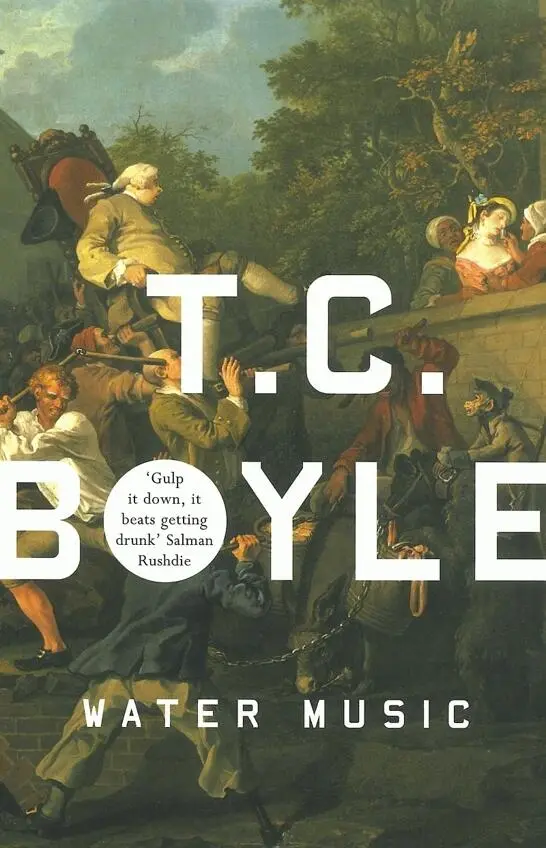
- Название:Water Music
- Автор:
- Издательство:Granta Books
- Жанр:
- Год:1983
- ISBN:9781862071551
- Рейтинг книги:3 / 5. Голосов: 1
-
Избранное:Добавить в избранное
- Отзывы:
-
Ваша оценка:
Water Music: краткое содержание, описание и аннотация
Предлагаем к чтению аннотацию, описание, краткое содержание или предисловие (зависит от того, что написал сам автор книги «Water Music»). Если вы не нашли необходимую информацию о книге — напишите в комментариях, мы постараемся отыскать её.
Water Music — читать онлайн бесплатно полную книгу (весь текст) целиком
Ниже представлен текст книги, разбитый по страницам. Система сохранения места последней прочитанной страницы, позволяет с удобством читать онлайн бесплатно книгу «Water Music», без необходимости каждый раз заново искать на чём Вы остановились. Поставьте закладку, и сможете в любой момент перейти на страницу, на которой закончили чтение.
Интервал:
Закладка:
Mungo knows one thing only: that they must avoid Kabara at all costs. Timbuctoo is the nexus of the Moorish trade, the hub that links Sahara, Sahel and Sudan. If they’ll resist him anywhere, they’ll resist him here. He turns his back on Amadi in disgust and orders the men to their paddles, snatching the tiller from Ned Rise and swinging the canoe round 180°. “Dig!” he exhorts through his clenched teeth, and slowly, painfully, the overloaded Joliba begins to crawl upstream. After an hour, however, Kabara is still in sight, the men are sapped, and the canoe, at full steam, can merely hang in the current like an obstruction. M’Keal is the first to see the futility of it. “Cor, Cap’n,” he calls over his shoulder to where the explorer sits at the tiller, “you expects us to ‘old the barge ‘ere till Gabriel blows ‘is trumpet or wot?” The old soldier’s words chuff from his lips: he’s breathing hard, his hands tremble at the paddle, he glows with his own juices like a suckling pig over the spit. Mungo considers a moment, and then, hardening as he had on Lake Dibbie, he pulls the tiller full right and the Joliba swings back round on Kabara. “Prepare to repel any boat that approaches within fifty yards,” he hisses. Bluebeard couldn’t have put it any better.
This time, canoes do come out to intercept them. Long, whippet-like dugouts full of irate Mussulmen, Mussulmen who want to behead and dismember Nazarini for the glory of Allah, to avenge the failure at Sansanding and the slaughter on Dibbie, to reassert their born and sworn right to a trade monopoly and to sorely chastise these whey-faced infidels who have neither asked nor paid for the privilege of traversing their borders. Hopping mad, the Moors fill eighteen canoes with beards, teeth and spears.
What the Moors lack, however, is firepower. Though their canoes, craftily piloted by Somonies and riparian Soorka, fan out to converge on the Joliba from all directions, they are unable to make even the darkest of dark-horse approaches to spearchucking range. Mungo and his boys, each armed with fifteen single-shot muskets, are blazing away like an army, sending a screaming sheet of lead out over the water to strip the flesh from Moorish bones and convert jubbahs to perforated winding sheets. Cursing through their beards, the Moors retire from the field and the Joliba whirls on down the river, uncontested.
♦ ♦ ♦
A week later the explorer observes that while they have passed Timbuctoo, they are still heading north — into the desert. The riverine vegetation, always lush, has begun to thin out a bit, and beyond the trees the hills are sparse and arid, prickling with euphorbia, desert rose and whistling thorn. The heat is profound, appalling, all-consuming. There is no escape from it. Beneath the canopy, as enervated as gutshot survivors of Austerlitz, Martyn and M’Keal play cards, doze, sip fou from a gourd, occasionally snaking out a hand to splash their shirts and faces with tepid river water. Ned Rise has erected a sunscreen over the tiller, and Amadi and his men, stripped to loincloths, squat in the shade of the canopy, rolling their bones and counting up their cowries. There is no thought of swimming. Not when crocodiles — some of them half as long as the boat — line the bank like spectators at a parade, or river horses beat the surface to a froth with a thundering, sucking, splashing display of pique or playfulness or whatever.
The sun rises and sets, time uncharted and undocumented, days strung together until another week is gone and still the river carries them north. There is no more beer or fruit or butter or bread, and the men are grumbling over a diet of salt beef, rice, yams and onions. Mungo looks at his compass forty times a day. He is concerned. So is Ned Rise. Ned questions the explorer, the explorer questions Amadi, Amadi shrugs. The suspense is killing. Not to mention the heat, the boredom, the doomed hopeless stir-craziness of men eternally at sea. This is what Columbus must have felt like, teetering on the rim of the world.
At a place identified by Amadi as Gouroumo, seven canoes dart out in pursuit of them, and the men, stripped down to shorts now like Amadi and his slaves, snap out of their lethargy long enough to pot a few luckless natives and strike terror in the hearts of the rest. Given the sameness of their days, given the boredom, the exercise is almost welcome, it is almost fun. What else have they got to do but lie around and sizzle like so many strips of bacon? Besides, cutting down the odd nigger or two keeps the old reflexes honed, steadies the hand and sharpens the eye against the day when some real trouble crops up. And it’s not as if they were going out of their way to pick a fight or anything. No, these naked cannibals put out after them like crocodiles, just drooling for the chance to pop a white man in the pot. After all the black crow they’ve been eating, it’d probably be like veal or something.
The explorer doesn’t like it. The people who attacked him at Gouroumo were negroes, and he’s got no quarrel with negroes. But they really leave him little choice. Whether they’ve been put up to it by the Moors, or whether they’re rankled because he hasn’t followed protocol with regard to gifts and permissions, he can’t say. All he knows is that they come out on the attack like a prizefighter lurching out of his corner, belligerent and determined, all he knows is that they want to stop him. And once he stops, he’s at their mercy. He can picture them rifling his stores, breathing in his face, punching at his breastbone with their blunt cracked forefingers, all the while chattering away in some muddled troglodytic language that’s like a barnyard flatulence, like pigs wheezing and kine passing wind. They could extort food and weapons, they could rob him, burn his notebooks, hand him over to the Moors. The thought of it throws a switch in his mind, case closed. Negroes will die, but he will not stop, come hell or high water. Repercussions be damned.
Unfortunately, the repercussions come sooner than he might have imagined, and in the form of canoes — sixty of them — just off a place called Gotoijege. It is late in the afternoon, two days after the incident at Gouroumo, and the Joliba is hugging a sheer rock wall that juts out into the river like a crooked elbow. Everything is still, stultified by the heat. The men are drowsing, caloric waves ripple over the rocky promontory, a lone vulture rides the convection currents high overhead. Gradually, like a waterborne leaf or twig, the Joliba works its way around the point and into the open river beyond. It is at this juncture that the explorer has his first intimation that all is not well: there seems to be something out there, obscured in the deep shadow of the promontory. Half a second later, which is to say half a second too late, he gets the picture.
It is a trap.
So many canoes crowd the cove it looks like a logjam. Up ahead, stretched across the river like a Stone Age armada, twenty more canoes hold the current. Hundreds of angry black faces, painted in various configurations of doom. Bulging black arms at the paddles, grids of swollen black vein and flexed muscle, flinty black hands clenched round bows and quivers, the nasty tapered shafts of long-nosed spears. No doubt about it: the word is out. Someone has let these people know that there are white men on the river, strange pale ghostly creatures running amok, creating havoc, murdering tribesmen up and down the shoreline, refusing to pay tolls or tribute or even to prostrate themselves before the high and mighty, the lordly and god-chosen, to plead for permission to pass through tribal lands. White men, begging to be chastised.
Suddenly, with a shout that could bring down all the snowfields in the Alps, the tableau erupts in violence. Where an instant before there had been sun and silence and the slow drowse of the drifting boat, there is now a frenetic seething wash of hostile humanity up and down both banks of the river. The promontory behind them is like a trampled anthill, swarming with stirred-up naked savages yabbering threats and insults and jabbing their pigstickers at the sky. Troops of women have emerged from nowhere, big-boned and bottom-heavy, cutting the air with calliope shrieks and pounding at great booming kettle drums as if they were flailing the hides of hapless explorers. Men and boys — hundreds of them — rush to the water’s edge flinging spears and stones and flaming torches, riddling the ship with poisoned arrows and crude iron knives. At the same time the canoes shoot into action, slipping behind the Joliba as snugly as shadows, big black athletes at the paddles, painted warriors crouching down behind them to hone their spears and limber up their thrusting muscles. And all of them — men, women, children, paddlers, thrusters, bowmen, spearchuckers and chiefs— hooting like butchers on a three-day drunk.
Читать дальшеИнтервал:
Закладка:
Похожие книги на «Water Music»
Представляем Вашему вниманию похожие книги на «Water Music» списком для выбора. Мы отобрали схожую по названию и смыслу литературу в надежде предоставить читателям больше вариантов отыскать новые, интересные, ещё непрочитанные произведения.









Обсуждение, отзывы о книге «Water Music» и просто собственные мнения читателей. Оставьте ваши комментарии, напишите, что Вы думаете о произведении, его смысле или главных героях. Укажите что конкретно понравилось, а что нет, и почему Вы так считаете.