T. Boyle - Water Music
Здесь есть возможность читать онлайн «T. Boyle - Water Music» весь текст электронной книги совершенно бесплатно (целиком полную версию без сокращений). В некоторых случаях можно слушать аудио, скачать через торрент в формате fb2 и присутствует краткое содержание. Год выпуска: 1983, ISBN: 1983, Издательство: Granta Books, Жанр: Современная проза, на английском языке. Описание произведения, (предисловие) а так же отзывы посетителей доступны на портале библиотеки ЛибКат.
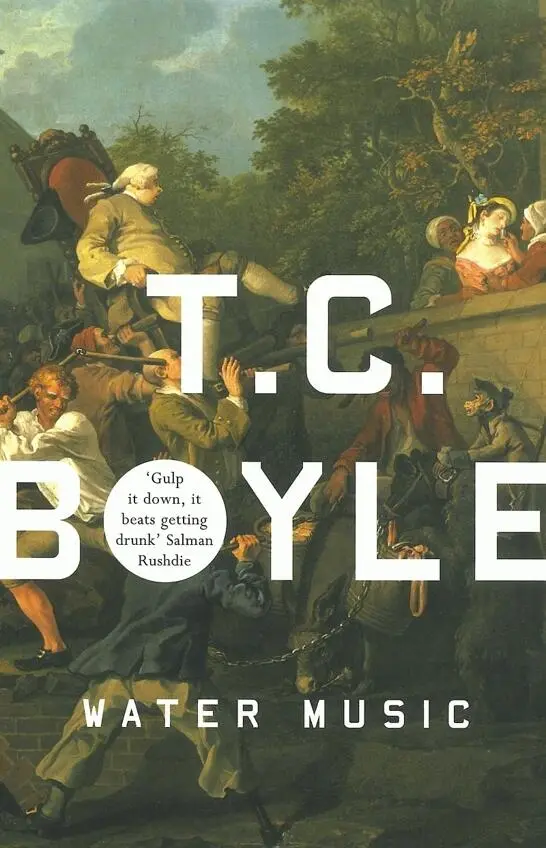
- Название:Water Music
- Автор:
- Издательство:Granta Books
- Жанр:
- Год:1983
- ISBN:9781862071551
- Рейтинг книги:3 / 5. Голосов: 1
-
Избранное:Добавить в избранное
- Отзывы:
-
Ваша оценка:
Water Music: краткое содержание, описание и аннотация
Предлагаем к чтению аннотацию, описание, краткое содержание или предисловие (зависит от того, что написал сам автор книги «Water Music»). Если вы не нашли необходимую информацию о книге — напишите в комментариях, мы постараемся отыскать её.
Water Music — читать онлайн бесплатно полную книгу (весь текст) целиком
Ниже представлен текст книги, разбитый по страницам. Система сохранения места последней прочитанной страницы, позволяет с удобством читать онлайн бесплатно книгу «Water Music», без необходимости каждый раз заново искать на чём Вы остановились. Поставьте закладку, и сможете в любой момент перейти на страницу, на которой закончили чтение.
Интервал:
Закладка:
It was obvious to Johnson that the man was a backstabber and a cheat, quite possibly a murderer, and certainly a consort of the Moors. But no matter what he said, the explorer dismissed it. “You’re jealous, that’s all,” Mungo said, “because Amadi Fatoumi’s half your age and he knows twice as much. He can speak Maniana, Hausa, Tuareg and Arabic, and he’s been to Timbuctoo and back.”
Now, at the eleventh hour, the red-faced explorer trembling before him as if he were ready to grapple to the death, Johnson felt it useless to press his case, useless to point out that his informants had told him that Amadi had been raised as a slave of the Il Braken tribe, had stabbed a man over a game of quoits and had cheated three quarters of the merchants in Sansanding. No, Mungo was half-sick with guilt and fear and uncertainty, and he clung to Amadi Fatoumi and his putative knowledge as he might have clung to a lifebuoy in a rough sea. There was no sense in arguing: Johnson could only plead. “Don’t go,” he said.
Mungo looked as if he were on the verge of a seizure. “Why the bloody hell not?” he roared.
Johnson took his arm, but Mungo jerked away and turned his back. “All right,” Johnson said. “Don’t go because I care about your pigheaded bones, don’t go because you won’t come back. Remember Eboe?”
Mungo whirled round as if he’d been stung. There was a look of pain and bewilderment on his face, a look of terror.
“Remember?” Johnson repeated. “And how about that old blind lady — the one at Silla — the one that sniffed the white man’s smell of you and took hold of your hair? You remember what she said?”
He remembered. Johnson could see it in his face. The old woman had paused and turned her dead eyes to him, muttering the name of a far-off place, a name that hung on her lips like the secret name of the devil, a strange barbaric incantatory name: Boussa. Beware of Boussa , she’d croaked. Beware .
Mungo’s face drained. For a long while he stood there facing Johnson, his arms raised, as if he were fighting some sort of ritual duel with him. Finally his lips began to move, in silence, as if he were praying.
“Don’t go,” Johnson repeated, and the spell was broken. Mungo’s face contorted, ugly as a mask. Quick and violent, he took hold of Johnson’s toga, bunching it under his chin and forcing his head back. “Traitor!” he shouted. “Filth, scum. You’re the one who’s evil, you’re the one who’s out to undermine me — not Amadi Fatoumi.” Then, with a single explosive thrust of his arm, he shoved the older man down in the dirt. “Get out!” he screamed, his voice broken with rage. “Get out, nigger!”
Johnson’s face showed nothing. He pushed himself up, brushed off his toga, and stepped out of Mungo Park’s life. Forever.
♦ BON VOYAGE ♦
Somewhere a cock is crowing and a muezzin yodeling out the morning prayers. There is the scrape and shuffle of sandals outside the tent as townswomen bend to collect dung for their breakfast fires, and from the wild tangle of bush at river’s edge, birdsong. Already, with the first light, a fierce parching heat has set in, and the tumescent air pours over the explorer as if it were slag. Wearily, with a puff of resignation, he rises from his sweaty blankets and head-splitting dreams to stagger outside and micturate against a wall of baked clay. Overnight the weather has changed, the seasons turned: just after midnight the wind shifted to the north and the harmattan began to hiss in off the great desert, bringing with it a feeling of enervation and depression that settles over him like a lead blanket. Standing there, half-awake, pud in hand, he feels washed out and hungover, though he hasn’t touched a drop in weeks.
The dark stain blossoms against the pale wall, now a winged dragon, now the head of a stag, and he is staring down at it in dull fascination when he suddenly becomes aware of a presence at his back, the muted sounds of foot shuffling and throat clearing. Turning his head with the slow abstraction of a sleepwalker, he discovers that the remnant of his army is lined up behind him, in rough formation, their tattered uniforms glowing in the pale light. Martyn and M’Keal, Ned Rise, Fred Frair and Abraham Bolton. Their bags are at their feet, muskets in hand. Behind them, Amadi Fatoumi and his three villainous-looking slaves, dressed in jubbah and tagilmust , like Moors. Looking over his shoulder he sees that all nine men are staring at him, silent, respectful, as if peeing against a wall in his underwear were comparable to consecrating the host or changing water to wine.
“Captain, Sir,” Martyn barks, breaking the silence. “The crew of the Joliba , reporting for duty as ordered.”
Of course. This is the morning of their departure, the morning they cast their fate to the wind — or rather the water. Yes, in the moment of waking it nearly slipped his mind, the air so heavy and oppressive, a touch of the fever creeping up on him again: yes, of course. The great adventure begins anew!
“All right, Leftenant,” Mungo croaks, tucking himself in and swinging round on his men. “Break down this tent, stow away my gear and prepare to shove off.” Woozy on his feet and bleary of eye, he scans the frightened, hopeful faces of the men and wants to tell them it’ll be all right, that the Niger doesn’t dry up in the middle of the desert or end in Lake Chad, that from here on in it’s smooth sailing. But he can’t. Because for all his hopes and prayers, suppositions and gut feelings, he can’t be sure that he isn’t leading them to a watery death in the godforsaken omphalos of a godforsaken continent. All he can add, by way of inspiration and comfort is a supererogatory order: “And be quick about it.”
♦ ♦ ♦
Unbeknownst to explorer, guide or crew, the hills outside Sansanding are at that very moment thundering with the sound of hoofbeats: the harmattan wind is not the only thing rumbling down out of the north. No: Dassoud, Scourge of the Sahel, is on his way into town with twelve hundred wild-eyed horsemen burning to engage the white men’s army. His intention is to hack the Nazarini to pieces — no matter how many they are or how well armed — and to impale Mungo Park’s head on the tip of his spear as an offering to his lady, Fatima of Jafnoo.
Dassoud, it will be observed, is some two and a half months behind schedule with his current campaign. He had planned to annihilate the explorer before the month of September was out, but during the long dilatory days of late September, October and early November, he came to discover that he was not quite the scourge he thought himself to be. The root of his troubles lay in internecine squabbling between the various tribes under his leadership. Though fanned to frenzy by the explorer’s letter and the intentions expressed in it, they were nonetheless reluctant to unite under Dassoud’s banner — or anyone’s for that matter. It was as simple as this: the timing was bad.
First, a blood feud had erupted between the Trasart and the Al-Mu’ta of Jafnoo. Mubarak of the Trasart had executed three of Boo Khaloom’s serfs for poaching at one of his wells; in retaliation, Boo Khaloom himself stole into the Trasart camp, pissed in Mubarak’s porridge and made off with his prize charger, which he held for ransom. After the ransom was paid in full, Boo Khaloom sent the horse back — in eight pieces, each neatly bundled in goat hide. Meanwhile, Mahmud Bari of the Il Braken had forgotten his chastising at the hands of Dassoud, and refused to participate in the jihad against the Nazarini unless he himself were to lead it. Exasperated, Dassoud was forced to waste two precious weeks in riding out to Gedumah, splitting Mahmud Bari open like a sausage and quelling the incipient rebellion. And then, as if this weren’t enough, the Foulahs chose that precise moment for a sneak attack on Jafnoo.
Читать дальшеИнтервал:
Закладка:
Похожие книги на «Water Music»
Представляем Вашему вниманию похожие книги на «Water Music» списком для выбора. Мы отобрали схожую по названию и смыслу литературу в надежде предоставить читателям больше вариантов отыскать новые, интересные, ещё непрочитанные произведения.












Обсуждение, отзывы о книге «Water Music» и просто собственные мнения читателей. Оставьте ваши комментарии, напишите, что Вы думаете о произведении, его смысле или главных героях. Укажите что конкретно понравилось, а что нет, и почему Вы так считаете.