T. Boyle - Water Music
Здесь есть возможность читать онлайн «T. Boyle - Water Music» весь текст электронной книги совершенно бесплатно (целиком полную версию без сокращений). В некоторых случаях можно слушать аудио, скачать через торрент в формате fb2 и присутствует краткое содержание. Год выпуска: 1983, ISBN: 1983, Издательство: Granta Books, Жанр: Современная проза, на английском языке. Описание произведения, (предисловие) а так же отзывы посетителей доступны на портале библиотеки ЛибКат.
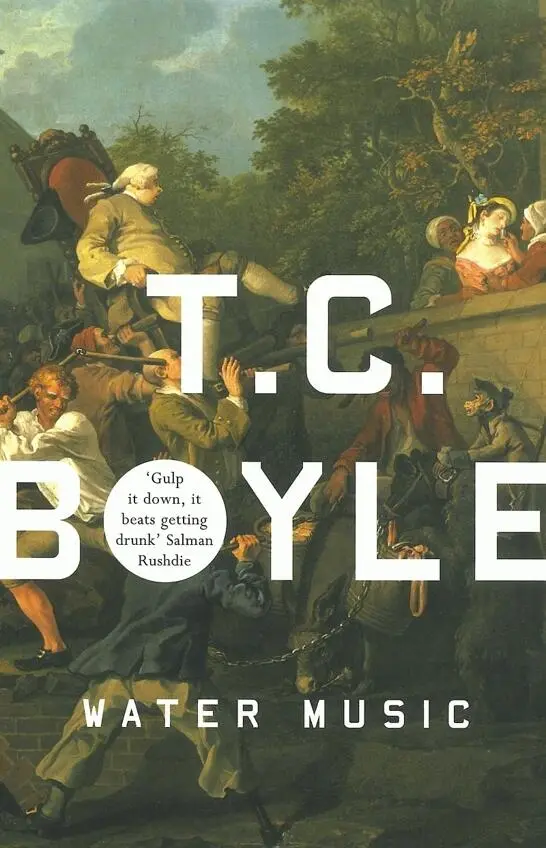
- Название:Water Music
- Автор:
- Издательство:Granta Books
- Жанр:
- Год:1983
- ISBN:9781862071551
- Рейтинг книги:3 / 5. Голосов: 1
-
Избранное:Добавить в избранное
- Отзывы:
-
Ваша оценка:
Water Music: краткое содержание, описание и аннотация
Предлагаем к чтению аннотацию, описание, краткое содержание или предисловие (зависит от того, что написал сам автор книги «Water Music»). Если вы не нашли необходимую информацию о книге — напишите в комментариях, мы постараемся отыскать её.
Water Music — читать онлайн бесплатно полную книгу (весь текст) целиком
Ниже представлен текст книги, разбитый по страницам. Система сохранения места последней прочитанной страницы, позволяет с удобством читать онлайн бесплатно книгу «Water Music», без необходимости каждый раз заново искать на чём Вы остановились. Поставьте закладку, и сможете в любой момент перейти на страницу, на которой закончили чтение.
Интервал:
Закладка:
And then, at Sansanding, he would greet Mungo Park once again.
♦ SANSANDING ♦
There are faces in the night, grimacing, leering, the faces of naked savages with serpent coils for hair, staring eyes and filed teeth. They close in on him, incisors champing with a hiss, there’s a wild shout, spears and stones and poison-tipped arrows raining down, the suck of the current, the roar of the rocks. . and he wakes, sweating, beneath the fine mesh of mosquito netting and a splash of stars. The explorer is at Sansanding, and he has been delirious on and off for a fortnight, a month — who knows? There was the death of Zander — yes, that set it off — and then the letter to Mansong. Beyond that, he can’t remember what was real and what phantasmagoric, what occurred in the eyes and memories of other men and what transpired only in his own. There was something with Jemmie Bird, something bad, an argument with Johnson, a period of drifting, floating on the river, it seemed, and then the whirling scents and colors of the marketplace at Sansanding and Mansong’s delay about providing a canoe. Yes, the fever subsiding, it begins to come back to him.
♦ ♦ ♦
Walls collapsed and volcanoes erupted the night Zander died. The sky split asunder and the earth lashed to and fro like a runaway wagon, pitching and lurching until the explorer had to get down on his knees and turn his intestines inside out. He retched, eyes tearing, a torrent of rice, tamarind, half-digested fish and bitter yellow bile spewing from his lips, while Zander lay there on his litter, dead. Mungo cursed. Bit his tongue. Pounded the dirt floor with his fists. When the earth finally stopped trembling he found that he couldn’t get up, there was no strength in his arms, his legs had gone dead — he was like an ocean-run salmon that frantically lashes its way up the Yarrow, impelled by some ancient implacable force, leap after coruscating leap, only to flounder in a shallow pool, its back out of water, tail twitching feebly. He was spent.
The night wore on. There was a cry like that of a nightjar, the sound of rushing wings. Why was he beating his way up the Niger? he asked himself. Why was he risking life, taking life? What kind of man was he, Mungo Park, to drag a narrow-shouldered little parlor-sitter like Zander out into the teeth of the wilderness? To desert a wife and four children? To lead thirty-six men to their deaths and blow a cringing old negro to Kingdom Come as if he were nothing more than an insect or toad? What had he come to? The answer was something he didn’t want to face. Not now. Not ever. At dawn, he pushed himself up and uncorked a keg of rum.
He was drunk for three days. Blind drunk. Johnson took charge in the interval, arranging for Zander’s burial, organizing the equipment for the trip to Sansanding, dispatching Serenummo and Dosita Sanoo with the letter for Mansong. When Mungo finally came around, he found himself in a pirogue, stretched out like a Viking on his way to Valhalla. It was night, starless and black as the void. He heard the swish of the paddles, a low murmur of voices. He heard the hooting and buzzing and gibbering of night things, a sound that rose in volume until it was as loud and undifferentiated as the boom of a heavy surf, and then he saw shapes in the night, faces and colors, animals with the heads of eagles and tails of serpents, and he knew the fever was on him. He’d been miraculously spared during the overland trek, but now, what with the drinking bout and the night he’d spent on the damp ground, it had stolen a march on him. Suddenly he sat up in the dark. “Zander!” he cried. “Johnson!”
A warm hand spread itself across his chest. “It’s all right, Mr. Park. A touch of the fever, that’s all. You on the river now. Hear it?”
He heard it. But he couldn’t just lie there — he was head of this expedition, after all. He had to get up and lead his men, steer the canoes, spy out the landfalls and come up with names for all the salient geographical features. There were maps to be drawn up, whole regions to be charted, botanical specimens to be plucked and dried.
The hand lay on his chest like an enormous weight. It was pushing him down, firm and persuasive. “Lie back, Mr. Park — everything’s under control,” Johnson whispered. “We hit Sansanding in the morning.”
What? Come into Sansanding flat out on his back? Never. Fever or no fever. Zander or no Zander, he had to get up and lead his men. He slapped the hand away like an irate child and jerked himself clumsily to his feet amid a tumult of cries, fore and aft. He heard the squawk of a startled bird somewhere up ahead, and then the canoe was lurching violently, left, right, left again, and he was pitched headlong into the inky soup of the night and the cold quick fastness of the Niger.
There were shouts and curses, some in English and some in the Somonie dialect of the boat people. The canoe in which Mungo had awakened was twenty-five feet long. It had contained bundles of equipment, two Somonies, Johnson, Ned Rise and Jemmie Bird. When it capsized, passengers and boatmen alike were flipped into the river. Jemmie, who had lashed himself to the cookpots, floated briefly, buoyed up by the big iron cauldrons; when moments later they tipped and filled with water, he sank like a stone. Ned, meanwhile, had managed to get hold of the explorer’s shirt collar and dog-paddle him toward the denser blackness of the shoreline. Johnson, floundering, happened by purest chance to blunder into the canoe, and hang on while it spun downriver, the sopping Somonies attempting to swim it ashore.
An hour later, the whole thing was history. The other canoes had converged on the spot with a torch, and had picked up the floating paddles. The canoe was steered to shore and righted, the explorer and Ned Rise located by means of hoots and whistles, and the equipment — which had been firmly lashed round the hull of the canoe — saved. Two kegs of gunpowder were ruined by the soaking, and a sack of rice had split. As for Jemmie Bird, he too was history.
♦ ♦ ♦
At Sansanding, the explorer was alternately lucid and delirious. Against Johnson’s advice, he set up a stall in the marketplace — the Mussulmen gathered around like dogs, snarling and baying, shouting about infidels, white demons and cut-rate prices — and sold off nearly all the excess beads, baft and baubles. The proceeds went into purchasing provisions for the great voyage downstream to the ocean. These mounted steadily in the dark recesses of the explorer’s hut, guerbas of beer and calabashes of palm wine, chickens in wicker baskets, strings of onions, desiccated fish, eggs, yams, millet and maize. Bundles of dried figs peeked out from beneath his pillow and lumps of goat cheese depended from the ceiling struts, redolent as an entire regiment’s unwashed socks. There was something in that smell that cleared his head, and waking in the midst of it one morning, the explorer shook off the fever long enough to write Mansong again, begging for his help in coming up with a seaworthy craft. The Munificent One’s response was ambiguous. The King smiles upon your enterprise, his messenger said, and will protect you as Mansong’s strangers in all territories under his jurisdiction, from west to east. But you must wait until the annual sacrifice to Chakalla before he can do anything for you. Wait, the messenger repeated, and Mansong will see that you are taken care of.
Mungo waited.
The days fell together, end to end, like dominoes. It was October already, and the rains had begun to slacken. Time was wasting. Finally, after repeated attempts to impress Mansong with the urgency of his request, the explorer decided to act on his own, and sent Johnson and Ned Rise down to the river to purchase the largest canoe they could find. But no one, it seemed, would provide them with a means of leaving the country unless Mansong himself gave the word. Johnson held up clicking sacks of cowries — a king’s ransom — but the boatmen just ducked their heads and looked away.
Читать дальшеИнтервал:
Закладка:
Похожие книги на «Water Music»
Представляем Вашему вниманию похожие книги на «Water Music» списком для выбора. Мы отобрали схожую по названию и смыслу литературу в надежде предоставить читателям больше вариантов отыскать новые, интересные, ещё непрочитанные произведения.



Обсуждение, отзывы о книге «Water Music» и просто собственные мнения читателей. Оставьте ваши комментарии, напишите, что Вы думаете о произведении, его смысле или главных героях. Укажите что конкретно понравилось, а что нет, и почему Вы так считаете.