T. Boyle - Water Music
Здесь есть возможность читать онлайн «T. Boyle - Water Music» весь текст электронной книги совершенно бесплатно (целиком полную версию без сокращений). В некоторых случаях можно слушать аудио, скачать через торрент в формате fb2 и присутствует краткое содержание. Год выпуска: 1983, ISBN: 1983, Издательство: Granta Books, Жанр: Современная проза, на английском языке. Описание произведения, (предисловие) а так же отзывы посетителей доступны на портале библиотеки ЛибКат.
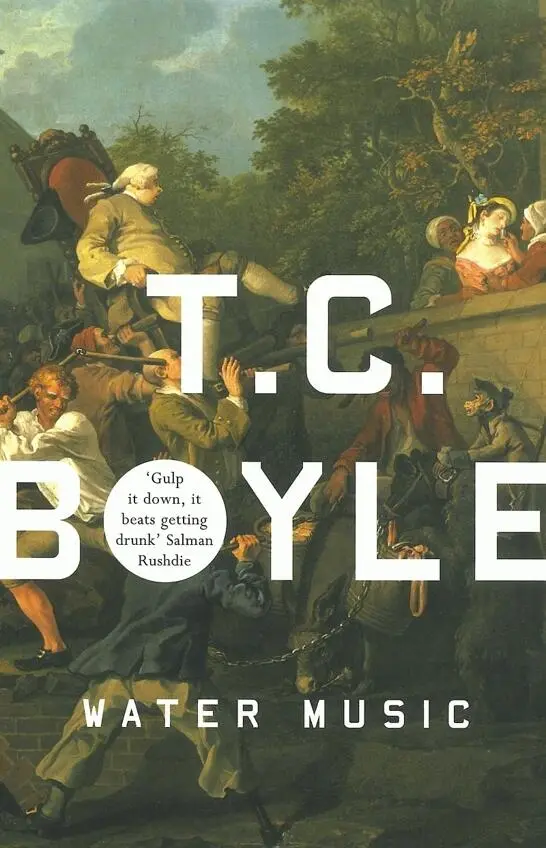
- Название:Water Music
- Автор:
- Издательство:Granta Books
- Жанр:
- Год:1983
- ISBN:9781862071551
- Рейтинг книги:3 / 5. Голосов: 1
-
Избранное:Добавить в избранное
- Отзывы:
-
Ваша оценка:
Water Music: краткое содержание, описание и аннотация
Предлагаем к чтению аннотацию, описание, краткое содержание или предисловие (зависит от того, что написал сам автор книги «Water Music»). Если вы не нашли необходимую информацию о книге — напишите в комментариях, мы постараемся отыскать её.
Water Music — читать онлайн бесплатно полную книгу (весь текст) целиком
Ниже представлен текст книги, разбитый по страницам. Система сохранения места последней прочитанной страницы, позволяет с удобством читать онлайн бесплатно книгу «Water Music», без необходимости каждый раз заново искать на чём Вы остановились. Поставьте закладку, и сможете в любой момент перейти на страницу, на которой закончили чтение.
Интервал:
Закладка:
♦ ♦ ♦
Now, the rain lashing at the walls of the tent like a Biblical plague, his guts turned to ice and his face on fire, he lies back on a sweat-soaked litter suspended between a pair of battered crates while a raven caws in the distance and black beetles crawl up his legs and whir in his face. He is dying. Sapped, wasted, down to just over a hundred pounds, he cannot — will not — go on. In disgrace, he’s allowed himself to be carried— carried like a woman or child — by men nearly as weak as he. Mungo has dosed him with calomel, let blood, hunted up snakes and tiny antelope and eyeless white grubs the size of a man’s forearm so that he could have fresh meat. All to no avail. He is dying. And glad of it.
Suddenly the flap swishes back and Mungo slips into the tent. His eyes are pits of concern, raw with doubt and worry, his face as gaunt and yellow as a deflated football. A drop of water clings to the tip of his nose. “How you feeling?” he asks.
Zander wants to lift his own weight from the explorer’s shoulders, wants to lie to him and say It’s all right — don’t you worry about me. But he can’t. When he opens his mouth to release the words there’s nothing there, no sound at all.
Mungo isn’t listening for the reply. He strides across the room, turns his back and shrugs out of the drenched greatcoat, then flings himself down on a crate beside his bed. There’s a whiff of sulfur as he lights a tallow candle, and then the rustle of paper. A moment later he’s scribbling away in his notebook with an almost frantic urgency, as if the act of putting words on paper could soften a blow or breathe life into a corpse.
Outside, the rain-slick village of Bambakoo bows under the weight of the deluge: tamarind, mahogany, fig, a freckling of bright tropical birds in a huddled wall of green. Beyond the glistening huts and thick cluster of riverine forest, the Niger punishes its banks, flaying the earth to its metamorphic bones, vocalizing its authority, swishing and sucking as it drinks in the rainfall like a bottomless hole. Zander can hear it from his bed, rain falling in the hills behind him, rushing past the tent in a throbbing network of brown tentacles, driving, caroming, leaping, until finally it breaks through to enlist in the stream for the long inexorable drive to the sea.
“It’s a pity,” Mungo is saying over his shoulder. “The loss of life, I mean. If I had it to do over I wouldn’t leave England till I was damned good and sure the rains were finished down here.” He pauses, the quill pen scratching away in the interlude. “It was the weather that did it — no doubt about it. We Scots and English just don’t have the constitution to take all this rotten air, this constant soaking, this—” He throws the pen down and presses his fingers to his eyes. Back turned, he begins again, his words choked with pain and disappointment, some fresh piece of bad news sticking in his teeth like gristle. “I may as well tell you now,” he groans, swinging round in his seat. “Scott’s dead. He—” The explorer glances up at his brother-in-law and then turns away again, as if ashamed to look him in the eye. “He gave in to the fever two nights ago. The Dooty just sent word by special messenger.”
Zander says nothing in response. He’s having trouble keeping his eyes open, and he can’t quite catch his breath. It’s like the first time he went into a football match at school and found himself in the dirt, his senses jarred, the wind knocked out of him.
There is a moment of silence, lingering and dull, underscored by the background hiss of the rain and the roar of the Niger. “Zander?” Mungo says. And then, almost a bark: “Zander!”
He’s there in a flash, leaping across the room and snatching at his brother-in-law’s wrist as if to prevent him from slipping over the edge of a precipice. The pulse is nothing, as faint and intermittent as the rattle of a broken pocketwatch. Panicked, the explorer grabs him up in his arms — a bundle of sticks in a sack — and fumbles a vinegar-soaked rag to his nostrils. Zander’s eyes flutter twice, the irises fixed under the upper lids as if staring back into themselves. There’s a red welt on his throat, and a cold flat pallor has crept into his face.
Dying, he looks like Ailie.
♦ THE END OF THE ROPE ♦
The Spanish use a single verb, esperar , to express both waiting and hoping. So too in English: there is no wait without expectation. One waits for spring, a table, death.
wait, to stay in a place or remain inactive or
in anticipation until something expected
takes place.
Ailie is waiting. Staying in Selkirk, at her father’s house, remaining inactive and expecting — what? The letter that tells her to wait no more, that she’ll never see husband or brother again? Or the hastily scrawled missive bringing news of Mungo’s reemergence on the coast of Africa, alive and well and embarking that day, a hero a thousand times over? Neither. Both. At this point she hardly cares: she’s at the end of her rope. All her life she’s waited for Mungo, waited for him to finish school, come home from Djakarta, Africa, London. She can wait no more. Really, sincerely, she’d rather know that they were dead — he and Zander both — than to live in this limbo of suspense, in this agony of living for someone else, out of one’s body, drawing each breath, day by day, in morbid anticipation of events in a place so distant it could be mythical.
She’s had three letters. One from Zander, addressed at Goree, and two from Mungo, addressed respectively from the Cape Verde Islands and Pisania. The Pisania letter came last week. It lay flat as a dagger in the postman’s palm, and the sight of it, sharp-edged and white, nearly cut her heart out. She thrust the envelope into her bag and hurried up the street in a nervous little jog trot, blood singing in her ears. She went through the front gate in a daze, the stairs echoed under her feet with a hundred insinuating creaks and groans, and then she was alone in her room. For a long while she just sat there at the edge of her bed studying the familiar handwriting scrawled across the envelope, fighting the impulse to chuck the whole thing in the fire. A quarter of an hour passed. And then, calm and deliberate as the tax collector, she slit the envelope with a paper knife and extracted the folded letter.
It said nothing.
Like its predecessor it was full of bravado and self-congratulation, talk of sturdy asses and stout-hearted men. He would lay the Niger flat, Mungo would, tape-measure and chart it end to end and be home in plenty of time to carve the Christmas goose. There were a few words of solicitude for her and the children toward the end. He hoped that the new baby was healthy and happy and that it was a boy. The letter was dated April 29: nearly five months ago.
She is waiting for another. She is waiting for Mungo to come back to her. She is waiting to resume her life. In the meantime, there are the children. Thomas, child of the century, is five, Archibald, born in April, has been weaned to applesauce and oatmeal mush. Together with Mungo junior and little Euphemia, they raise a persistent whining clamor that either soothes her with its substance and immediacy or drives her to distraction, depending on her mood. She hasn’t touched her microscope since spring. She is bored. It’s the same old story.
With one exception: Georgie Gleg. He spent the summer at Galashiels, away from the university and his practice. Each day he called on her in Selkirk with some offering, a bundle of flowers, box of sweetmeats, a three-volume novel. He took her out into the country in his carriage, brought her to dinner at what was left of the family estate at Galashiels. He entertained her. Distracted her from her brooding, her waiting, the stark gut-wrenching fears that clouded her days and haunted her nights.
Читать дальшеИнтервал:
Закладка:
Похожие книги на «Water Music»
Представляем Вашему вниманию похожие книги на «Water Music» списком для выбора. Мы отобрали схожую по названию и смыслу литературу в надежде предоставить читателям больше вариантов отыскать новые, интересные, ещё непрочитанные произведения.










Обсуждение, отзывы о книге «Water Music» и просто собственные мнения читателей. Оставьте ваши комментарии, напишите, что Вы думаете о произведении, его смысле или главных героях. Укажите что конкретно понравилось, а что нет, и почему Вы так считаете.