T. Boyle - Water Music
Здесь есть возможность читать онлайн «T. Boyle - Water Music» весь текст электронной книги совершенно бесплатно (целиком полную версию без сокращений). В некоторых случаях можно слушать аудио, скачать через торрент в формате fb2 и присутствует краткое содержание. Год выпуска: 1983, ISBN: 1983, Издательство: Granta Books, Жанр: Современная проза, на английском языке. Описание произведения, (предисловие) а так же отзывы посетителей доступны на портале библиотеки ЛибКат.
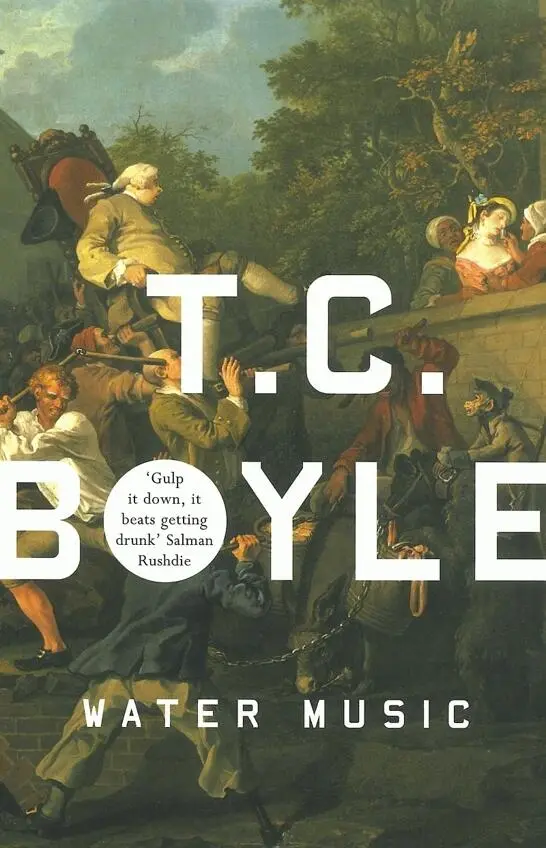
- Название:Water Music
- Автор:
- Издательство:Granta Books
- Жанр:
- Год:1983
- ISBN:9781862071551
- Рейтинг книги:3 / 5. Голосов: 1
-
Избранное:Добавить в избранное
- Отзывы:
-
Ваша оценка:
Water Music: краткое содержание, описание и аннотация
Предлагаем к чтению аннотацию, описание, краткое содержание или предисловие (зависит от того, что написал сам автор книги «Water Music»). Если вы не нашли необходимую информацию о книге — напишите в комментариях, мы постараемся отыскать её.
Water Music — читать онлайн бесплатно полную книгу (весь текст) целиком
Ниже представлен текст книги, разбитый по страницам. Система сохранения места последней прочитанной страницы, позволяет с удобством читать онлайн бесплатно книгу «Water Music», без необходимости каждый раз заново искать на чём Вы остановились. Поставьте закладку, и сможете в любой момент перейти на страницу, на которой закончили чтение.
Интервал:
Закладка:
Johnson — i.e., Isaaco, as he now mysteriously prefers to be called — has proven as invaluable to the current expedition as he was to the first. Devoted, knowledgeable, humble and intelligent, this true-blue African homme des lettres who once plucked cotton in the Carolinas and ministered to Sir Reginald Durfeys’ sartorial needs at Piltdown and in London, has devoted himself heart and soul to extending the boundaries of geographical knowledge, forsaking the comforts of home and family to help us forge a new road from the Gambia to the Niger. Just this morning he appeared outside my tent with the humble but politic suggestion that we send word ahead to Mansong of Bambarra to the effect that we have entered his realm and ask his blessing for our enterprise. “A capital idea!” I cried, and immediately dispatched two of Johnson s black servants for Segu, bearing gifts for Mansong and his son Da, along with a letter detailing our object in once again visiting his country. It is my fervent hope that this munificent potentate will provide us with the vessels to prosecute our endeavor, as without carpenters it may prove ticklish to construct our own craft.
In the meanwhile, I have decided — again at Johnson’s suggestion — to float down the river past Segu to the city of Sansanding (conveyed by a curious tribe who make their living at transporting goods and people to and fro in their dugouts, rather like the gondoliers of Venice), where we would dispose of our trade goods in barter and launch the H.M.S. Joliba for parts unknown. I quite agree with my faithful dragoman that etiquette requires us to bypass Segu, so as not to force ourselves once again on the bountiful and truly Christian charity of Mansong, who was of course so concerned for our first expedition. And while Sansanding is said to be a predominantly Moorish town, we should be able to get a better price there for our wares, and in any case, should be well off in the broad lap of the Niger before the Moors’ ingrained fanaticism and unreasoning prejudices might work us any harm. Once afloat, I have determined to have no truck whatever with the local tribes, in the event that they should prove hostile, especially as we follow the river northward into the heart of the Moorish domain. I shall bargain with no one till we have reached the sea. God willing, the journey will be as tranquil as it is revealing. I have heard no word of the devilish Dassoud. I trust he has long since paid the price for his sins.
River of Mystery, River of Legend, River of Gold! How good it is to be back under its spell, to gaze out over the broad back of its churning waters, to ladle up a long cooling draught of its health and invigoration. Alexander Anderson, my own dear brother-in-law and second in command, seems much heartened by the spectacle of it. This courageous Scotsman, struggling against the effects of the climate and the violent exertions of our march, has stood by me through thick and thin, a comfort and an example. His fever seems much abated, and the healing waters of the Niger have brought such a flush back to his pale cheeks that I find myself thinking invariably of roaring hearths and the brisk gentle snowfalls of the Borderlands. I have every hope of his imminent and complete recovery, and of Mr. Scott’s rejoining us before the week is out. And then, our minds and bodies refreshed, we shall set forth to conquer the Niger.
♦ O THE HEAVY CHANGE ♦
He was a born dreamer. A born fool, his father would have said, a brattlin’ gowk, a randie gangrel, good for nothing but drainin’ whisky bottles and liftin’ a fork to his face. Sent off to school at the age of six, he drew into himself, a devourer of mythologies and travelers’ tales, a solipsist who found refuge from the harsh physical world of boarding school in the soothing pages of a book or a solitary walk through overgrown woods and abandoned churchyards. Home for the holidays, he wandered the hills round Selkirk, a stranger to the crofters’ sons who ignored him in the streets and then called him a snob behind his back. His sister was his only friend.
He was a boy, slight and unathletic, and then he was a man. He hardly noticed the change. It was as rhythmic and unremarkable a process as the movement of the seasons, grass greening, leaves falling, snow, rain, sun, boarding school, public school, university. From the moment his mother left till the day he took his degree at Edinburgh, his existence was calibrated, the path clearly marked, the pace easy, and there was no reason to ask himself what he wanted to do in life — he knew, with the bland assurance of the untried, that whatever it was it would be spectacular.
But then, back under his father’s roof, degree in hand, Alexander Anderson was at a loss. For the first time in his life he was free to make a choice, run where his legs took him, do as he pleased. The responsibility was crushing. Horace, Catullus, Aristotle’s Physiology —what good did they do him now? He didn’t want to go into medicine, despite his father’s pressuring — too belittling, disgusting even. Nor would he practice law or take up the cloth like so many of his unsettled classmates. He toyed briefly with the idea of making a name for himself as a poet — the glorious Southey, intrepid Burns, astonishing Anderson — but gave it up after filling six or seven copybooks with lugubrious, self-pitying tripe after MacKenzie’s The Man of Feeling and coming to realize in an equable and matter-of-fact way that he hadn’t a shred of talent. The military occurred to him next — the flashing red jacket, the drum and fife, bringing the French to their knees and all that — but no, that was where all the athletes wound up — on the battlefield, their heads staved in — and how could he, at five feet four and nine stone on the nose, possibly hope to compete with them?
And so, halfheartedly making the rounds with his father, he stayed on at Selkirk, infused with vague yearnings, bowed down like a snow-covered sapling with anomie and self-contempt, eating and dressing well enough on the interest from his modest trust fund, drinking to kill time, and dreaming, always dreaming.
Then Mungo came home from the Niger, scintillating, heroic, huge with success, and Zander no longer doubted what he would do with his life. There would be a second expedition, and Zander would be part of it. What more daring occupation was there? Not Nelson, not Napoleon himself could match it. The thrill of pitting oneself against the unknown, the delicious risk, the heady exhilaration of victory over nature itself: it was too good to be true. How could he have thought of anything else these past few years? Of course, he thought to himself, of course, the idea of it sprouting in him like a tough clinging vine, like ivy, burgeoning till it sought out and filled every crack and crevice of his being. He would wade through bogs, hack his way through scrub and nettle, scouting out the trail for his brother-in-law, small and quick and lithe, probing at all the deep-buried secrets of the Dark Continent. It was a revelation. Alexander Anderson, explorer. This is what he’d been saving himself for.
Little did he realize he would have to wait seven years for his chance.
Seven long torturous years, years that wore on him like an indeterminate prison sentence, no time off for good behavior. He killed time with drink, riding, a flirtation here and there. He hunted, smoked cigars, took up boxing to build his endurance. And he shadowed Mungo. Made him repeat his stories over and over till he could quote them word for word, till they ran through his head like the stuff of legend. He puttered away at the only trade he knew — doctoring — as a way of distracting himself from this thing that had become an obsession. At night, or on the long gray afternoons when he couldn’t muster the energy to lance a boil or apply a clyster, he devoured everything available on the subject of Africa and exploration. He read Moore and Bruce and Leo Africanus; he wore out three copies of his brother-in-law’s Travels , carrying a battered volume with him at all times, muttering over the dog-eared pages, quoting it to startled patients and half-witted farmers as if it were a holy book. Then one afternoon Mungo took him aside and told him to get ready. He was elated. When the bottom fell out three months later he sank into despair. A year passed — the longest, bleakest year of his life — before Mungo came to him again. This time it was no false alarm. He packed his bags in a trance, all his hopes and dreams realized, all the years of waiting come to an end. He was going to Africa.
Читать дальшеИнтервал:
Закладка:
Похожие книги на «Water Music»
Представляем Вашему вниманию похожие книги на «Water Music» списком для выбора. Мы отобрали схожую по названию и смыслу литературу в надежде предоставить читателям больше вариантов отыскать новые, интересные, ещё непрочитанные произведения.










Обсуждение, отзывы о книге «Water Music» и просто собственные мнения читателей. Оставьте ваши комментарии, напишите, что Вы думаете о произведении, его смысле или главных героях. Укажите что конкретно понравилось, а что нет, и почему Вы так считаете.