T. Boyle - Water Music
Здесь есть возможность читать онлайн «T. Boyle - Water Music» весь текст электронной книги совершенно бесплатно (целиком полную версию без сокращений). В некоторых случаях можно слушать аудио, скачать через торрент в формате fb2 и присутствует краткое содержание. Год выпуска: 1983, ISBN: 1983, Издательство: Granta Books, Жанр: Современная проза, на английском языке. Описание произведения, (предисловие) а так же отзывы посетителей доступны на портале библиотеки ЛибКат.
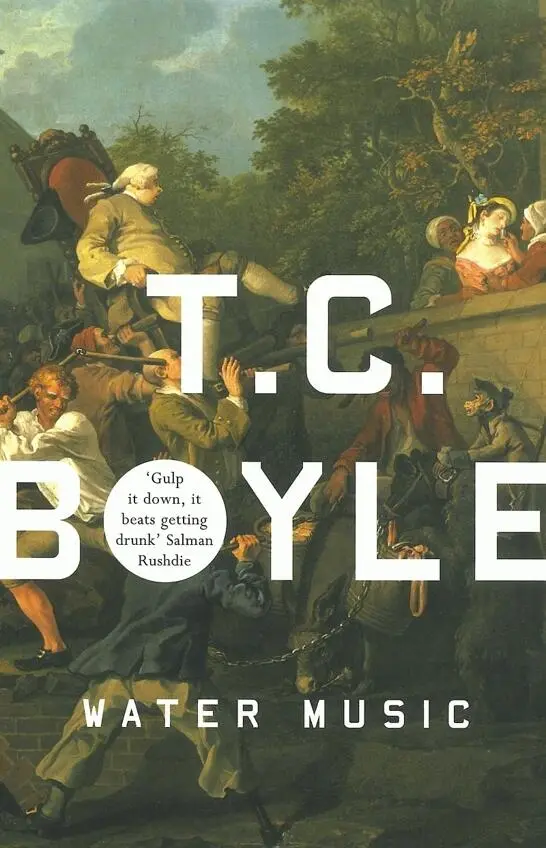
- Название:Water Music
- Автор:
- Издательство:Granta Books
- Жанр:
- Год:1983
- ISBN:9781862071551
- Рейтинг книги:3 / 5. Голосов: 1
-
Избранное:Добавить в избранное
- Отзывы:
-
Ваша оценка:
Water Music: краткое содержание, описание и аннотация
Предлагаем к чтению аннотацию, описание, краткое содержание или предисловие (зависит от того, что написал сам автор книги «Water Music»). Если вы не нашли необходимую информацию о книге — напишите в комментариях, мы постараемся отыскать её.
Water Music — читать онлайн бесплатно полную книгу (весь текст) целиком
Ниже представлен текст книги, разбитый по страницам. Система сохранения места последней прочитанной страницы, позволяет с удобством читать онлайн бесплатно книгу «Water Music», без необходимости каждый раз заново искать на чём Вы остановились. Поставьте закладку, и сможете в любой момент перейти на страницу, на которой закончили чтение.
Интервал:
Закладка:
“Come out of there, you bleeder!” Martyn shouts.
The horses crash through the brush, shattering saplings, wheeling to and fro in confusion. “Where’d he go?” Scott cries, his voice nearly a whinny, eyes fixed on the ground like a fox hunter’s.
The frustration is boiling over. Voices call out, the horses snort and blow, reinforcements rush up on foot. But again, magically, the thief seems to have eluded them. The explorer turns to Johnson with a shrug, but Johnson is paying no attention to him, merely sitting there astride his mare, silently pointing a stick at the baobab above them. There, like a treed animal, is the thief, cowering against a gouty limb some twenty-five feet from the ground. He hangs his head, trembling, and drops the object clenched in his fist. One of the men picks it up. It is a compass, set in cork, the compass Ailie had given Mungo when they parted. To help you find your way back to me, she’d said.
“Shoot, Mr. Park.” Johnson’s voice.
Martyn, his blood up, makes it a chant. “Shoot. Shoot.”
Ever so slowly, inch by inch, the explorer raises his pistol until he is looking down the length of it at the wretched little man quaking in the tree. The moment seems eternal, predator and prey, winner and loser. Small and hungry-looking, his skin purple with wet, the thief gazes down at him out of hopeless eyes, eyes gone dead already, a milkiness, a glaze there, as of butchered calves or dogs run down in the road. The man’s thigh looks no bigger around than Mungo’s forearm. On the inside of it, just below the groin, the flesh is shredded as if it had been ground up in a machine, and there are bits of hair and dirt and leafmold clinging to the edges of the wound. The rain is playing a threnody in the leaves.
“Shoot!”
The explorer thinks of Sir Joseph Banks, of his book, of London and the whirl of celebrity, Ailie, the children, sun on the Yarrow.
What am I doing? he thinks. What in God’s name am I doing?
Then he pulls the trigger.
THE LAST SMIRK
The report is terrible, awesome, rebounding off the rainslick boulders like the boom of dynamite in a concert hall, like the angry blast of a mountain blowing its top. It is tailed almost immediately by a piteous screech and one, two, three more rumbling gunshots. Ned Rise, standing alone in the defile, thinks of men at attention, flags waving, ceremonial salvos you can feel in your feet, the ushering in of a new era. He listens to these gunshots with a mixture of aversion and relief. Aversion at the thought of some poor wog cut down in his tracks, relief that the great white hero has finally come to his senses. Because things have been bad, very bad. What with the men dropping from fever and shits, the rain bogging them down and the niggers robbing them blind, it’s begun to look as if none of them will lay eyes on the Niger — not Park, not the Leftenant, not the little sap of a brother-in-law. And where does that leave Ned Rise, survivor? In a heap with the rest of them, stripped naked by the natives, vultures spinning overhead. Unless Park toughens up and shows a bit of muscle. The gunshots are a good start.
Ned has been standing there the whole while, motionless, listening to the last distant hue and cry, waiting for the echo of the coup de grace. Now he turns back to his ass, recinches the saddle and tightens the lashings on the various sacks and trunks strung over the animal’s back. The rain, if anything, has begun to fall harder. As he stoops for the all but useless musket Mungo threw down in the mud, his eye catches a movement in the glade ahead. More thieves? Wild beasts with a taste for ass flesh — or human? Instinctively, Ned reaches for his knife.
There it is again. A movement in the undergrowth. “Hey!” Ned calls out, nervously fingering the hangman’s welt under his collar. The trail ahead dips through the glade — a single massive baobab, a cluster of saplings, savanna grass, wildflowers, thick clots of briar — and then descends a long rocky path flanked by another tumble of gargantuan boulders. At Ned’s shout the movement stops abruptly. There is something back there, no doubt about it, and there’s no way in the world Ned is going to move within range of it. He’ll just wait till the others come up, he’s thinking, when the briars begin to quake violently, as though some large animal were trying to uproot them.
Losing patience, Ned bends to shy a stone into the bushes and is surprised to hear the soft unmistakable thud of stone on flesh, a sound he’d learned to distinguish while winging pigeons as a boy. An instant later a pair of black hands part the leaves, and a disgruntled face appears — but what a face! As black and wild as a gorilla’s. No: blacker and wilder, because it is a human face. The eyes glaring out from sockets reddened with ochre, deep vertical scars like terrible wounds creasing forehead and cheeks, the hair pulled back in a topknot and a tight necklace of cobra heads drawn round the neck like a warning, as if to say I am venomous and I will not hesitate to bite. This fellow makes the local thieves look like babes — even the savages at Pisania pale by comparison. Hopelessly, Ned raises the dripping musket, the knife clenched under his arm, pis aller.
Nothing happens. For a long moment Ned and the wildman face one another at a distance of perhaps fifty feet, the rain slanting down, Ned trying his best to look formidable and self-possessed. Then, suddenly, inexplicably, the wildman is grinning. A wild wet obscene grimace of a grin, big lips distended, teeth filed to points. And then he’s gone. Poof. Like a degenerate elf.
♦ ♦ ♦
That night they camp in the open, rain beating on the tents like aboriginal drums. There are brilliant flashes of light, the hollow ghostly calls of animals wandering in the night. Around two the watchfire is doused by a sudden driving downpour, and a pack of hyenas — chinless, ears pinned back — slink into camp and eviscerate a pack ass.
The following night they are again camped in the open, and again it is raining. So too the next night, and the next. As near as Ned can figure, it is around mid-July, a month past the time the great white hero said they’d be coasting down the Niger. Two more weeks, he tells them. Another hundred fifty, hundred sixty miles. Hang in there men, he coaches.
Ha. Hang in there. This morning Ned watched Jonas Watkins cough his lungs up and then pitch face forward in the bloody muck. They got him to his feet, but he just reeled round and collapsed again. His face was splotched red and white and his eyes were like milk. Park came by and asked if he could go on. Jonas couldn’t answer. After awhile the great white hero remounted and told Jemmie Bird to leave some salt beef and ammunition for Watkins. Come along when you feel better, Park said. Another joke. If the expedition was a man going bald, poor Jonas was just another hair fallen to the carpet. But what really rankles is that skinny little wimp of a leftenant — the brother-in-law. He gets dragged along on a litter like he was royalty or something while Jonas gets dumped beside the road for the vultures. Who does Park think he’s kidding?
Ned grits his teeth — and hangs in there. The month wears on. They climb ridges, traverse plains, pass through a succession of identical shit-stinking villages. Strange birds fly up in their faces, carnivores rush out at the asses in a tawny blur, herds of huge lunging deer with striped flanks and twisted horns fly off at the sound of their voices. They eat honey badger and woodrat, bathe in puddles infested with leeches, bilharzia and guinea worm. The world stinks of humus and creeping mold.
In one miserable two-day period they ford three rain-whipped rivers: the Wonda, the Kinyaco and the Ba Lee. Each booms along like an angry god, prickling with uprooted trees and tangled nests of brush, hiding snags and snakes and crocodiles, the water brown as a turd, ribbed and rushing. At the first one — was it the first? — Jimmy M’Inelli, a decent sort who could handle a deck of cards better with one hand than most people could manipulate a knife and fork with two, was gobbled up by a crocodile as if he were a bit of cheese and cracker. Ned was standing right next to him at the time, waist-deep and not ten feet from the far bank, when the thing plowed into the poor fool like a log coming down a sluiceway, flipped open its jaws in an awesome mechanical way, and sank into the brown stew of the current. One second he was shouting to M’Inelli to take his hand, the next he was looking at a ripple in the water. Ned never hesitated. He was an acrobat, he was an eagle. As he shot through the air he let out a short sharp bark of surprise, and then found himself on the bank, dripping and shuddering, heaving for breath like a steam engine. His mind was racing. He saw Billy’s face, Shaddy Walters’, Jonas’, M’Inelli’s. Fear seized him like a pincer: somehow, by force or persuasion, he had to circumvent Park.
Читать дальшеИнтервал:
Закладка:
Похожие книги на «Water Music»
Представляем Вашему вниманию похожие книги на «Water Music» списком для выбора. Мы отобрали схожую по названию и смыслу литературу в надежде предоставить читателям больше вариантов отыскать новые, интересные, ещё непрочитанные произведения.




Обсуждение, отзывы о книге «Water Music» и просто собственные мнения читателей. Оставьте ваши комментарии, напишите, что Вы думаете о произведении, его смысле или главных героях. Укажите что конкретно понравилось, а что нет, и почему Вы так считаете.