T. Boyle - Water Music
Здесь есть возможность читать онлайн «T. Boyle - Water Music» весь текст электронной книги совершенно бесплатно (целиком полную версию без сокращений). В некоторых случаях можно слушать аудио, скачать через торрент в формате fb2 и присутствует краткое содержание. Год выпуска: 1983, ISBN: 1983, Издательство: Granta Books, Жанр: Современная проза, на английском языке. Описание произведения, (предисловие) а так же отзывы посетителей доступны на портале библиотеки ЛибКат.
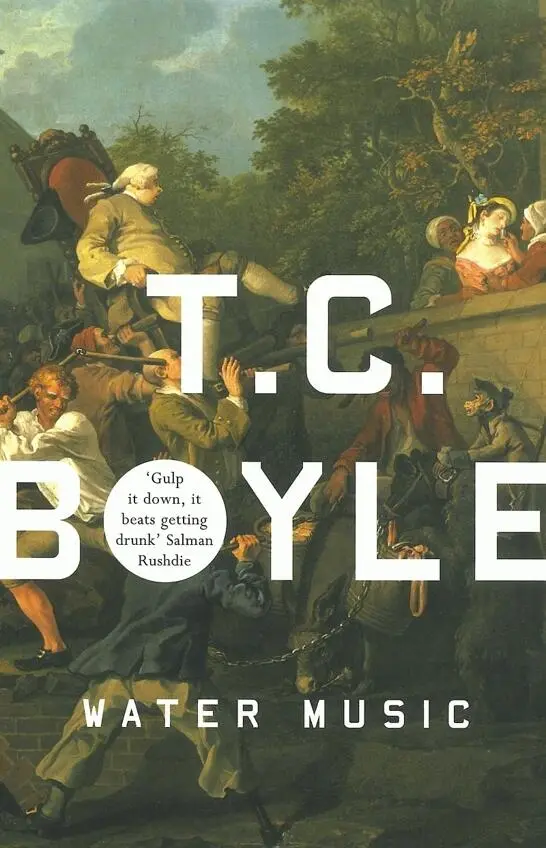
- Название:Water Music
- Автор:
- Издательство:Granta Books
- Жанр:
- Год:1983
- ISBN:9781862071551
- Рейтинг книги:3 / 5. Голосов: 1
-
Избранное:Добавить в избранное
- Отзывы:
-
Ваша оценка:
Water Music: краткое содержание, описание и аннотация
Предлагаем к чтению аннотацию, описание, краткое содержание или предисловие (зависит от того, что написал сам автор книги «Water Music»). Если вы не нашли необходимую информацию о книге — напишите в комментариях, мы постараемся отыскать её.
Water Music — читать онлайн бесплатно полную книгу (весь текст) целиком
Ниже представлен текст книги, разбитый по страницам. Система сохранения места последней прочитанной страницы, позволяет с удобством читать онлайн бесплатно книгу «Water Music», без необходимости каждый раз заново искать на чём Вы остановились. Поставьте закладку, и сможете в любой момент перейти на страницу, на которой закончили чтение.
Интервал:
Закладка:
The explorer was seated at his makeshift desk, a welter of half-written letters, journal extracts and crude maps heaped up around him. Apart from the clutter of the desk, the interior of the tent was arranged with an Essene precision. In the corner, packed and ready, was the knapsack containing the explorer’s personal effects; beside it lay the leather-bound trunks that protected his sextant and thermometers and the sheafs of dried stems, leaves and buds he planned to bring back to England for classification.
All the foodstuffs had been removed and stowed away neatly in the hull of the Joliba , a lingering odor of goat cheese and chicken excrement testimony to their recent removal. Even the floor had been swept clean.
A moment passed — eight hammering heartbeats. Johnson’s hortatory words hung in the air like the memory of something dead, while the explorer, dressed only in his underwear, squinted through the eye of a needle and moistened a strand of thread with the tip of his tongue. He never even looked up.
“I mean it, brother,” Johnson said. “I’m takin’ Serenummo and Dosita and the two Dembas and headin’ for Dindikoo — tomorrow. If you got any sense at all — and by now I’m pretty well convinced you don’t — you’ll come with me.”
Mungo was trying to close up a six-inch tear in the seat of his nankeen trousers, but his hands shook so he couldn’t seem to thread the needle. This was frustrating. It was bad enough that he had to run around and get the boat loaded and the men ready, not knowing whether he was going off to triumph or defeat, but this damned sewing took the cake. He flung the needle down in disgust and glared up at Johnson. “Listen,” he said, his voice thick and harsh, “don’t you come around here trying to pressure me at the last minute because it’s just not going to work. You’ve been a naysayer all along, and I’ll tell you, I don’t need it. Just get your things together and climb into that boat. Period. End of discussion.”
Johnson was slowly shaking his head. He looked a great deal older than he had just a few months earlier at Dindikoo, more worn and frayed. He’d lost one of his chins, and the great bulge of his abdomen seemed to have receded. With his hair getting progressively whiter and his limbs stiff, he’d begun to look like the sixty-two-year-old he was. “You don’t need me,” he said, “you got Amadi Fatoumi.”
It was true. Johnson had never been farther east than Sansanding, and knew absolutely nothing of the geography, the peoples or the languages of the lower Niger. And Mungo had engaged a new guide — an itinerant merchant named Amadi Fatoumi, who’d been as far as Kong, Badoo, Gotto and Cape Coast Castle to the south, and Timbuctoo, Hausa, Maniana and Bornou eastward. But still, the idea of going on without Johnson was insupportable. It chilled Mungo to the bone, frightened him to the soles of his feet. Without Johnson he was totally on his own. “All right,” he said, pushing himself up from the table. “I’ll triple your wages, send you crateloads of books, paintings — anything you want.”
“No,” Johnson said, still shaking his head in that weary, resigned way. “You’ll never send me anythin’, Mungo. Because if you launch that boat tomorrow you’ll never live to see England again.”
“Bullshit!” Mungo shouted, hammering his fist against the tent-pole until the canvas began to quake and billow.
“Turn back,” Johnson whispered. “For me. For your wife and your children. Turn back now before it’s too late.”
The explorer was stalking up and down in his underwear, flailing his arms like some great waterbird lifting itself from the swamp. “You know I can’t do that, old boy.” He was trying to control his voice. “I’ve spent a fortune — all government money— and I’ve lost nine out of ten men that came with me. Georgie Scott is dead, and Zander. And you expect me to tuck my tail between my legs and turn back now? How would I face Sir Joseph? Camden? Even Ailie? No: it’s impossible. I’ve got to go on.”
“Hey,” Johnson’s voice was soft, still soft, as if he were whispering to Amuta in the night, “stuff your ego, swallow your pride. You made a mistake, let’s face it. You dragged all these sick dogs and all this excess baggage out here with you in the middle of the monsoon — what do you expect? Go back. Go back now and mount another expedition. You’re a young man. You can do it.”
Self-doubt was something new to Mungo, something that had crept up on him like a growth, a malignancy, during the course of this second expedition. Self-doubt, and guilt. Every word out of Johnson’s mouth struck him with all the force of his own convictions, every word jabbed him like a needle. But he was stubborn. He threw his head back. “I leave at dawn.”
“I won’t be there,” Johnson said. It was a simple statement of fact. He held the explorer’s eyes as he reached into his toga and produced a silver-plated pistol: sleek and long-nosed, it was engraved with the initials of the only man he’d ever killed, an Englishman like this one, with his fair hair and red face. “Take it,” he said, his voice rumbling so low as to be barely audible. “It’s brought me luck.”
Lit by a late-afternoon shaft of light, the gun flashed in the explorer’s hand as if it were charged, as if it were some magical instrument capable of hurling thunderbolts and spewing brimstone. He tucked it in his belt, confused, searching out his words. “Johnson,” he began, “you mean there’s nothing I— “
The older man cut him off. “Watch out for Amadi Fatoumi,” he said. “I don’t like him. I don’t like what I hear about him.”
In these last days of uncertainty and apprehension, the explorer had become as volatile as a case of Scots whisky. A moment ago he’d been moved; now, at the mention of Amadi’s name, a hot sudden rage grabbed hold of him and shook him till he trembled. “What do you mean?” he demanded. “Because he isn’t fat and old he’s no good? Because he doesn’t wear a gold straight pin through his nose he can’t be trusted?”
Johnson merely looked into his eyes, cold and steady. What he meant was that Amadi Fatoumi was about as trustworthy as a cobra with a toothache, and that Mungo was no judge of character. Fatoumi was a merchant all right — he sold guns and drugs and West Indian rum to the tribes in the interior and brought back slaves in return. He was a Mandingo — from Kasson — but his head was shaved to the skin and he wore an oily black beard that fanned out to his shoulders after the Moorish fashion. There was an unfathomable blackness to his eyes — pupil and iris nearly indistinguishable — and he had a habit of rubbing his hands and ducking his head as he spoke.
He’d turned up one afternoon with Martyn and M’Keal. They’d found him in the marketplace — or rather he’d found them. They were drunk, as usual, on sooloo beer and a clear hard liquor distilled from tomberong berries and known to the natives as fou , when he sidled up to them with a grin. Amadi had about twenty-five words of English — words like fouter and kill and whore —and he regaled lieutenant and sergeant with them for half an hour, playing the fool, until he escorted them down a back alley, provided them with the services of two pliant females and a ball of black hashish. “Captain, Sir,” Martyn had said to the explorer some hours later, “this is a capital fellow.” Amadi stood between the drooping Martyn and the wild-eyed M’Keal, in sandals and jubbah . He took the explorer’s hand and pumped it. “Please to see you,” he murmured. Half an hour later he was signed on with the expedition at triple wages and the promise of one quarter of the stores remaining on reaching Hausaland.
Читать дальшеИнтервал:
Закладка:
Похожие книги на «Water Music»
Представляем Вашему вниманию похожие книги на «Water Music» списком для выбора. Мы отобрали схожую по названию и смыслу литературу в надежде предоставить читателям больше вариантов отыскать новые, интересные, ещё непрочитанные произведения.









Обсуждение, отзывы о книге «Water Music» и просто собственные мнения читателей. Оставьте ваши комментарии, напишите, что Вы думаете о произведении, его смысле или главных героях. Укажите что конкретно понравилось, а что нет, и почему Вы так считаете.