Jonathan Levi - Septimania
Здесь есть возможность читать онлайн «Jonathan Levi - Septimania» весь текст электронной книги совершенно бесплатно (целиком полную версию без сокращений). В некоторых случаях можно слушать аудио, скачать через торрент в формате fb2 и присутствует краткое содержание. Год выпуска: 2016, Издательство: The Overlook Press, Жанр: Современная проза, на английском языке. Описание произведения, (предисловие) а так же отзывы посетителей доступны на портале библиотеки ЛибКат.
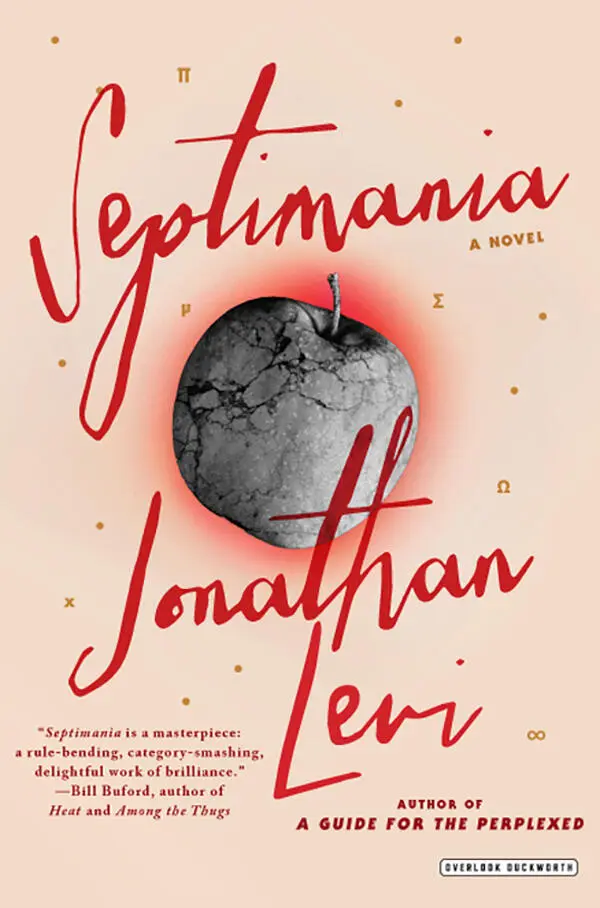
- Название:Septimania
- Автор:
- Издательство:The Overlook Press
- Жанр:
- Год:2016
- ISBN:нет данных
- Рейтинг книги:4 / 5. Голосов: 1
-
Избранное:Добавить в избранное
- Отзывы:
-
Ваша оценка:
Septimania: краткое содержание, описание и аннотация
Предлагаем к чтению аннотацию, описание, краткое содержание или предисловие (зависит от того, что написал сам автор книги «Septimania»). Если вы не нашли необходимую информацию о книге — напишите в комментариях, мы постараемся отыскать её.
Over the next fifty years, Malory’s search for Louiza leads to encounters with Pope John Paul II, a band of lost Romanians, a magical Bernini statue, Haroun al Rashid of Arabian Nights fame, an elephant that changes color, a shadowy U.S. spy agency and one of the 9/11 bombers, an appleseed from the original Tree of Knowledge, and the secret history of Isaac Newton and his discovery of a Grand Unified Theory that explains everything. It is the quest of a Candide for love and knowledge, and the ultimate discovery that they may be unified after all.
Septimania — читать онлайн бесплатно полную книгу (весь текст) целиком
Ниже представлен текст книги, разбитый по страницам. Система сохранения места последней прочитанной страницы, позволяет с удобством читать онлайн бесплатно книгу «Septimania», без необходимости каждый раз заново искать на чём Вы остановились. Поставьте закладку, и сможете в любой момент перейти на страницу, на которой закончили чтение.
Интервал:
Закладка:
Malory’s nostrils opened to the barely perceptible but gently hallucinatory honey and clover, balsam and loam.
“The vestibule”—Settimio led Malory back to the Canova and the Michelangelo, Giotto, della Robbia, and half a dozen other Renaissance Italians—“is a poetic reminder that your ancestor Charlemagne was crowned Holy Roman Emperor, the way you were yesterday evening by the new pope.”
“I was?” Malory asked, less to Settimio than to the Santa Marta that reminded him so strongly of his mother and the Venus that had his grandmother’s hair — and only that, he hoped — and wondered why those two women hadn’t given him a little hint while they were alive that they, and therefore he, were descended from Charlemagne and King David.
“Holy Roman Emperor and King of the Jews.” Settimio walked out of an opening at the far end of the hub. “But the true genius of Yehoshua and Charlemagne was to befriend the Caliph of Baghdad. The friendship of Haroun al Rashid and the first King of Septimania is said to have been very great, almost biblical in proportion.”
“The Caliph of Baghdad?” Malory followed through an arch topped by a blackened medallion of another familial Virgin. Could she be Mexican?
“Welcome to the majlis, mio Principe. ”
The long summers Malory had spent with his mother in the countryside outside Narbonne had been filled with illustrated books — the complete Morte d’Arthur of Thomas Malory with Aubrey Beardsley’s rose-crowned drawings; Richard Halliburton’s Book of Wonders with engravings of the Library of Alexandria, the Colossus at Rhodes, and other long-gone miracles of an ancient human race. And of course he had spent days, weeks, months in the inky harems and casbahs of Richard Burton’s One Thousand and One Nights. But to enter the majlis , as Settimio called it, was to abandon whatever reality his bath and tea and scone had provided him and give himself over to the storybook kingdom that Settimio insisted on calling his home. The walls were tiled, the ceiling honeycombed in a stone crocheted by a sweatshop of djinns . In the center of the room, a fountain of seven bronze lions gargled water into a stone basin.
“These carpets,” Settimio was saying, “are from the Caspian shores near Tabriz. The tapestries on the far wall were conceived by the magicians of Shiraz on the Persian Gulf and woven with the lost Kashan art of Infinite Knots that makes it impossible for even the restorers from the Vatican Museums to decipher where the rug begins and where the rug ends.”
“Cor,” Malory said, sitting down because his legs were finding it less easy than his brain to keep up with Settimio’s tour.
“The bolsters cushioning the walls are from Yemen, the censers from Kazakhstan. And the throne you are sitting on …”
“Sorry!” Malory jumped up.
“It is yours, mio Principe, the throne for the King of Septimania. Please …” Settimio took Malory’s elbow lightly and eased him back down. “This throne was carved by a single axe from a single apple tree in the garden of a palace in Baghdad. It was transported to Rome in person by the Caliph Haroun al Rashid as a belated wedding present for Gan and his bride Aldana, the red-haired daughter of Charlemagne, on the occasion of Charlemagne’s coronation as Holy Roman Emperor in the Year 800.”
“Not a bedtime story,” Malory said, rubbing his left palm along the armrest.
“No,” Settimio acknowledged. “Applewood. One tree.”
“But,” Malory said, standing up, the scientist in him awakening, “how do you know all this? How do you know it’s not just another story cooked up by some younger Scheherazade?”
“Books, mio Principe. I believe in books.” Settimio smiled, perhaps the first time Malory had seen him smile. “I believe you also know something about books. Would you be so good as to follow me?” Settimio walked to the far end of the majlis , where the niche in the eastern wall curved back between the Catholic vestibule and the Jewish dining room. Malory approached and looked inside.
“In here?” Malory asked. There was a passageway. A passageway of tile and wood and light — a light that led up, that led down, that led sideways. They walked. They walked some more. The rooms of the villa that Malory had seen felt like they must be mere anterooms, and yet Malory continued to follow Settimio through the passageway up to a wooden door padded in leather.
“The Sanctum Sanctorum,” Settimio said. “The true wealth of Septimania. The Holy of Holies.”
The padded leather gave only a hint of how discreetly Septimania veiled its treasure. Settimio opened the door and led Malory into the first room. It was equally modest — a low-ceilinged study, bare except for a seven-sided desk lit by a concentric fixture suspended from a coffered ceiling. The seven books on the seven sides of the desk were anything but simple.
“On the left,” Settimio said, pointing to one of seven boxes, “is the oldest manuscript in your collection — a Septuagint, dating from the third century BC, the Greek translation by seventy-two rabbis of the forty-six books of the Tanach, what the pope, as you may know, calls the Old Testament. Next to it is a Codex, complete with the New Testament, or at least many of the books of the Codex are still associated with the New Testament. It was commissioned by the Emperor Constantine shortly after his conversion to Christianity and given by Pope Leo III to Charlemagne in the year 800 on the event of his own coronation as Holy Roman Emperor. It is known as the Codex Septimania, although known as such to very few. Next is the first of the five Korans made around 650 AD by the Third Caliph Uthman, son-in-law of the Prophet Mohammed, the oldest Koran in existence, except, according to believers, for the Koran that was made by Mohammed the Prophet and which the Angel Gibreel keeps in his own Sanctum Sanctorum up in Heaven. The following two boxes hold the writings of Buddha in one, the Vedas of the Hindus in the other, including a fragment of the Rigveda that is thought to be over three thousand years old.”
A choked gurgle came from Malory’s throat. He was pleased that he was even that articulate.
“The sixth box, at your grandmother’s request, is the oldest version of Isaac Newton’s Principia Mathematica .”
“Wait a minute,” Malory said, suddenly waking up in a world he knew. “I’ve seen the oldest edition — Newton’s own copy of 1686. It’s back at Trinity College, in the Wren Library, with Newton’s handwritten corrections for the second edition.”
“You may find,” Settimio said, with a smile of some satisfaction, “that this copy predates the Trinity copy by some twenty years.”
“Twenty years!” Malory was shocked and then alarmed and then shocked again, like some ten-year-old junior scientist not quite convinced that sticking a fork into an electrical socket is a bad thing. “The manuscript?” he asked somewhat more stupidly, although just saying the words tickled his neck. “You have the original manuscript? From 1666? In Newton’s hand?”
“ You have the manuscript,” Settimio corrected him. “This is all yours, mio Principe .”
“And the seventh book? The final book?”
“Is a box,” Settimio said, and waited for some type of reaction.
“Empty?” Malory asked.
“Open it and see.”
“But if I open it …” And Malory was back in the organ loft of St. George’s, Whistler Abbey, with Schrödinger’s cat and Louiza’s Pip and his own indecision.
“ Simplex sigillum veri, ” Settimio said.
“ Simplex sigillum veri ?”
“The simple is the sign of the truth.”
Читать дальшеИнтервал:
Закладка:
Похожие книги на «Septimania»
Представляем Вашему вниманию похожие книги на «Septimania» списком для выбора. Мы отобрали схожую по названию и смыслу литературу в надежде предоставить читателям больше вариантов отыскать новые, интересные, ещё непрочитанные произведения.









Обсуждение, отзывы о книге «Septimania» и просто собственные мнения читателей. Оставьте ваши комментарии, напишите, что Вы думаете о произведении, его смысле или главных героях. Укажите что конкретно понравилось, а что нет, и почему Вы так считаете.