Jonathan Levi - Septimania
Здесь есть возможность читать онлайн «Jonathan Levi - Septimania» весь текст электронной книги совершенно бесплатно (целиком полную версию без сокращений). В некоторых случаях можно слушать аудио, скачать через торрент в формате fb2 и присутствует краткое содержание. Год выпуска: 2016, Издательство: The Overlook Press, Жанр: Современная проза, на английском языке. Описание произведения, (предисловие) а так же отзывы посетителей доступны на портале библиотеки ЛибКат.
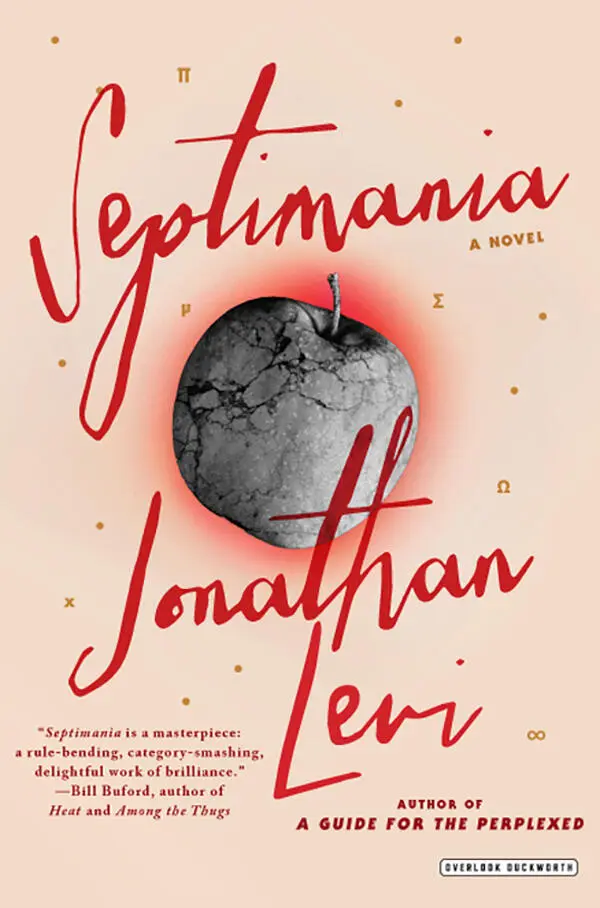
- Название:Septimania
- Автор:
- Издательство:The Overlook Press
- Жанр:
- Год:2016
- ISBN:нет данных
- Рейтинг книги:4 / 5. Голосов: 1
-
Избранное:Добавить в избранное
- Отзывы:
-
Ваша оценка:
Septimania: краткое содержание, описание и аннотация
Предлагаем к чтению аннотацию, описание, краткое содержание или предисловие (зависит от того, что написал сам автор книги «Septimania»). Если вы не нашли необходимую информацию о книге — напишите в комментариях, мы постараемся отыскать её.
Over the next fifty years, Malory’s search for Louiza leads to encounters with Pope John Paul II, a band of lost Romanians, a magical Bernini statue, Haroun al Rashid of Arabian Nights fame, an elephant that changes color, a shadowy U.S. spy agency and one of the 9/11 bombers, an appleseed from the original Tree of Knowledge, and the secret history of Isaac Newton and his discovery of a Grand Unified Theory that explains everything. It is the quest of a Candide for love and knowledge, and the ultimate discovery that they may be unified after all.
Septimania — читать онлайн бесплатно полную книгу (весь текст) целиком
Ниже представлен текст книги, разбитый по страницам. Система сохранения места последней прочитанной страницы, позволяет с удобством читать онлайн бесплатно книгу «Septimania», без необходимости каждый раз заново искать на чём Вы остановились. Поставьте закладку, и сможете в любой момент перейти на страницу, на которой закончили чтение.
Интервал:
Закладка:
“Newton!” he said.
“Newton,” Settimio answered. There was no mistaking the face, the coat. This was the student Newton, the Newton of the great discoveries, the Newton of the annus mirabilis of 1666, only slightly younger than Malory. “He posed for the sculptor.”
“The sculptor?”
“Gian Lorenzo Bernini,” Settimio said. “There are several Berninis in the villa and the garden.”
“Bernini went to England?” Malory turned to Settimio. “And sculpted Newton? During the Plague?”
“The ledger for the year shows that Isaac Newton posed for the statue here.”
“Here? What year?”
“1666, I believe.”
“In Rome?”
“In the garden. I would be happy to show you where.”
“The garden?” Malory repeated.
“Perhaps after breakfast, I could take you out.”
“You mean here? Newton was here? In 1666?” Malory knew the history, the biography, the writings, the readings, the eating habits of Isaac Newton better than anybody, perhaps even better than Newton knew himself. Malory knew that although Newton was acquainted with a number of European scientists, even had a romantic relationship — it was rumored — with a Swiss mathematician, the world met Newton in London. Newton never left England. Newton never traveled to Europe, much less to Rome. The statue must clearly be an act of the imagination.
But was Bernini’s imagination — the great Gian Lorenzo Bernini, favorite of princes and popes — interested in Newton? And the second figure — a woman. Was there ever a woman who was interested in Newton? Newton had never shown any inclination towards females, except of course his mother, Hannah, and the niece who kept house for him in his later years. Who was this second figure, this woman? She was slightly smaller, her nose more aquiline, her eyes larger, her chin with a delicate cleft above a polished neck.
Then Malory saw the ball that the two were tossing. Now that he stood and approached the statue, scone in hand, he could see that it was no ball at all, but a polished marble apple. Malory smiled. Of course. Bernini’s imagination had been piqued by story. He had sculpted Newton and the woman and the apple as an allegory for one of his more scientifically minded patrons. The gossip must have crossed the continent, the reports that a falling apple had led the young Isaac to his theories on gravity and the attractions of heavenly bodies at a distance. Perhaps the woman was Bernini’s Renaissance approximation of Minerva herself, the Goddess of Wisdom, tarted up in the robes of Lucrezia Borgia or Catherine de Medici or some more intimate Bernini conquest.
Then Malory stopped smiling. He had assumed that the ball, the apple, was attached discreetly to another piece of stone or supported by a thin piece of iron or suspended by a filament from the ceiling or the outstretched hands of one or the other of the apple-tossers. But as Malory ran one hand and then another above, below, to the sides and then around the apple, like a Christmas magician at the Cambridge Corn Market, he could find no support, no suspension. The apple was floating in mid-air.
“Settimio.”
“ Sí, ” Settimio offered with his usual gentle guidance. “It is quite remarkable, is it not? Molto particolare. ”
Molto particolare was not what Malory was thinking.
“I am hardly an expert,” Settimio said. “I understand that you are an aficionado of Signor Newton and the world of physics in general.”
“This is, well …” Malory hesitated at his own certainty in either observation or judgement. “This is, impossible.” Malory walked around the statue, knelt down below the apple, and peered up.
“And yet, mio Principe ,” Settimio suggested, “the stars remain suspended in the heavens. The Moon itself moves in perfect balance around the Earth, which revolves in its turn around the Sun — all without the aid of supporting wires. From what I understand, Newton himself …”
“Yes, yes …” Malory’s mind was moving with impatience. He knew the astronomy and the physics of the motion of planets. He knew that the Sun drew the Earth towards its center and the Earth drew the Sun towards its own, and that the balance between the two depended on the size of each and the distance between the two, not to mention the speed of the Earth’s journey in orbit around the Sun. And he knew that the Moon and the Earth danced a similar tango and that even the Sun flirted with the Moon as it did with millions of hotter Milky Way companions on a somewhat larger dance floor. And he knew that everything was guided by the laws of attraction at a distance between bodies. And he knew, as Einstein and generations of physicists and historians and schoolchildren and BBC commentators, not to mention Anna Ford, knew, that Newton searched his whole life for a simple rule by which the motions of the heavenly bodies of the planetary system could be completely calculated, if one knew where they all were at one time.
And Malory also knew that theoretically — a word that was tossed around colloquia and High Tables like custard and claret— theoretically every body had its own gravitational pull. Every body was a magnet. Not just the Moon, but chunky asteroids, Apollo 13, Mount Everest, Moby Dick. Even a man the size of, say, Aldo Moro or Settimio — who was thankfully a few hairs shorter than Malory — had his own power of attraction. But it didn’t take too many experiments, with a shard of toothpick or even tissue, to realize that the gravitational pull of the Earth would yank any apple — McIntosh or marble — with a far greater force than a statue, even one carved by the great Gian Lorenzo Bernini, who could carve fingers clutching thighs out of marble and make you believe they were clasping flesh.
“May I?” Malory turned to Settimio, pointing at the apple.
“Everything in this villa is yours, my lord,” Settimio answered simply. “But there may be consequences.”
And sure enough, as Malory reached out to take the apple, he felt a tug from either side, as if the statue of Newton on the left and the statue of the woman on the right were fighting him — as surely as the Earth — for the piece of fruit. It wasn’t that the apple was so heavy or magnetic or sticky or golden. The figures tottered as Malory pulled, and Settimio stood by with widened eyes. It felt to Malory that just a little more effort … But no, he just could not move it. Malory let go. Newton and the marble woman and Settimio seemed to take a breath of relief and tottered no more, secure once again in a mutual attraction that had withstood more than three hundred years of dustings and earthquakes and other attempts, since Malory could not imagine he was the first to try to steal the apple.
Malory leaned back on the table and then slid down into one of the Tiberian chairs that Settimio quickly shifted beneath him. He took a fresh cup of tea from Settimio and chewed on the rest of his scone, all the while fixing his gaze on the marble apple.
“Settimio,” he said. “I’m ready. Please explain — what is this place you call my home?”
2/2
 IO PRINCIPE, ” SETTIMIO SAID, “YOU ASKED ME THAT QUESTION last night. I told you the story of Yehoshua the butcher who delivered Narbonne to the Franks. Of Charlemagne’s promise to give a kingdom to Yehoshua and his Jews. How Charlemagne sent a request to the Caliph of Baghdad to send him a Jewish prince from the line of David and Solomon to take the throne as the first King of Septimania.”
“You mean,” Malory asked, “that wasn’t just a bedtime story?”
“The statue that attracts you so strongly,” Settimio answered, “is it just a statue? This dining room — the chairs of Tiberian oak, the table of Jerusalem cedar — is not only the room where I hope to serve you many meals as my ancestors served a long line of kings before you, but also tells its own story of Septimania, bedtime stories stretching back to King Solomon, King David, and beyond.”
Читать дальшеИнтервал:
Закладка:
Похожие книги на «Septimania»
Представляем Вашему вниманию похожие книги на «Septimania» списком для выбора. Мы отобрали схожую по названию и смыслу литературу в надежде предоставить читателям больше вариантов отыскать новые, интересные, ещё непрочитанные произведения.






Обсуждение, отзывы о книге «Septimania» и просто собственные мнения читателей. Оставьте ваши комментарии, напишите, что Вы думаете о произведении, его смысле или главных героях. Укажите что конкретно понравилось, а что нет, и почему Вы так считаете.