Jonathan Levi - Septimania
Здесь есть возможность читать онлайн «Jonathan Levi - Septimania» весь текст электронной книги совершенно бесплатно (целиком полную версию без сокращений). В некоторых случаях можно слушать аудио, скачать через торрент в формате fb2 и присутствует краткое содержание. Год выпуска: 2016, Издательство: The Overlook Press, Жанр: Современная проза, на английском языке. Описание произведения, (предисловие) а так же отзывы посетителей доступны на портале библиотеки ЛибКат.
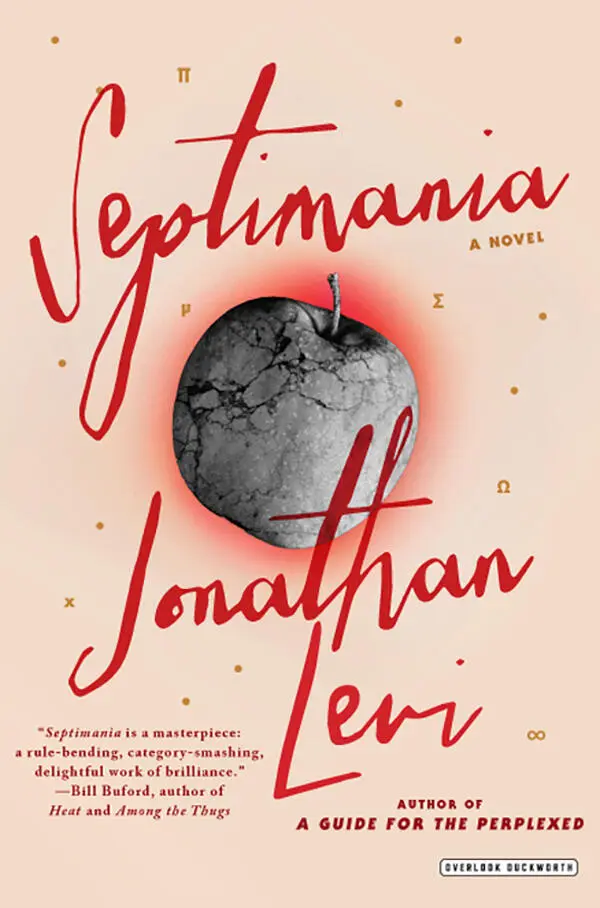
- Название:Septimania
- Автор:
- Издательство:The Overlook Press
- Жанр:
- Год:2016
- ISBN:нет данных
- Рейтинг книги:4 / 5. Голосов: 1
-
Избранное:Добавить в избранное
- Отзывы:
-
Ваша оценка:
Septimania: краткое содержание, описание и аннотация
Предлагаем к чтению аннотацию, описание, краткое содержание или предисловие (зависит от того, что написал сам автор книги «Septimania»). Если вы не нашли необходимую информацию о книге — напишите в комментариях, мы постараемся отыскать её.
Over the next fifty years, Malory’s search for Louiza leads to encounters with Pope John Paul II, a band of lost Romanians, a magical Bernini statue, Haroun al Rashid of Arabian Nights fame, an elephant that changes color, a shadowy U.S. spy agency and one of the 9/11 bombers, an appleseed from the original Tree of Knowledge, and the secret history of Isaac Newton and his discovery of a Grand Unified Theory that explains everything. It is the quest of a Candide for love and knowledge, and the ultimate discovery that they may be unified after all.
Septimania — читать онлайн бесплатно полную книгу (весь текст) целиком
Ниже представлен текст книги, разбитый по страницам. Система сохранения места последней прочитанной страницы, позволяет с удобством читать онлайн бесплатно книгу «Septimania», без необходимости каждый раз заново искать на чём Вы остановились. Поставьте закладку, и сможете в любой момент перейти на страницу, на которой закончили чтение.
Интервал:
Закладка:
“Louiza?” he called out.
There was light.
There was more.
Above him a ceiling of a blue richer than the sky of Santa Maria sopra Minerva, as pure and saturated with color as any he had seen through any of the dozens of Newtonian prisms he’d examined over the years. It was a color unknown to the British sky, but an inseparable part of the wood outside Narbonne, where he had lain for hours on his back on a mattress of bluebells, paralyzed by nature.
Malory pushed himself up on his elbows. Around the walls, Malory’s own image gazed back at him. In a dozen or so portraits set into the hazelnut panels of the room, Malory’s own face — young and old, as a man, as a woman, in costumes as ornate and archaic as any he had seen in the halls and chapels of Cambridge — looked back at him, refracted in mirrors of time and manner. In curling wigs or in flat caps, with beards or rouged cheeks, every portrait had an ear or a chin or a cheek that Malory felt was essentially his own. The perplexed look in all of their eyes as they looked at him lying in the bed, made him realize that his own appearance of general bewilderment had more to do with genes and less with his history of abandonment. The painting directly across from him — the most recent an Edwardian-looking gentleman, perhaps his great-grandfather, the last prince of Septimania before himself — couldn’t hide his own confusion behind a starched collar and whiskers. Had all those faces in all the portraits in the bedroom wondered at one time the same thing he was wondering — what am I doing here?
In answer, there was a knock on the door.
“ Mio Principe? ” A knock again. “I saw your light. Do you require something?”
“Ah—” Malory said. Which meant nothing, but was interpreted as an invitation.
Settimio was dressed in dark trousers, a long white shirt, clipped at the cuff by medallions that caught the light from Malory’s bedside lamp and shone a touch of comprehension into his awakening brain. Above the shirt and trousers, Settimio wore a smock, long and leathery like the apron of a butcher. It must be morning, Malory thought, or perhaps later.
“Did you sleep well, Principe? ”
“Were you reading to me all night, Settimio?” Was there really a story about a Jewish butcher?
“Reading?”
“Telling me a story?”
“Until you fell asleep.”
“Which was?”
“Almost the moment you lay back against the pillow. Yesterday was a long day. One for which your grandmother did little to prepare you.”
“She knew?” Malory pulled his shoulders a little higher above the pillow.
“Your grandmother knew many things. I communicated with her in recent years exclusively by telephone. But she was always a deeply curious person.”
“Hunh,” Malory said, searching the wall for any portrait that might resemble Old Mrs. Emery. “Not curious enough to introduce herself to me. Until the end. Or almost.”
“Curiosity, mio Principe, is often best served by discretion.”
“Observation at a distance?”
Settimio smiled. Again Malory felt the comfort of a perfect mark on an exam, applause at the end of a concert. With the relaxation that accompanies pleasure came the conviction that he needed the toilet. And that today he would find Louiza. Again. With the same delicate hints and gestures he had used the night before, Settimio guided Malory out of the bedroom and up two short steps to a bathroom no smaller than the bedroom Malory had just left. If Malory had bothered to look up, he would have seen his own reflection multiplied — if not as many times then more accurately than in the portraits of the bedroom. But while one hemisphere of his brain was trying to understand where he was, the other was fixed on where he wanted to be. Since the effort so occupied the brain of Malory, the body was left to its own automatic devices. It urinated, it flushed, it bathed, it shampooed and shaved — Settimio not only ran a bath but set out Malory’s toiletries, such as they were, in places where the automaton of his body could not fail to use them. In a robe of velvet and midnight blue, Malory returned to the bedroom.
“Settimio?”
“ Principe ?”
“What time is it?” A fresh pair of jeans and a chamois shirt, brand new but clearly in his style, lay on his bed. Had Settimio set them out while he was bathing? And made the bed? “We should get back to the hospital. What is the name?”
“Fatebenefratelli. But you may recall that the nurse you wished to interview expects you in four hours. Might I suggest something to eat?” The jeans, the shirt fit. So did the ankle boots — in a leather and a toe not too ostentatiously Italian. Not even at Cambridge, where the bedders — under the supervision of Rix’s integral wife, Emma — swept and tidied away his bedclothes and tea-droppings, had he been shown such an assiduous respect.
“Then we have time to ring the Embassy.” Malory stood. The boots were a miracle. “You mentioned the carabinieri last night.”
“We have two types of scone.” Settimio pinched the shoulders of the chamois and flattened the shirt against Malory’s chest. “And there is marmalade. Your own oranges. Breakfast. You will find it immensely restorative.” Settimio turned and exited the bedroom. Malory looked up at the portraits, each one a perplexed soul. Was there a Settimio hidden on the reverse of each, face pressed against the wall in discretion?
Malory followed Settimio down a paneled corridor, his boots treading without a sound on a wood of acoustical properties Malory could not plumb. The corridor opened into a low-coffered foyer, a gentle hub leading out into other corridors, a handful of paintings and sculptures punctuating the entrances and exits.
“Settimio.” Malory stopped. “Who is that?”
“Borromini, della Robbia, Giotto.”
But that wasn’t the question Malory was asking. With the same sense of recognition he’d had upon waking to the portraits in the bedroom, Malory saw his mother’s cheek in the Michelangelo Santa Marta, his grandmother’s hair in the Canova Venus by the western wall. Settimio walked. Marta smiled down on Malory. Breakfast, she seemed to say. Eat now, we will talk later. Malory followed. Malory sat. Settimio poured his tea. Malory pulled the first scone in two, varnished one surface with a layer of orange marmalade and rind, and took a bite. He chewed. Marta was right — the scone helped. He took another bite. He raised his eyes. He stopped chewing.
“Settimio, where are we?” It wasn’t the scone, the tea that confounded him. He knew he wasn’t back in Cambridge, although the hovering of Settimio bothered him in the way that had often made him embarrass Rix into sitting down once he’d brought Malory’s morning tea to his rooms, to talk about Trinity’s recent acquisition of machinery for polishing cutlery or cutting grass.
“The dining room,” Settimio said with simplicity. But when Malory failed to respond, he continued. “You are sitting in one of seven chairs of Tiberian oak. The table is Jerusalem cedar. Gifts, all of them. I would be happy to go into more detail if you wish.”
“That.” Malory swallowed and pointed with the half-eaten scone. “Them.”
Across from Malory, on the far side of the table of Jerusalem cedar, a marble statue stood raised on its base. Or rather, two life-sized statues stood on a single base. A man and a woman. Two marble people, in the long hair and long coats of the Enlightenment, were clearly enjoying themselves. The sculptor had caught them in the middle of a game, a ball game. One was tossing the ball to the other — although at the distance of a dining room table and a half-eaten scone, Malory couldn’t tell properly which one was tossing to which. Malory put down the scone, wiped his mouth, and pushed back his oaken chair — with the aid, naturally, of Settimio. He walked around the table to the statues. The figures were slightly smaller than Malory and greeted him on their pedestal at eye level. Malory recognized the male statue immediately.
Читать дальшеИнтервал:
Закладка:
Похожие книги на «Septimania»
Представляем Вашему вниманию похожие книги на «Septimania» списком для выбора. Мы отобрали схожую по названию и смыслу литературу в надежде предоставить читателям больше вариантов отыскать новые, интересные, ещё непрочитанные произведения.











Обсуждение, отзывы о книге «Septimania» и просто собственные мнения читателей. Оставьте ваши комментарии, напишите, что Вы думаете о произведении, его смысле или главных героях. Укажите что конкретно понравилось, а что нет, и почему Вы так считаете.