Adam Johnson - Emporium
Здесь есть возможность читать онлайн «Adam Johnson - Emporium» весь текст электронной книги совершенно бесплатно (целиком полную версию без сокращений). В некоторых случаях можно слушать аудио, скачать через торрент в формате fb2 и присутствует краткое содержание. Год выпуска: 2003, Издательство: Penguin Books, Жанр: Современная проза, на английском языке. Описание произведения, (предисловие) а так же отзывы посетителей доступны на портале библиотеки ЛибКат.
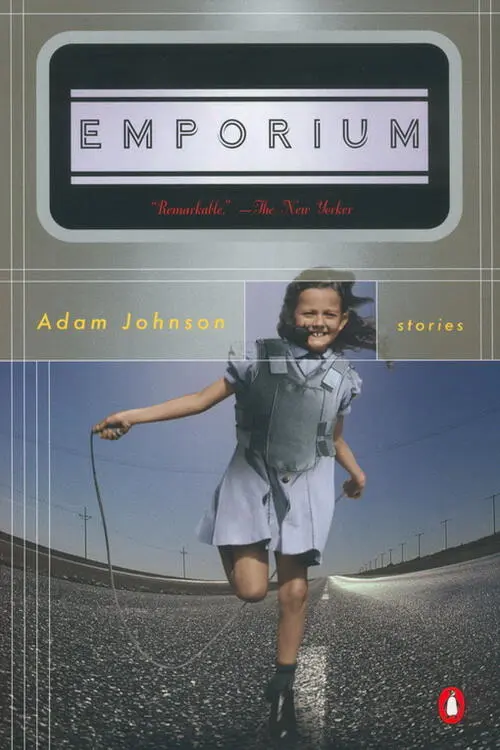
- Название:Emporium
- Автор:
- Издательство:Penguin Books
- Жанр:
- Год:2003
- ISBN:нет данных
- Рейтинг книги:3 / 5. Голосов: 1
-
Избранное:Добавить в избранное
- Отзывы:
-
Ваша оценка:
Emporium: краткое содержание, описание и аннотация
Предлагаем к чтению аннотацию, описание, краткое содержание или предисловие (зависит от того, что написал сам автор книги «Emporium»). Если вы не нашли необходимую информацию о книге — напишите в комментариях, мы постараемся отыскать её.
Emporium — читать онлайн бесплатно полную книгу (весь текст) целиком
Ниже представлен текст книги, разбитый по страницам. Система сохранения места последней прочитанной страницы, позволяет с удобством читать онлайн бесплатно книгу «Emporium», без необходимости каждый раз заново искать на чём Вы остановились. Поставьте закладку, и сможете в любой момент перейти на страницу, на которой закончили чтение.
Интервал:
Закладка:
“Let’s sit in the car,” I suggest.
As soon as we’re in, Loren’s like a gymnast the way she sidles on top of me, straddling my lap, despite the close quarters.
Up close, the light coming in sideways, I notice the faint lines around her eyes, her mouth, a few gray strands in the hair that clings to my arm. But something seems to radiate from her, too, and it’s like I can see those fine wires she was talking about, extending out, connecting to a maze of things, like all those objects on her key chain. And now one wire strings to me, which makes me feel mature somehow, adultlike for once.
I kiss her, and we begin making out with enough fury to froth up a sweaty milk of Armor All from the vinyl seat. We finger gums, ears, cheek hollows, let our teeth run zippery down neck ridges, across clavicles. We revel in friction, fabric, hair, and then I discover something dangling from the key chain in the ignition that I hadn’t noticed before: a laminated photo of young Cheryl, the Goody Two-shoes in Civic Responsibility who gave her oral presentation on “Loving Thy Neighbor.”
I reach for the belt buckle of Loren’s shorts.
“Easy, tiger,” she says. She pulls back and grabs my shoulders, holding me at arm’s length.
I lift my eyebrows. “The night is young,” I tell her.
“Oh, that’s precious. A line from a movie.” She laughs. “You’re dangerous. You could really cause some problems.”
* * *
I drop by my father’s place on the way home. He only lives two blocks from my house, and I try to hang out with him when he gets down on himself. He refuses to have a phone, and after a running argument with the Postal Service, they stopped delivering his mail. So you deal with my father in person. He also doesn’t believe in things like licenses, bonding, registration, or insurance, which is why they impounded his four-ton flatbed truck last week, the reason I have to haul so much block by hand.
In the driveway, I park next to his Dodge, and our trucks are like twins with beds full of sand and pink block. Crossing the lawn, I move through the weepy branches of eucalyptus trees I climbed as a kid. I grew up in this house, and it’s always strange to see my old home as a bachelor’s place — bare couch, blank walls, a crate of motorcycle parts in the corner.
Mom got this place in the settlement, and then she and I moved to a new, “memory-free” house down the street so I could go to the same school. She kept the old house as an investment, and then, in a twist of fate, leased it to my father. Mom took some psychology courses in college, and she believes a male influence is important for me to have around. Providing this, in her opinion, is a good investment.
Before I’m through the gate that leads to the backyard and the kitchen’s sliding door, I hear my father’s rip saw and smell hot sap and green pine. Inside, I find him sawing lumber, which is generally a bad sign. In the dining room where we all once ate our meals together, he has positioned a lone table saw, and he smokes a little Mexican cigar called a rojo as he feeds the pitched blade. He is shirtless, and the sawdust frosts the hair on his chest and arms, obscuring his old navy tattoos.
“What’cha building?” I ask, and the board he’s mitering bucks back.
“Jesus,” he says. “Give me a heart attack.”
He kills the saw and gives me a big smile, even though I know he’s been real negative on himself lately. He’s gotten to a strange place these days, and I don’t even know what to call it. He’s a worker, however, and whenever he gets like this, he remodels something, though I don’t tell my mother about the skylights he cut into her roof or the bunks he built so he could sleep the way he did on the navy boats.
He grabs us two beers and explains his plan. “I’ve been thinking about building a breakfast bar,” he says, sweeping his arm. “Over here, so it catches the sunlight when I eat cereal and check out the paper. Breakfast is the most important meal of the day, right?”
There’s some sarcasm in his voice, but the gesture is sincere — a blue-panthered bicep, coated with sawdust, shows me the only way it knows to fix things.
“I think they’re calling them nooks these days — breakfast nooks,” I tell him. “Because of how a bar makes you think of alcohol.”
Dad grabs two folding chairs and considers this. We open the chairs and sit with our beers on either side of a masking tape outline on the floor, which is in the general shape of the future breakfast nook.
We both sit quiet a minute and imagine, I guess, that it’s morning, sun shining and some birds chirping maybe, as if Dad and I are reading the paper with coffee in a house we used to share. But it’s beer we’re drinking, and when I was living here, I was the kind of kid who mostly ate by myself, in front of the TV.
“I don’t know,” he says, smoking. “I don’t think I’m a nook kind of guy. What about a breakfast bench. We could call it that.”
“What about this idea,” I tell him. “How about we get the flatbed truck out of the impound yard? We could scrape up the money to make it legal and get it back on the road.”
“Forget about the flatbed,” he says, shaking his head. “The flatbed was an experiment. The flatbed’s over.”
I take a sip of beer and a memory comes to me from when I was eight, and my father came through this door, home from a naval tour to announce that he hated the smell of metal, of insulation, and paint. He hated galvanized grating, he said, and red light bulbs and he was never going to take another order again as long as he lived. Even as a kid, I knew his heart was never really in the navy — we lived in the middle of a desert, and it didn’t seem like serious sailors would commute to the ocean. But my father became serious about being an ex-sailor and serious about his hatred of authority.
I try a different angle. “Are we going to let them get away with taking our truck?” I ask him.
He puts his rojo in his teeth and hunches sideways so he can dig in his pocket, where he finds his keys. He twists a key off the chain and tosses it to me. “Here,” he says. “It’s your truck now. You take care of it. Treat it like a baby.”
When I leave, I set the key on the edge of the table saw. I don’t want anything to do with it.
* * *
When I’m finally home, there’s a car in the driveway I don’t recognize, one of those slanty-shaped Saabs. The house is dark inside, and I strip naked by the sliding door, before heading out to the backyard, where I masturbate on the lawn. The sprinklers have run, and my bare feet leave dark prints in the misted grass. I have a lot on my mind, so it takes a long time. Above, birds wrestle their wings in the tight nests of a palm tree. The grapefruit leaves are thick, waxy, as I stare up through them.
* * *
In the morning, I come downstairs to find a man in slacks and an unbuttoned dress shirt eating in our kitchen. A loose tie drapes his shoulder. There is a little TV on the counter, and he’s watching “Shark Week” on the Discovery Channel while thumbing through some papers.
“Hey,” I say. His briefcase sits open, and he wears reading glasses, though he looks too young for them. He’s really going at the cereal.
“Hey,” he says. “I’m Greg. We met at your mom’s office party.”
“I remember,” I say and grab a bowl.
“No, wait.” He points at me with a spoon. “Maybe it was at that awards thing.”
“Sure,” I tell him. “That sounds right.”
When I pick up the box of Cap’n Crunch, it’s empty.
“Isn’t this stuff great?” Greg asks. “God, I haven’t had this stuff in years.”
“Yeah, that’s why my mom buys it for me. ”
Читать дальшеИнтервал:
Закладка:
Похожие книги на «Emporium»
Представляем Вашему вниманию похожие книги на «Emporium» списком для выбора. Мы отобрали схожую по названию и смыслу литературу в надежде предоставить читателям больше вариантов отыскать новые, интересные, ещё непрочитанные произведения.






Обсуждение, отзывы о книге «Emporium» и просто собственные мнения читателей. Оставьте ваши комментарии, напишите, что Вы думаете о произведении, его смысле или главных героях. Укажите что конкретно понравилось, а что нет, и почему Вы так считаете.