Adam Johnson - Emporium
Здесь есть возможность читать онлайн «Adam Johnson - Emporium» весь текст электронной книги совершенно бесплатно (целиком полную версию без сокращений). В некоторых случаях можно слушать аудио, скачать через торрент в формате fb2 и присутствует краткое содержание. Год выпуска: 2003, Издательство: Penguin Books, Жанр: Современная проза, на английском языке. Описание произведения, (предисловие) а так же отзывы посетителей доступны на портале библиотеки ЛибКат.
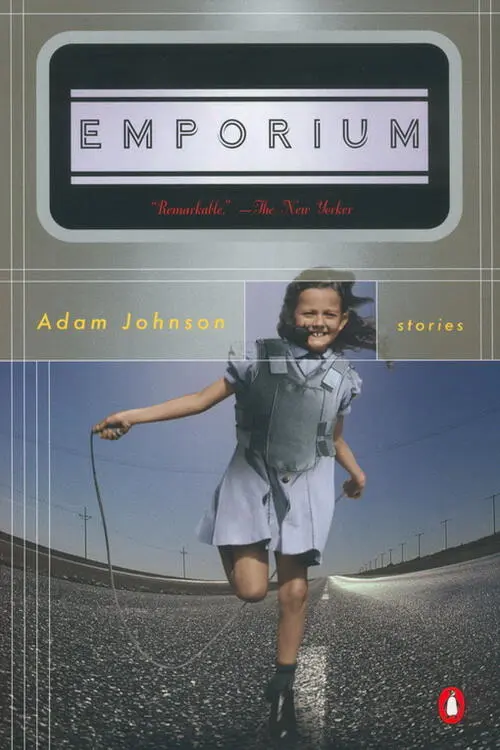
- Название:Emporium
- Автор:
- Издательство:Penguin Books
- Жанр:
- Год:2003
- ISBN:нет данных
- Рейтинг книги:3 / 5. Голосов: 1
-
Избранное:Добавить в избранное
- Отзывы:
-
Ваша оценка:
Emporium: краткое содержание, описание и аннотация
Предлагаем к чтению аннотацию, описание, краткое содержание или предисловие (зависит от того, что написал сам автор книги «Emporium»). Если вы не нашли необходимую информацию о книге — напишите в комментариях, мы постараемся отыскать её.
Emporium — читать онлайн бесплатно полную книгу (весь текст) целиком
Ниже представлен текст книги, разбитый по страницам. Система сохранения места последней прочитанной страницы, позволяет с удобством читать онлайн бесплатно книгу «Emporium», без необходимости каждый раз заново искать на чём Вы остановились. Поставьте закладку, и сможете в любой момент перейти на страницу, на которой закончили чтение.
Интервал:
Закладка:
But there’s not much for Treen to be wary of. My father’s a pretty nice guy who sat on gunboats for about ten years, where he probably battled some serious boredom, engaged the enemy’s tattooists, and then surrendered in general before returning home to leave my mother and me.
“Look,” Treen says and points where we are to build the next section of wall. “My neighbors are shit-heeling me. They said they would pay for half the cost of the wall, and now they’re backing out.”
I try to visualize a shit-heeling.
“They know they’ve got me,” Treen says. “They know I’m going to build the wall anyway. I’m wondering if there’s a way we can make their side of the wall crooked or crappy or something.”
This appeals to my father’s sense of justice. “Sometimes,” he says, “the joints on a wall come out looking smooth and clean. Sometimes they’re uneven and messy.”
“Can you do that, make them crappy?”
“Can do,” my father says.
I think this idea is a mistake. Our walls are solid and true, built to last, not like most you see today, cracking from lack of rebar, skimpy mortar, or thin footings. You only get one chance to build a wall right.
“Was it the color?” I ask Treen.
“What?”
“The neighbors,” I say. “Did they hate the pink?”
“It’s not pink,” Treen says. “It’s called Anasazi Sunset.”
The rest of the day, my father and I work quietly, on opposite sides of a wall we are on tiptoes to finish. I groom my joints, while Dad lets the mortar slop where it may, the two of us running rows until the wall completely outgrows us, and all I can make out of my father is the pitched blade of his trowel. There’s a strange comfort to spending the afternoon a few feet from someone you cannot really hear or see, though I can’t quite explain it. You just know they’re there, even when they don’t seem to be there.
* * *
On Thursday, I sit by Loren in City Hall, and we play more games.
Mr. Doyle has us pull words from a purple velvet bag that looks suspiciously like the kind that come with bottles of Crown Royale, and play a kind of charades. The words begin simple enough. There’s “friend” and “goal.” A man in a suit acts out “share” by holding imaginary objects close to his heart before giving them away to each of us. We receive our invisible gifts with two hands, to prevent spilling.
But the words start to get weird — next come “sacrifice,” “testify,” and “redeem.” My word is stupid. I reach into the fuzzy bag and draw a folded slip that reads “hope.” I have no idea what to do with this.
I walk to the head of the table, and unable to think of any way to convey hope, just stand there in front of those creepy, outward-slanting windows that invite you to fall into the parking lot below.
“Balance,” the old woman shouts.
“Sober,” someone says.
I wave these responses off, but with the sight of my lifted arms comes “wings,” “soar,” and “guardian angel.”
I decide to divide the word into two parts, “hoe” and “pee.” I begin to work my imaginary hoe through crop rows, emphasizing my elbows and the straightness of the tool. I get “garden,” which prompts “grow” and “blossom.”
Loren shouts “weed.”
I try the “pee” part of the formula by tracing an imaginary arc of urine with my little finger, extending it from my crotch out toward the confused redirectees.
The old woman shouts “police horse,” and Mr. Doyle says my time is up.
When it’s Loren’s turn, she sets down her sport cup and comes to stand before us with her word. She looks down at her feet, concentrates, then works her lips as if she’s evening her lipstick. What she does next makes everyone lean back and inhale. She bends down, throws her legs high, and executes a perfect handstand — palms pressed wide on the tan carpet, spine curved hard, legs together.
No one takes a shot at what this might mean, except me. “Jesus,” I say.
Like that, she pops back up, and is shaking her hair straight before anyone can react. “Beautiful, Ronnie,” she says.
Clearly troubled, Mr. Doyle comes to check the piece of paper. He opens the folded square, eyes the two of us, then puts it in his pocket. “This is a good time for a breather,” he announces.
At break Loren and I take off, heading south toward the Maricopas, the closest thing I know to Mexico on a Thursday night. My truck is full of block and tools, and when we reach a certain speed, sand whips in the windows and bites us.
To the east, the moon is swollen, rising, so that it is framed in the truck window past Loren’s face, which is fixed somewhere just short of regret.
“I should tell you,” she says. “My husband can tear a phone book in half.”
“Are we talking Rural or Metro?”
“We’re talking about the Yellow Pages.”
I laugh, and with that, some reservation leaves her face.
Loren opens lukewarm wine coolers for us and tunes the radio to a Mexican station. I point out the snakes that appear in the edges of our headlights, sprawled across the shoulders of the road to warm themselves on the asphalt. The road begins to bob and switch, and where the foothills of the Maricopas rise, we pull off the main road, the tires moaning through the sugar sand of an arroyo until I shift into four-wheel.
To the south are cliffs that appear obsidian, and the distant heat lightning they reflect seems to flash from deep within them. Loren’s eyes are drawn to where we came from, to the orange dome of Phoenix. I wander through rolling hills and washouts until we are deep enough into the dark carpet of the desert that the faint whoosh of cars on the road vanishes.
I park near an outcropping of black rock that rims the swell of several dunes. There is silence when I cut the motor, and Loren is wide-eyed at what lies before us. Chollas stand fuzzy and glowing against the indigo sand, and saguaros look cut from smoky, purple-green glass.
The sand hills loom ahead, and after climbing out, we move through the crumbly, pink chalkstone and caramel-colored joshua trees that lead the way. From somewhere, a light breeze brings the clean, dusty smell of wet granite. Smoke trees waft in the dark, stirring elf owls and their strange double calls.
“It’s like a whole nother world,” Loren says.
“This is happening every night out here,” I tell her.
We move on into the desert, taking deep steps up the moonlit faces of the dunes, and sliding down their bluish, shadowy backs. We sink and climb, sometimes on all fours, our hands and feet moving through a cool layer of air that hovers over the sand. When there is nothing to be seen but dunes, we lie at an angle along a crest, the stars overhead seeming to wobble and migrate, shifting design as easily as the high, formless clouds that cruise below them.
Loren rolls on top of me, straddles my midsection.
“I’ve done some things,” she says, “and Jack’s done his share, believe me. But I’m not really one to run around, alright? I’m just telling you that.”
“Do you love him?”
She puts a hand on my chest to support her weight, and with the other, touches my cheek. “What do you know about love?”
She smiles, but it’s a little bitter, too. I shrug.
“Do you ever think about leaving him?”
“That’s not so easy.”
“I don’t know. My dad left us at the same time he left the navy. Then he moved in down the street, and I saw more of him than ever.”
“Oh, tiger,” she says. “I’m not sure if that’s a sad story or not.”
My shirt and pants are starting to fill with sand. I touch Loren’s side, feel the last, stunted ribs of her cage. “It’s the only story I got.”
Читать дальшеИнтервал:
Закладка:
Похожие книги на «Emporium»
Представляем Вашему вниманию похожие книги на «Emporium» списком для выбора. Мы отобрали схожую по названию и смыслу литературу в надежде предоставить читателям больше вариантов отыскать новые, интересные, ещё непрочитанные произведения.












Обсуждение, отзывы о книге «Emporium» и просто собственные мнения читателей. Оставьте ваши комментарии, напишите, что Вы думаете о произведении, его смысле или главных героях. Укажите что конкретно понравилось, а что нет, и почему Вы так считаете.