Adam Johnson - Emporium
Здесь есть возможность читать онлайн «Adam Johnson - Emporium» весь текст электронной книги совершенно бесплатно (целиком полную версию без сокращений). В некоторых случаях можно слушать аудио, скачать через торрент в формате fb2 и присутствует краткое содержание. Год выпуска: 2003, Издательство: Penguin Books, Жанр: Современная проза, на английском языке. Описание произведения, (предисловие) а так же отзывы посетителей доступны на портале библиотеки ЛибКат.
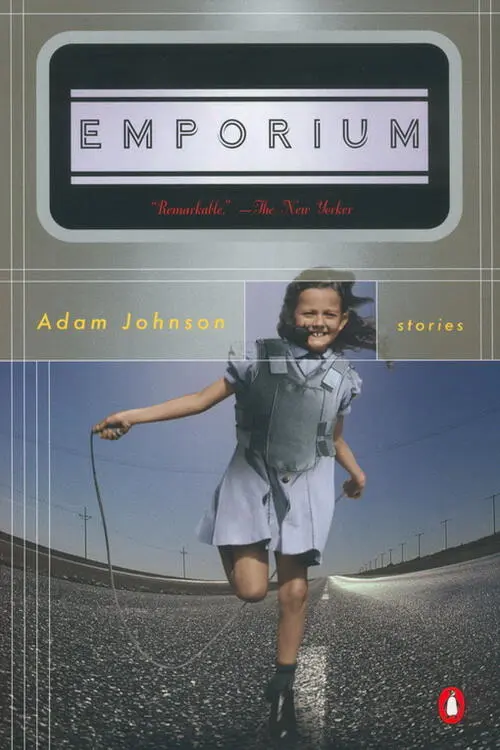
- Название:Emporium
- Автор:
- Издательство:Penguin Books
- Жанр:
- Год:2003
- ISBN:нет данных
- Рейтинг книги:3 / 5. Голосов: 1
-
Избранное:Добавить в избранное
- Отзывы:
-
Ваша оценка:
Emporium: краткое содержание, описание и аннотация
Предлагаем к чтению аннотацию, описание, краткое содержание или предисловие (зависит от того, что написал сам автор книги «Emporium»). Если вы не нашли необходимую информацию о книге — напишите в комментариях, мы постараемся отыскать её.
Emporium — читать онлайн бесплатно полную книгу (весь текст) целиком
Ниже представлен текст книги, разбитый по страницам. Система сохранения места последней прочитанной страницы, позволяет с удобством читать онлайн бесплатно книгу «Emporium», без необходимости каждый раз заново искать на чём Вы остановились. Поставьте закладку, и сможете в любой момент перейти на страницу, на которой закончили чтение.
Интервал:
Закладка:
Greg kind of coughs, but it might be a laugh. “Sorry,” he says.
Mom comes downstairs. She’s wearing a black suit with a bright scarf, and she’s in a pretty good mood. She is fumbling with an earring and heading for the coffee when she grabs one of my hands. She turns it back and forth in the light. It’s still a faint pink. “You better graduate college,” she tells me, shaking her head. Then she hands me some pamphlets. “Here, I got these for you.”
The pamphlets are about depression. One’s entitled “Warning Signs,” which features a big, yellow Yield on the cover. The other features a lamb, bright-eyed, gazing out from where it is cradled, in the great paws of a lion. This one’s named “Last Call.” Crucial to my mother’s idea of my father is that there is something really wrong with him, because if there isn’t something wrong with him, then he left us for no reason.
“Where’d you get these?” I ask her.
“City Hall. I filed a petition there yesterday, and they had all these sitting out on a table.”
Mom kisses Greg, grabs her briefcase, and then kisses me before heading out into the garage, leaving the two of us.
The theme music from Jaws is on the TV.
“So, are you just going to hang out?” I ask.
“Well, I got to finish this report,” he says, “and my show’s not over. Shouldn’t you be in class or somewhere?”
I shrug and take a stool across the counter from Greg, who makes being a county judge look pretty easy. “Shouldn’t you be married or something?”
“I was,” Greg says, “but I got a little condo now.”
When I graduated, my friend Terry Patuni asked me to move in with him, to get our own place, and I said no, like an idiot. Mom was like, “stay at home and live for free,” but she works a lot, and I do all the stuff like mowing the lawn and don’t get shit for it.
I check out the pamphlets to the sounds of thrashing fish. The big warning sign in the depressed person’s behavior, it turns out, is a sudden mood shift to peace and happiness, even elation. This can often mean a final decision has been made, and the weight of all earthly troubles has been lifted.
Sharks have limited feelings, I also learn, and they never sleep.
* * *
In Civic Responsibility class, I sit behind Cheryl. She wears a long dress with thin straps and sunflowers all over it. A fine gold cross has worked its way around the back of her neck, so it faces me, and there are running waves of goosebumps across her shoulders and the backs of her arms. I’ve never really said anything to Cheryl before, but I begin to wonder what she’s thinking to cause them. I lean forward to smell her hair — apples. They use the same shampoo.
We watch a movie on land conservation, and I realize two things. One, by the light of a video, Cheryl’s hair takes on the exact blue my swimming pool casts into the bougainvillea on nights when I lie on the diving board and masturbate toward the stars. Two, my father was born to be a U. S. park ranger. He has a deceivingly breezy manner that would be good with tourists, the military marksmanship to cull herds from the open door of a helicopter, and the disposition to spend weeks on end in solitude.
After class, Cheryl and I file out the door together, and I fall in with her as she heads toward the Snack Shack.
I put my hands in my pockets and try to be smooth. “Pretty lame video, huh?”
“I don’t know,” she says. “I kind of liked the part where they tagged the bears.”
“Bears can be troublemakers,” I say and watch as she digs through her woven shoulder bag. She balances it on the jut of a hip, and I check our the red marks on her shoulders from her bra straps, smile at the way her sunglasses start to slide off her nose, and she lets them fall in the bag as she digs around. But I don’t really see anything nymphomaniac about her.
She pulls out a pack of menthols. “Smoke?”
“I didn’t know you guys were allowed to smoke,” I tell her.
“What are you talking about? Allowed by who?”
“Aren’t you all Christian?” I ask. “I mean, the body’s like the temple, right?”
“I’m not even going to respond to that,” she says. “First of all, Jesus doesn’t even care about the body — he’s into your soul. And besides, nobody ever told Jesus what to do.”
“Jesus doesn’t care what you do with your body?”
Cheryl takes her time lighting the cigarette. “I make my own decisions,” she says and then heads off, walking all cool because she knows I’m watching.
When she’s gone, I take the long way to the student parking lot, past the south lawn where the cheer team usually practices this time of morning. I like the way their skin flashes through those blue and gold outfits, and I sometimes hang my fingers in the fencing and stare. Today, though, the high kicks and girl tosses seem different. Today their uplifted arms and bright smiles make them look falsely optimistic, and according to my pamphlets, possibly suicidal.
I drive to the gravel pits, where I have them dump a quarter ton of sand in the bed, and then head to our job site in Chandler, my rear tires rubbing the fenders the whole way.
The neighborhood we’re working in has only half walked out of the desert, and the house is one of those sprawling adobe numbers with fat, curved sides and wooden hogan ladders. The guy who owns the place is some hotshot named Treen. I don’t like him, but he wants three hundred feet of pink wall around the lot and a strange, yellow decorative wall out front. This is enough work to carry my father for some time.
I mix mortar while my father, in an open khaki workshirt, eats a doughnut, smokes his rojo, and butters block at the same time, tapping the rows into level with the butt of his trowel. I shovel sand, cement, lime, and dye into the mixer, then polish off a grape soda as I fire the hose nozzle into the spinning drum. It’s funny how the ingredients always refuse to mix for a while. Gray, red, brown, and white flop, clump and clot in the tumbler before finally blending into a smooth, pink mortar.
I crumple the soda can and drop it in the half-finished wall, listening as it jangles its way to the bottom. We throw snack wrappers, smoke packs, fast-food trash, and Hamms beer bottles into the hollows in the wall formed by the holes in the block. I tossed a broken wristwatch into a wall once, and another time, I ditched a stupid paperback I was reading called Battlefield Earth! And somewhere in the city of Phoenix is a wall that holds a lost set of my father’s car keys. Sometimes I imagine people in the future tearing down our walls and trying to figure out who we were by what they find inside.
We both start laying block, and we find a groove, working on opposite sides of the waist-high wall to move faster. We don’t usually work face to face, and for some reason, I start inventing stories, one after another, to try to crack my father up. He must know I’m making it all up, but he keeps laughing, and I can’t fully explain my need to lie. I say I heard on the radio that they switched two monkey’s heads in a lab in Switzerland. I describe how a cocky filmmaker was eaten on “Shark Week.” Leonard Nimoy is secretly buying the space station Mir. There’s a cult of Christian nymphomaniacs recruiting in Tempe, I tell him. They all smoke menthols.
At lunch, we spread our shirts on the ground in the shade of our freshly jointed wall, and we are leaning back to eat burritos and drink beer when Treen comes over. It’s clear he’s been lying on pool furniture by the red lines across the backs of his legs and arms. He’s wearing swim trunks and a sweater in the heat, one so thin and loose I know it costs hundreds of dollars.
Treen eyeballs the beer but says nothing. I can tell he’s more nervous about my father’s tattoos — the red lantern on his shoulder, the blackbird fanning his back, a string of foreign characters down his spine. From here, Treen stares at the golden burst of what is supposed to be a Chinese dragon’s head on Dad’s chest. It always looked more like a goldfish to me.
Читать дальшеИнтервал:
Закладка:
Похожие книги на «Emporium»
Представляем Вашему вниманию похожие книги на «Emporium» списком для выбора. Мы отобрали схожую по названию и смыслу литературу в надежде предоставить читателям больше вариантов отыскать новые, интересные, ещё непрочитанные произведения.










Обсуждение, отзывы о книге «Emporium» и просто собственные мнения читателей. Оставьте ваши комментарии, напишите, что Вы думаете о произведении, его смысле или главных героях. Укажите что конкретно понравилось, а что нет, и почему Вы так считаете.