Adam Johnson - Emporium
Здесь есть возможность читать онлайн «Adam Johnson - Emporium» весь текст электронной книги совершенно бесплатно (целиком полную версию без сокращений). В некоторых случаях можно слушать аудио, скачать через торрент в формате fb2 и присутствует краткое содержание. Год выпуска: 2003, Издательство: Penguin Books, Жанр: Современная проза, на английском языке. Описание произведения, (предисловие) а так же отзывы посетителей доступны на портале библиотеки ЛибКат.
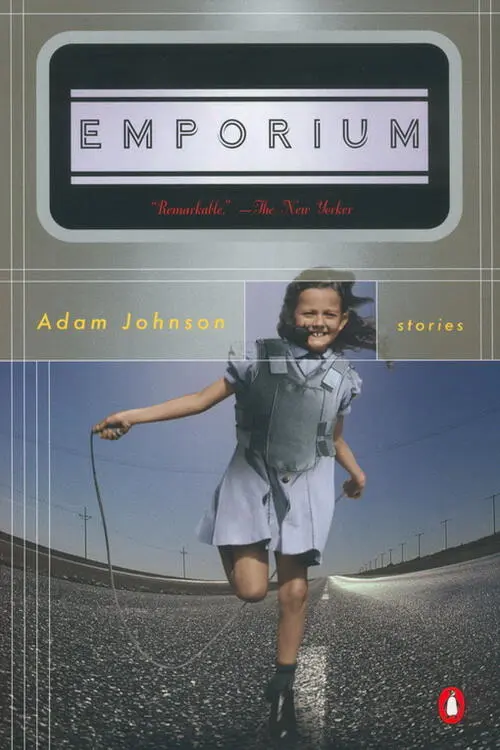
- Название:Emporium
- Автор:
- Издательство:Penguin Books
- Жанр:
- Год:2003
- ISBN:нет данных
- Рейтинг книги:3 / 5. Голосов: 1
-
Избранное:Добавить в избранное
- Отзывы:
-
Ваша оценка:
Emporium: краткое содержание, описание и аннотация
Предлагаем к чтению аннотацию, описание, краткое содержание или предисловие (зависит от того, что написал сам автор книги «Emporium»). Если вы не нашли необходимую информацию о книге — напишите в комментариях, мы постараемся отыскать её.
Emporium — читать онлайн бесплатно полную книгу (весь текст) целиком
Ниже представлен текст книги, разбитый по страницам. Система сохранения места последней прочитанной страницы, позволяет с удобством читать онлайн бесплатно книгу «Emporium», без необходимости каждый раз заново искать на чём Вы остановились. Поставьте закладку, и сможете в любой момент перейти на страницу, на которой закончили чтение.
Интервал:
Закладка:
“Like they say,” Loren lifts her drink. “Rain falls equally on saint and sinner.”
I lift my drink, too, but the sight of her lipstick, dark and smudged on the rim, makes me pause. I cup my mouth around it, get a shiver in the hot parking lot.
Back inside, we are broken into groups to play unusual board games that seem designed to teach us how to have fun without controlled substances, which is supposed to be the point of this class. In reality, however, all the games are rigged so that everyone loses, and there’s something weirdly churchy about them. There’s “High Times” and “One for the Road,” which uses hazardous highway signs to convey its message. Loren and I join a group playing a Monopoly-style game named “Last Call.” You start with plenty of money, but it quickly goes to pay the bartenders, dealers, and bookies. Once poor, you have to draw from a stack of cards called Sobering Realities . I keep landing on Make Mine a Double . Loren wraps her Corvette around a tree. I go blind and my pregnancy ends in stillbirth.
After class, I walk with Loren in the parking lot. “Sorry we went Bottoms Up at the end,” I tell her. “Those dice had to be loaded.”
“Look,” she says. “You want to go for a drive? I want to go for a drive.”
“A drive where to?”
Loren glances up, shrugs. “I don’t want to go home just yet.”
She hands me the keys to the Chevelle, and the chain weighs a ton with all sorts of trinkets attached to it, but I head for the driver’s door and the ’Velle fires up with authority. The interior is mint: three-speed on the column, amber gauges, and a black vinyl bench seat that is an ad for Armor All. Out on the hood is a red-faced tachometer that glows brighter the more I rev. I don’t know why they put them out there, but it’s universal for tough.
On the dash is a statue of Jesus. It’s not the one of him being crucified, but from before, on the way to the cross with his crown and blood and bad back. The statue’s arms are uplifted, and the cheap plastic molding makes the fingers look webbed.
“Don’t worry about that,” Loren says and pops the statue out of the little base that holds its feet and reclamps it upside-down, so that Jesus is doing a handstand.
Somehow, when I see her do this, I’m not as nervous about driving Loren in a muscle car custom-built by her husband, a man so without fear that he’s removed the seat belts.
“Let’s go to the tower,” I say, which is the big water tank on the side of Hayden Mountain that looks down on the university.
I ease through the parking lot, but I can’t help goosing the ’Velle on the first left out of City Hall, a move that sends me sliding across the slick seat into Loren’s lap, leaving the car idling, driverless, sideways in the street.
“Why don’t we try that one again?” she says.
The car runs hot as we wander the backstreets of Tempe’s college scene, past bars and taquerias, even the open-air cantina where I pissed on the horse, but I don’t point that out. Near the old Hayden Mill, we hit a bump and there’s a wild jangle in the trunk. “Christ,” Loren says, “Jack and his crowbars.”
Up the winding road, we park in front of the storm-wire fence that surrounds the massive tank. Loren and I sit on the hood with the last of our drinks. Under us, the cooling motor hisses and seethes to run again, and out there is the orange wash of the south valley: to the east is the floodlighted Sun Devil stadium, and south, beyond Tempe, Chandler, and the Heights, are the Maricopa Mountains, while west sit the Papagos, circling the dark Phoenix Zoo.
Around us is a rocky shelf of beer cans and cigarette butts, and then a steep drop-off down to the lights of the university, whose cement walkways and hard-angled courtyards tremble in the heat.
“Have you ever been to Mexico?” Loren asks, and I realize she’s looking a lot farther south than I am.
“A few times,” I say, but she wants to hear more, I can tell. “It’s not so different, really. You can go twenty minutes outside of Tempe and you’d think you were in the desert outside Guymas or Hermasillo.”
Loren begins running her hand over my thigh, tracing her fingers along the muscle, absently pulling out bits of mortar that have hardened in the hair. The little pricks of pain give me an erection so fast and sure I get light-headed. I describe the smell of Mexican creosote after rain, the wicked look to a yucca plantation, the taste of prickly pear meat.
“When you said things were complicated,” I say. “Complicated how?”
“You’re young. You’ll get older, you’ll see.” She rattles the ice in the bottom of her cup, then she chews a piece, her voice throaty through the plastic. “There’s a point of overconnection in life. Everything’s suddenly strung together, like with fishing wires you can’t see.”
I don’t really get what Loren’s talking about, and she sees it on my face.
“Earlier tonight I got a glass of water,” she says. “Plain water. But from somewhere in the house, Cheryl hears the ice crusher go off in the fridge door. Maybe the ice crusher makes her think of the cold packs for Jack’s tendons, my vodka martinis, or the fishing bait coolers Jack fills whenever he feels a ‘relapse’ coming on. Either way, Cheryl deals with things by blasting the Christian rock. And then here comes Jack, all red and worked up, concentration shot, stomping in from the garage where he’s been shadowboxing Jesus. The wires go a thousand places from there.”
An El Camino pulls up a couple car lengths away, and I give it a good look over while I try to wrap my brain around what Loren’s saying. The car’s seen some rough trade. Its panels have been blasted and primered, and there’s a pattern of Bondo rings consistent with the repair of damage from automatic gunfire. There is a homemade hood scoop large enough to funnel every bad idea in town into the motor’s smoky maw.
“Forget about all that stuff, though,” she says. “You don’t have to worry about that for a while. Maybe that’s why I was drawn to you. That and your hands. Soon as I saw your hands, I had a feeling about you.”
She takes my palm, touches all the little nicks from my trowel. She rubs the patches of red on my wrists. “My daughter has this,” she says, “on her neck, though hers is a softer red. I think it’s beautiful. Jack hates it. He thinks everything’s a sign.”
“This is just dye,” I tell Loren. “I lay block for my father. We buy colored block and then dye the mortar. It saves the cost of painting the wall later.”
“I still like it.”
Loren cups my hand, working her thumbs deep between the bones. Her breath is sweet with alcohol and Sprite, and over her shoulder I absently watch a man and woman exit the El Camino, come round to the front bumper, and unbutton each other’s jeans.
I touch her neck, running the back of my hand along that tendon there. I trace the underside of her jaw, smooth her brow with my thumb. She closes her eyes a moment, the outlines of her pupils roaming beneath the lids, and looking at her features, it hits me all of a sudden who her daughter might be: Cheryl, a girl I sometimes sit near in my Civic Responsibility class at Tempe Community College, a girl with a red mark on her neck, a locket-shaped pocket of red.
Behind Loren, the man and woman start going at it on the grill of the El Camino, humping with the bland monotony of a sump pump, while the hollow throat of the hood scoop exhales waves of heat from the motor. The guy’s around my dad’s age, fifty maybe, and though I’ve done the nasty at least three different times, I guess it kind of weirds me out to see older people doing it. I mean, they don’t even take their clothes off.
Читать дальшеИнтервал:
Закладка:
Похожие книги на «Emporium»
Представляем Вашему вниманию похожие книги на «Emporium» списком для выбора. Мы отобрали схожую по названию и смыслу литературу в надежде предоставить читателям больше вариантов отыскать новые, интересные, ещё непрочитанные произведения.





Обсуждение, отзывы о книге «Emporium» и просто собственные мнения читателей. Оставьте ваши комментарии, напишите, что Вы думаете о произведении, его смысле или главных героях. Укажите что конкретно понравилось, а что нет, и почему Вы так считаете.