Adam Johnson - Emporium
Здесь есть возможность читать онлайн «Adam Johnson - Emporium» весь текст электронной книги совершенно бесплатно (целиком полную версию без сокращений). В некоторых случаях можно слушать аудио, скачать через торрент в формате fb2 и присутствует краткое содержание. Год выпуска: 2003, Издательство: Penguin Books, Жанр: Современная проза, на английском языке. Описание произведения, (предисловие) а так же отзывы посетителей доступны на портале библиотеки ЛибКат.
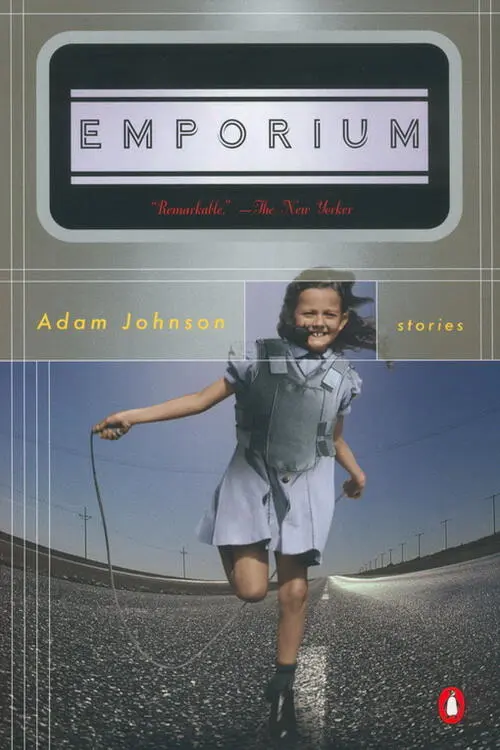
- Название:Emporium
- Автор:
- Издательство:Penguin Books
- Жанр:
- Год:2003
- ISBN:нет данных
- Рейтинг книги:3 / 5. Голосов: 1
-
Избранное:Добавить в избранное
- Отзывы:
-
Ваша оценка:
Emporium: краткое содержание, описание и аннотация
Предлагаем к чтению аннотацию, описание, краткое содержание или предисловие (зависит от того, что написал сам автор книги «Emporium»). Если вы не нашли необходимую информацию о книге — напишите в комментариях, мы постараемся отыскать её.
Emporium — читать онлайн бесплатно полную книгу (весь текст) целиком
Ниже представлен текст книги, разбитый по страницам. Система сохранения места последней прочитанной страницы, позволяет с удобством читать онлайн бесплатно книгу «Emporium», без необходимости каждый раз заново искать на чём Вы остановились. Поставьте закладку, и сможете в любой момент перейти на страницу, на которой закончили чтение.
Интервал:
Закладка:
Q shook his head. “I need a vacation,” he said into the Canadian darkness.
We wouldn’t be able to raise Jacques on the dictascope for another twenty-seven minutes, so we all marched back down into the bunker, where we sat upon upturned thorium drums and shot the breeze. Mansoor described the appearance of the moon, seen from the rooftops of Islamabad, on one particular night of his boyhood, an image that still moved him, yet eluded description—“not saffron, not tamarind, lighter than orange peel”—while I entertained my first notions of life after this project. Already, I could see Q and myself on vacation in Acapulco, sipping Mooseheads on the beach, while the rhythms of the swaying palms and surf blended into the singsong of Mansoor’s memory, “the color of spiced butter, near melting, but textured and pewtery, like old lacquer, or perhaps the yellow base of a parrot’s beak, where it disappears into the violet of its feathers.”
Q started telling a story about the old days, about doing research back before fancy instruments. I hung on his every word, so rapt I didn’t notice he’d accidentally lifted my thermos off the floor.
“We worked on instinct, letting our balls be our guide,” Q was saying as he unscrewed the lid to my flatworm experiment. “In the days before electron microscopes, logarithms were our eyes. We didn’t need particle accelerators when our guts told us that nutrinos existed.” Then he lifted the thermos of liquid nitrogen to his mouth. He drank, turned blue, and we lost him, right there in the bunker.
“Give us room,” I yelled as I prepared to revive him. Mansoor held back Scotty, already weeping as he reached to touch Q’s sleeve. Vu was in hysterics, but they all left the bunker so I could get to work. I placed Q’s body in one of the long thorium drums. Next, I filled the drum with warm water. Then I gave Q lots of love.
It didn’t work. I couldn’t bring him back. There was only an expression of beautiful inquiry in Q’s eyes, a look suggesting he’d witnessed what lay ahead — warmth, light, acceptance — perhaps my truest proof of sympathy’s existence.
Alone, I wept in a way that did not redden my eyes or crack my face. It was a sadness that expressed itself only as a rattle in my lungs, a strange twitch to my fingers, and it is a weeping that never stopped. This sorrow settled in, became such a bunk mate that I forgot its source. Convinced I had asthma, arthritis, anything, it wasn’t until a decade later, when I ran across a photo of Q in a top-secret folder that I knew I wept yet. At the back of the file, I saw Q’s real name: Randolph.
The guys returned to console me, but I waved them off. There was nothing to do but get back to work. In three short days, Jacques would safely float down to the biggest party Ontario had ever seen. Mulroney had already ordered the beer. Until then, we owed that little fur trapper our best. It’s what Q would’ve wanted.
“Allo, allo,” we heard over the speaker. “C’est Jacques. Dites-moi, mes amis.”
We looked at each other. Dr. Q was the only one who’d spoken French.
Mansoor grabbed my arm. “Just repeat whatever the heck he says.”
“Quel ciel! J’observe les cometes et le systeme solaire.”
I grabbed the handset while Vu checked Jacques’s position. “Solaire,” I said.
We all watched for Jacques’s green blip as Vu fired up the dictascope.
When the screen warmed up, Jacques’s blip was way off course.
“Wouldn’cha know he missed the moon,” Vu said, “by about a heck of a lot, eh.”
“Make you now an around turn,” I said to Jacques. “U-turn.”
“Oui,” he said. “Espace resemble l’uterine. L’acte du creation est tres evident.”
Vu grabbed the handset. “Look here, Jacques, you better return, eh.”
“Retournez?”
Mansoor gave it a go. “Use the stick, Jacques. Time for the baton of joy.”
We then lost radio contact with him for about five minutes.
Despite the unnerving radio silence, Jacques’s green blip did slowly begin to turn back toward the moon, except now he was forced to land on the dark side. Scotty grabbed a slide rule for some quick extrapolation. His fingers whirred, then stopped cold. “He’s used too much fuel in the turn around. He’ll never make it home.”
Upon landing, Jacques began broadcasting nonstop, narrating everything he saw on the moon’s far side. His voice soared and plunged, was laced with awe and fever. I imagined the landscape he described, its starlit plains legioned by purple well-heads of rock, the sky above a lecture on black. As Jacques spoke and spoke, I filled the great canyons and craters with my own loss and loneliness, felt a void no rope could span.
What we really needed was a French dictionary or some type of recording device, but we’d left Q’s reel-to-reel back at the Tundra Lab. All night, we listened to Jacques convey to us wholesale the pure nature of the universe. In the morning, the nodule’s battery went dead, and we never heard from Jacques again.
The whole thing was a public relations nightmare for the CIA, which was forced to deny ordering over eighty kiloliters of beer delivered to Martyr’s Park in downtown Ottawa. Mulroney’s men confiscated all our documents, and then they began killing us. Vu was thrown down an ice crevasse, Scotty was immolated below the launch pad of a Yukon ballistic base, and rumor has it that Mansoor’s last date was with our own half-working deathray. The labs were burned and the bunkers buried in an attempt to hide the embarrassing truth that the great nation of Canada could put a man on the moon, but not bring him back. The only evidence this country ever even had a space program is the total wasteland we made of north-central Canada.
Yet I survived, even though all my attempts at reanimation had failed, and I was a bad scientist. I was a career-long failure as a weapons development scientist. I toyed with anthrax a bit, to little avail, and then there was that now-famous stab I took at controlling the weather. I suppose my only success was some minor work with defoliants.
I wouldn’t learn why my life was spared for some time, until the CIA approached me and revealed that they’d been doing their own flatworm experiments for years, but with less noble intentions. They were getting close to harnessing the power of sympathy, a force the CIA believed, if properly applied, could fuel the greatest destructive device ever created. All they needed was the equation I’d developed to calculate the quotient of sympathy. Naturally, I was excited and vowed to help any way possible. But when I explained this force could also join all men, without the need for genital contact, in a perfect state of harmony, they canceled the project and swore me to secrecy.
But now I say, enjoy: Σ{∆S — E} 2= Q.
There you have it. There’s your moon and poodle, your falling apples, rising tides, Keplerian laws of angular momentum, and the attraction of all bodies in this swelling universe. There’s your dang formula — go ahead and take it. Science never brought me closer to the brotherhood of man. I drifted from government work to the private sector, and eventually to the university — talk about your wasteland. It turned out I’d get that casserole after all: I finally wed, and fate dealt me five daughters.
No, the closest I came to transcending our cruel existence was on those Arctic nights, long ago, when we set aside our personal needs and lived as a team. Together, we didn’t feel the cold. We were at home in the dark. Scotty would be humming over the whir of veterinary shears, while Vu practiced slap shots with old tuna cans, and Dr. Q knitted us leggings to line our crampon boots. Jacques was the only one restless enough to keep leaving our team. It was as if, like a foot in a freezer, some missing part of him waited in the endless cold and dark, always beyond the next glacier. On that night I lost Randolph, I felt a part of me was missing. I wandered the icefields and stared at the moon, a place where a small man, armed with nothing but guts and rope, moved alone under the indifferent firmament. I was no explorer, I realized. I had no stomach for real discovery.
Читать дальшеИнтервал:
Закладка:
Похожие книги на «Emporium»
Представляем Вашему вниманию похожие книги на «Emporium» списком для выбора. Мы отобрали схожую по названию и смыслу литературу в надежде предоставить читателям больше вариантов отыскать новые, интересные, ещё непрочитанные произведения.




Обсуждение, отзывы о книге «Emporium» и просто собственные мнения читателей. Оставьте ваши комментарии, напишите, что Вы думаете о произведении, его смысле или главных героях. Укажите что конкретно понравилось, а что нет, и почему Вы так считаете.