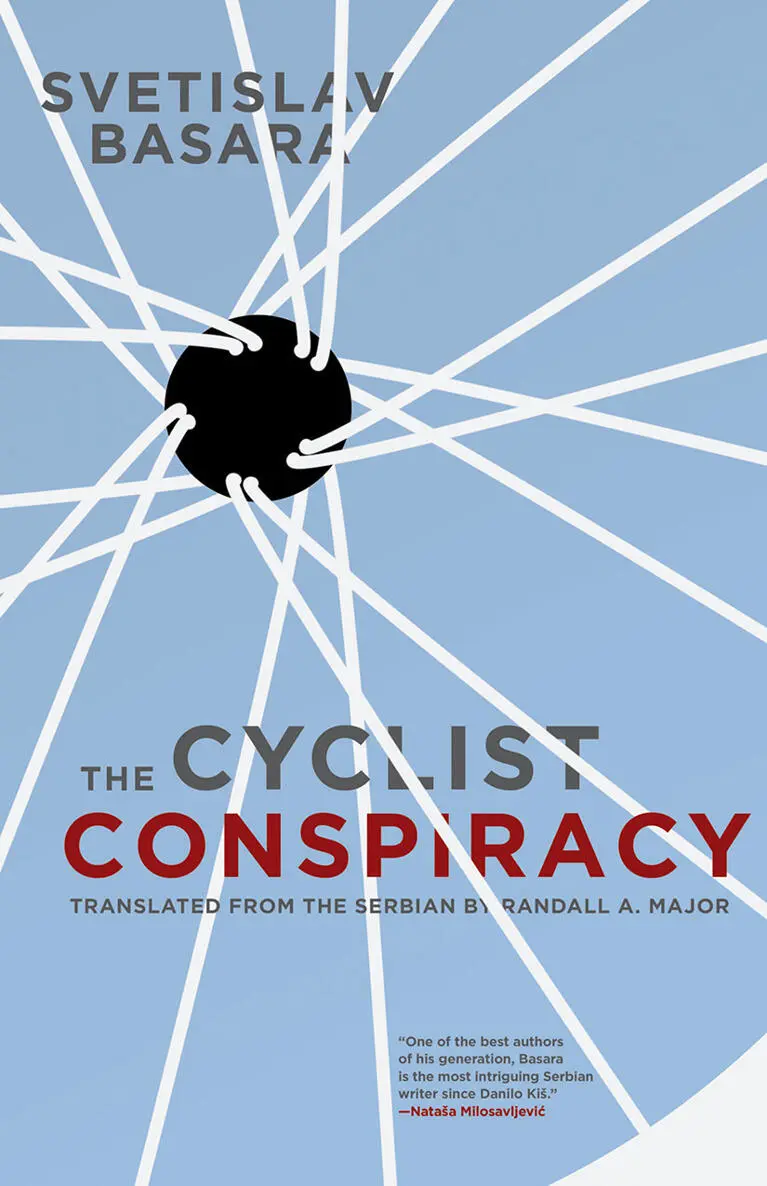
Svetislav Basara - The Cyclist Conspiracy
Здесь есть возможность читать онлайн «Svetislav Basara - The Cyclist Conspiracy» весь текст электронной книги совершенно бесплатно (целиком полную версию без сокращений). В некоторых случаях можно слушать аудио, скачать через торрент в формате fb2 и присутствует краткое содержание. Год выпуска: 2012, Издательство: Open Letter, Жанр: Современная проза, на английском языке. Описание произведения, (предисловие) а так же отзывы посетителей доступны на портале библиотеки ЛибКат.
- Название:The Cyclist Conspiracy
- Автор:
- Издательство:Open Letter
- Жанр:
- Год:2012
- ISBN:нет данных
- Рейтинг книги:4 / 5. Голосов: 1
-
Избранное:Добавить в избранное
- Отзывы:
-
Ваша оценка:
The Cyclist Conspiracy: краткое содержание, описание и аннотация
Предлагаем к чтению аннотацию, описание, краткое содержание или предисловие (зависит от того, что написал сам автор книги «The Cyclist Conspiracy»). Если вы не нашли необходимую информацию о книге — напишите в комментариях, мы постараемся отыскать её.
Masterfully intertwining the threads of waking and dreams into the fabric of the present, the past, and the future, Svetislav Basara’s Pynchon-esque The Cyclist Conspiracy is a bold, funny, and imaginative romp.
The Cyclist Conspiracy — читать онлайн бесплатно полную книгу (весь текст) целиком
Ниже представлен текст книги, разбитый по страницам. Система сохранения места последней прочитанной страницы, позволяет с удобством читать онлайн бесплатно книгу «The Cyclist Conspiracy», без необходимости каждый раз заново искать на чём Вы остановились. Поставьте закладку, и сможете в любой момент перейти на страницу, на которой закончили чтение.
Интервал:
Закладка:
And then, there was also another factor: his relationship with his mother. Since she had no husband, and did have a son, she was like the Holy Virgin and Ernest saw himself in the role of Messiah; he identified with the superego to the extent that he experienced it as his true self. But there was also the ego. A well adapted personality generally seeks (and finds) justifications for the actions of the ego. In Ernest’s case, the ego was experienced overall as interference; it was not able to do anything good. In other words: for Ernest, every action of the ego was wrong, in his case — because of his Calvinist upbringing — even sinful, which just made the situation worse. On several occasions I attempted to help Ernest become aware that he was ill after all. He never denied it, even once; the gurus in his dreams, purportedly, also told him that. But, Ernest added, the whole world is sick; there is not a single man who is not mentally ill. However, the sect to which he belonged had undertaken steps to fix that. Preparations are being made for the construction of some sort of fantastic hospital for 20,000,000 mental patients who will finally externalize the madness of the world and in that externalization make the madness disappear.
It was obvious that, as a result of his insufficient ego, Ernest was falling ever more frequently under the control of the unconscious. I will present some of my notes that support my conclusions:
“I have never been able,” Ernest said, “to say with confidence: I am so and so. But I believed others. I was convinced that that was happening only to me, that it was a rare disease that I had to conceal in order to exist at least on the surface. That is why I lived closed up in myself, unable to truly enter a conversation with anyone outside the circle of those already used to my presence, out of the fear that after just a few exchanges of words, others would realize that I don’t exist, that they would laugh and wave their hands, and that I would have to dissipate into the nothingness where I belong. I was stupid. Now I know that other people feel that way as well, but they just hide it out of habit, but also partially out of silly self-confidence. Yes, we hide behind the screen of our clothes and our titles, which are indeed real, as opposed to people. But we can only hide our nothingness from others with those things. Not from ourselves. We do not exist on the other side. The more important one. The one inside…
(…) I wondered how I would react to the news of my own death. I think I would remain calm. But I would still continue to go out for walks, to see my friends. Because we are all dead already; why get excited?”
No doubt, the causes of Ernest’s existential insecurity should be sought in the absence of his father. One who has no father does not have an object to identify himself with; between him and his ancestors (history), there is a gaping hole — nothingness; all who have gone before him are dead, and he experiences his existence as an act of betrayal. That is why the verse says: “When you fall asleep, die to this world.” That also suits his intolerance of time, symbolized in his breaking of clocks. However, this was not a rebellion against the time in which we are disappearing, but against the time in which we go on existing.
Naturally, Ernest had a different version. He was not interested in his father, but in being. He was convinced that he had no kind of father-related complex whatsoever. The blunder he made by breaking the clocks and hitting his mother was a consequence of his anger caused by his mother’s indiscretion. Otherwise, he felt deeply sorry for his actions and he loved his mother. He had no intention of abandoning his convictions, but he was sorry that he had confided to me secrets that were worthy only of the elect few, thinking that I was more open to spirituality.
Miraculously, the complete disassociation of Ernest’s personality, which had reached a truly high degree, did not cause suffering, or even asocial behavior. Ernest was reconciled with that duality and he lived, conditionally speaking, quite normally. He no longer came to see me, but I followed his further development with interest. Apathetically he graduated from college and found a job. The people around him were satisfied and they considered him to be completely healed, but I feared that all of that could not end well. As it soon turned out, my fears proved to be justified. On the eve of Easter the next year, I got a letter from Mrs. M., Ernest’s mother, in which I was informed that Ernest had gone out on his bicycle one day and never come back. The police were informed, ads were run in the paper, all in vain. Since then, all traces of Ernest have been lost.
CORRESPONDENCE FROM MRS. MEIER TO FREUD
Zürich
23 September 1930
Dear Herr Doctor Freud,
Two years ago, I informed you of the tragic disappearance of my son. Because I know how carefully you follow the lives of your patients, I feel obligated to inform you that I recently received reliable information that Ernest is alive and well.
When I had finally lost all hope, I was visited by Mr. Schleiermacher, a business acquaintance of my father, who reported to me that, while on a trip to Istanbul this July, he had seen Ernest in the company of some rather dubious characters. Led by a certain J. Kowalsky (Mr. Schleiermacher claims that he is an anarchist), they were riding velocipedes around Beyazit Meydani. Mr. Schleiermacher, being a thorough man and desiring to be certain, said hello to Ernest who got off his bicycle and politely returned his greeting. The abovementioned gentleman assured me that Ernest seemed to be completely composed, that he acted and talked normally, with the exception of the slightly strange comment: “There, now you have a good reason to visit my mother.”
However, a few days later, my joy at hearing these things was clouded by a letter from Ernest. The contents of that letter filled me with a mixture of profound sadness and terrible fear. In that letter bursting with confusing sentences, Ernest accused me of being Mr. Schleiermacher’s mistress, and he predicted that I will die in the near future. Because only you can help me, there is something that I must confess. Before I married my late husband, Rheiner, I did have relations with Mr. Schleiermacher on several occasions. Likewise, during our latest encounter, I had relations with the same gentleman again; you can probably understand: I am a widow, the loneliness, the good news… What bothers and frightens me is indeed the question: How could Ernest have known about my relationship, the first part of which took place before he was born, and the second while he was thousands of miles away from Zürich?
Then, there is one more matter that I have never told you. Several months before his death, Ernest’s father showed signs of, if I may say so, quiet madness. In some old book he had bought at a second-hand shop, he found the notes of the previous owner; some gibberish about a sect of heretics on an imaginary island somewhere in the far north Atlantic. If he had been introverted earlier, Rheiner finally broke off all communication with those around him. He spent his final days at the printer’s, where he printed the abovementioned manuscript — a pile of impudent fantasies — in a print-run of only six copies.
I am convinced that my mistake — not telling you about these facts — was perhaps fatal; perhaps, if you had had those facts available, you could have done more for Ernest.
I hope that you realize what a truly uncomfortable position I am in. I am at the edge of my spiritual strength, and I hope for your support and encouragement.
With profoundest respect,
Herta Meier
FROM ERNEST TO HIS MOTHER
Читать дальшеИнтервал:
Закладка:
Похожие книги на «The Cyclist Conspiracy»
Представляем Вашему вниманию похожие книги на «The Cyclist Conspiracy» списком для выбора. Мы отобрали схожую по названию и смыслу литературу в надежде предоставить читателям больше вариантов отыскать новые, интересные, ещё непрочитанные произведения.












Обсуждение, отзывы о книге «The Cyclist Conspiracy» и просто собственные мнения читателей. Оставьте ваши комментарии, напишите, что Вы думаете о произведении, его смысле или главных героях. Укажите что конкретно понравилось, а что нет, и почему Вы так считаете.