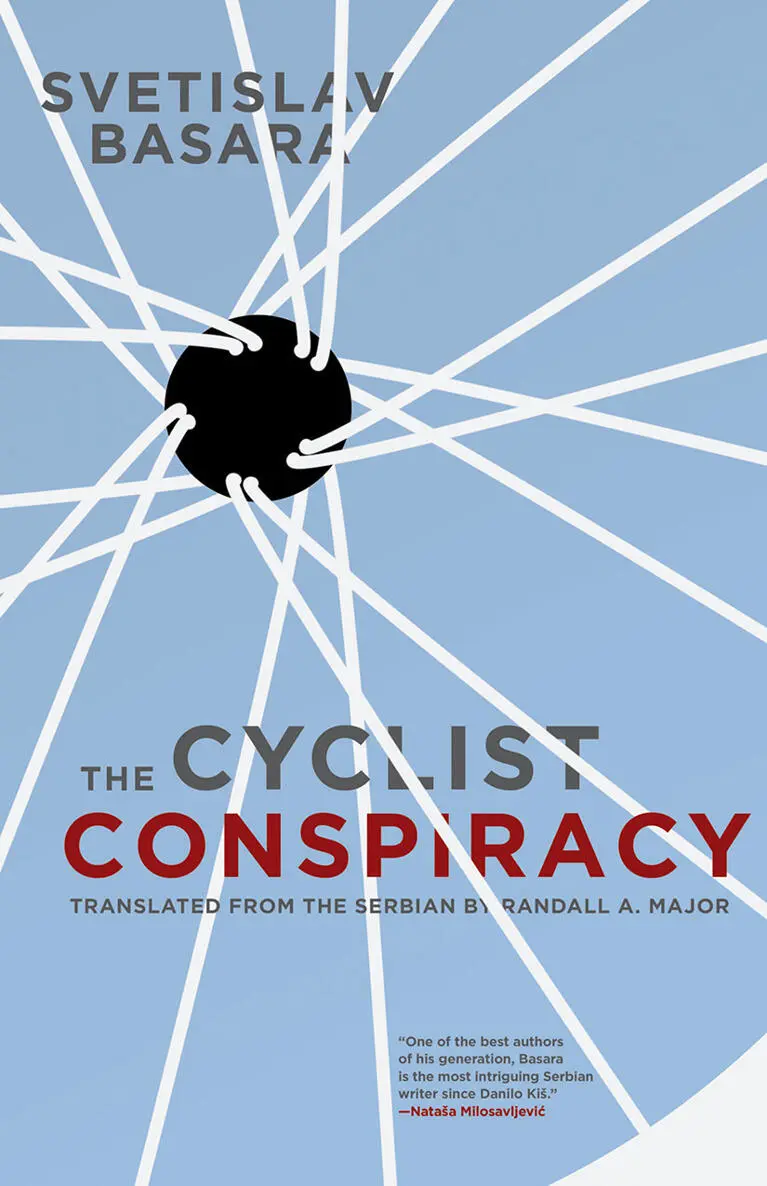
Svetislav Basara - The Cyclist Conspiracy
Здесь есть возможность читать онлайн «Svetislav Basara - The Cyclist Conspiracy» весь текст электронной книги совершенно бесплатно (целиком полную версию без сокращений). В некоторых случаях можно слушать аудио, скачать через торрент в формате fb2 и присутствует краткое содержание. Год выпуска: 2012, Издательство: Open Letter, Жанр: Современная проза, на английском языке. Описание произведения, (предисловие) а так же отзывы посетителей доступны на портале библиотеки ЛибКат.
- Название:The Cyclist Conspiracy
- Автор:
- Издательство:Open Letter
- Жанр:
- Год:2012
- ISBN:нет данных
- Рейтинг книги:4 / 5. Голосов: 1
-
Избранное:Добавить в избранное
- Отзывы:
-
Ваша оценка:
The Cyclist Conspiracy: краткое содержание, описание и аннотация
Предлагаем к чтению аннотацию, описание, краткое содержание или предисловие (зависит от того, что написал сам автор книги «The Cyclist Conspiracy»). Если вы не нашли необходимую информацию о книге — напишите в комментариях, мы постараемся отыскать её.
Masterfully intertwining the threads of waking and dreams into the fabric of the present, the past, and the future, Svetislav Basara’s Pynchon-esque The Cyclist Conspiracy is a bold, funny, and imaginative romp.
The Cyclist Conspiracy — читать онлайн бесплатно полную книгу (весь текст) целиком
Ниже представлен текст книги, разбитый по страницам. Система сохранения места последней прочитанной страницы, позволяет с удобством читать онлайн бесплатно книгу «The Cyclist Conspiracy», без необходимости каждый раз заново искать на чём Вы остановились. Поставьте закладку, и сможете в любой момент перейти на страницу, на которой закончили чтение.
Интервал:
Закладка:
In the circles of the esotericians, the legend is circulating that the Evangelical Bicyclists are the successors of the Byzantine iconoclast tradition and that they celebrate basileus Leo III as their forerunner. ***The following words are attributed to a Grand Master of the order: “Let us pay respect to Leo! All images are the creations of Satan and idolatry. First, people put pictures of God on the wall, then the king, then Stalin. In the end, everyone will idolize their own picture, they will adore and fear themselves.” It would be worthwhile to search for the roots of the geo-political and religious weltanschauung of the Evangelical Bicyclists of the Rose Cross in that allegiance to the Byzantine spiritual tradition. Namely, they do not consider the history of Europe to be legitimate after January 28, 842, when basileus Theophilus died and the iconophiles ultimately triumphed; the Bicyclists believe that God was forever exiled from the human soul into objects — into icons, churches, statues — and that since then every event collides with God’s providence, that they are the work of human and Satanic aims. Consequently, they do not recognize any of the borders or countries that have sprouted up in the territory of the Byzantine Empire.
In addition, their view of Christianity is interesting. Paradoxically, the Little Brothers are convinced that it was the strongest in the 20 thcentury because it was in its most profound crisis. Christianity that is not in crisis is not Christianity for them. There is one apocryphal writing, a bit of yellow paper without a title or a signature, on which the following words can be found:
The misfortune of Europe is not that it became Christianized, as the young Hegel so regrettably interpreted things, but actually because it did not become Christianized enough. Way down in their souls, Europeans are still barbarians. There you will find them bowing down to icons and seeking forgiveness where the sin was committed, in the outside world, and not where it was conceived: in their souls. There you will find them forcing “pagans,” by fire and the sword, to convert to the religion of love. The appearance of Nazism is the proof that they remained more or less secretly pagans. It could be said that people were waiting for centuries for Hitler to appear.
It is astounding, the lack of care which the Evangelical Bicyclists show for their documents, which are anyway so small in number. Their most important work is “Theology and Bicyclism” and, to my knowledge, no one has ever seen the integral version of it. Written on some fifty pages of paper, of various sizes and quality, it is actually not even kept all in one place, but its individual parts can be found among the members of the order for reading or study. The one manuscript readily available, the abovementioned Basel Parchment, is not very convincing. Although perfectly printed in calligraphy, and though the parchment is of excellent quality, the content leaves a lot to be desired:
Grand Master to the Brothers!
I would like to announce that Dharamsala is a city in India of some 40,000 inhabitants. All day long, they do nothing except sit in the shade of mango groves crying out till they are exhausted: OM MANE PADME HUM, in the expectation that they will be enlightened. Of the other points of interest, I should mention the herds of holy cows that are different from regular cows because they have haloes.
In the whole city there are only three bicycles, rusty, neglected, and falling apart.
Where the cows are saints, the bicycles rust. He who has ears, let him hear.
The abovementioned Herbert Meier cites that very document, the most tangible one, about the Little Brothers as evidence that the order is a fabrication, a mystification created by idle souls. According to him, the text lacks spirituality of any kind. In the polemic which appeared in the Christian Science Monitor , D. H. Grainger opposed Meier, comparing the Basel Parchment to the lessons of a teacher of Zen. “Taken from the context of the spirituality of a closed community,” Grainger writes, “a sentence, or even a paragraph cannot be expected to make sense outside the group of followers. Even the Bible, whose myths are deeply entrenched in the collective unconscious, seems like a heap of nonsense and hallucinations to the untrained eye.” Further in the text, Grainger relates the negligence of the Bicyclists to their deeply implanted feeling of belonging to the eternal. “One who truly looks into eternity,” the author says, “does not care about the ephemerality of things and books. It is logical to connect the iconoclasm of the Evangelical Bicyclists with their scorn of manmade objects. One might say: they consciously abhor books about the holy, so that the books will not conceal the holy.”
However, as far as it is known, the Little Brothers do not hide their manuscripts, projects and actions in the least, citing Christ’s words from the apocryphal Gospel according to Thomas: “If you take out what is within you, what you have taken out will save you. If you do not take out what is within you, what you have not taken out will destroy you.” Due to the completely public nature of their actions, the Evangelical Bicyclists are protected by the greatest possible secrecy. If we examine that claim a little more carefully, we will see that it is not lacking in logic whatsoever: an object of interest is generally one that is hidden, while easily available things go unnoticed; the more obvious a thing is, the more mysterious it is. Even the Creator himself, who is the most real and most present, is he not also the most invisible and the most unapproachable?
In the real world, the Little Brothers do not own any kind of building, they do not have gatherings or significant initiations or rituals. According to some sources, they meet in a safe place, far from the noise and curious onlookers — in their dreams. It is worthwhile to mention that J. W. Kowalsky, who is thought to have been a Grand Master or at least an important member of the order, in the period between 1930 and 1936, maintained intensive correspondence with Sigmund Freud, the father of psychoanalysis. One of J. Kowalsky’s letters addressed to Freud was published in the journal Psychoanalysis Today (8, 1959):
Dear Herr Doctor Freud,
The remarks on dreams that you presented in your letter are undoubtedly of great importance for the further explication of that phenomenon, otherwise neglected by scholarship. The fact that dreaming directly anticipates the future (the case of the alarm clock)
****
not only indicates its nature in protecting the dreamer from waking, but also shows that we need to reflect most seriously about all our fundamental knowledge of time and space.
Even though you reproach me for being a “poet,” even though I am interested in matters of scholarship, I am prepared to withstand such reprimands. I would dare to claim: not only are dreams a territory full of the symbols of the libido, they are much more than that. I would say: they are the frontier between our world and otherworldliness, or whatever you would like to call it, where completely different laws apply than these that we are accustomed to, perhaps by force.
The misfortune lies in the fact that we are too highly oriented to events in reality. Not only are dreams not taken seriously, they are even thought to be nonsense. Your contribution to a different view of this matter will be highly valued by history, I am convinced. I would like to offer you a rather daring supposition: as you know, the process of the maturation of the human being is closely connected with upbringing and education; we teach our children the secrets and rules of life. We do not do anything like that with dreams. We dream, if I may say it that way, chaotically, randomly. Perhaps that is why we live that way — chaotically and randomly. I am convinced that self-discipline, so necessary for success in waking life, would render excellent results in our dreams as well. If, one day, we were to take control of ourselves in our dreams, instead of surrendering ourselves to sad fantasies, undoubtedly we would discover a lot about our own past, and also about the past of the species to which we belong.
Читать дальшеИнтервал:
Закладка:
Похожие книги на «The Cyclist Conspiracy»
Представляем Вашему вниманию похожие книги на «The Cyclist Conspiracy» списком для выбора. Мы отобрали схожую по названию и смыслу литературу в надежде предоставить читателям больше вариантов отыскать новые, интересные, ещё непрочитанные произведения.












Обсуждение, отзывы о книге «The Cyclist Conspiracy» и просто собственные мнения читателей. Оставьте ваши комментарии, напишите, что Вы думаете о произведении, его смысле или главных героях. Укажите что конкретно понравилось, а что нет, и почему Вы так считаете.