William Maxwell - The Chateau
Здесь есть возможность читать онлайн «William Maxwell - The Chateau» весь текст электронной книги совершенно бесплатно (целиком полную версию без сокращений). В некоторых случаях можно слушать аудио, скачать через торрент в формате fb2 и присутствует краткое содержание. Год выпуска: 2012, Издательство: Vintage, Жанр: Современная проза, на английском языке. Описание произведения, (предисловие) а так же отзывы посетителей доступны на портале библиотеки ЛибКат.
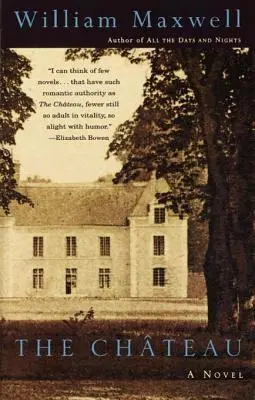
- Название:The Chateau
- Автор:
- Издательство:Vintage
- Жанр:
- Год:2012
- ISBN:нет данных
- Рейтинг книги:4 / 5. Голосов: 1
-
Избранное:Добавить в избранное
- Отзывы:
-
Ваша оценка:
The Chateau: краткое содержание, описание и аннотация
Предлагаем к чтению аннотацию, описание, краткое содержание или предисловие (зависит от того, что написал сам автор книги «The Chateau»). Если вы не нашли необходимую информацию о книге — напишите в комментариях, мы постараемся отыскать её.
The Chateau — читать онлайн бесплатно полную книгу (весь текст) целиком
Ниже представлен текст книги, разбитый по страницам. Система сохранения места последней прочитанной страницы, позволяет с удобством читать онлайн бесплатно книгу «The Chateau», без необходимости каждый раз заново искать на чём Вы остановились. Поставьте закладку, и сможете в любой момент перейти на страницу, на которой закончили чтение.
Интервал:
Закладка:
To his surprise, the Frenchman stood up and said stiffly: “I will speak to my uncle.”
“If it means that, never mind. I don’t want to bother anyone. I just thought you could take me around and tell me about the portraits, but it isn’t in the least important.”
“I will speak to my uncle. It is his house.”
Twice in one evening, Harold thought with despair. For it was perfectly clear from the gravity with which his request had been received that it was not the light thing he had thought it was.
Jean Allégret conducted him up the steps and into the hall and said: “Wait here.” Then he turned and went back down the steps. Watching through the open doorway, Harold saw him approach a tall elderly man who was standing with a group of people in the moonlight. He bent his head down attentively while Jean Allégret spoke to him. Then, instead of turning and coming toward the house, they left the group and walked up and down, talking earnestly. A minute passed, and then another, and another. Harold began to feel more and more conspicuous, standing in the lighted hall as on a stage, in plain sight of everyone on the terrace. He had already been in those two rooms. The others were dancing there now. And he could have looked at the pictures, the tapestries, the marble statuary, by himself, if he hadn’t been afraid that it would be bad-mannered. And in America people were always pleased when you asked to see their house.
Uncle and nephew made one more complete turn around the terrace, still talking, and apparently arrived at a decision, for they turned suddenly and came toward the house. Jean Allégret introduced Harold to his uncle and then left them together. M. Allégret spoke no English. He was about sixty, taller than Harold, dignified, and soft-spoken. For a minute or two he went on making polite conversation. Then he said abruptly, as if in reply to something Harold had just said: “Vous prenez un intérêt aux maisons?”
“Je prends un intérêt dans cette maison. Mais—”
“Alors.” Turning, M. Allégret led him over to a lithograph hanging on the wall beside the door into the salon. “Voici un tableau d’une chasse à courre qui a eu lieu ici en mille neuf cent sept,” he said. “La clef indique l’identité des personnes. Voici le Kaiser, et auprès de lui est le Prince Philippe zu Eulenberg … le Prince Frédéric-Guillaume … la Princesse Sophie de Württemberg, portant l’amazone noire, et le roi d’Angleterre … Mon père et ma mère … le Prince Charles de Saxe … avec leurs chasseurs et leurs laquais. Le tableau a été peint de mémoire, naturellement. Ces bois de cerf que vous voyez le long du mur.…”

AT ELEVEN O’CLOCK Alix came toward the circle in the library, where Harold and four or five young men were talking about French school life, and said: “Eugène thinks it is time we went home.”
Harold shook hands around the circle and then sought out Jean Allégret.
“We have to go,” he said, “and I wanted to be sure I said good night to all your cousins. Would you take me around to them? I am not sure which—”
This request presented no difficulties. Barbara and Harold said good night to Mme Allégret, to various rather plain young girls, and to M. Allégret, who came out of the house with them. The others were waiting with the bicycles, under the grape arbor. Jean Allégret and his uncle conducted the party from the château along the driveway as far as the place where it dropped steeply downhill, and there they said good night. Harold and Jean Allégret shook hands warmly, one last time. Calling good night, good night, they coasted down the hill, through the dark tunnel of branches, with the dim carbide bicycle lamps barely showing the curves in the road, and emerged suddenly into bright moonlight. Dismounting at a sandy patch before the bridge, Harold risked saying to Eugène: “Did you have a pleasant evening?”
“No. They were too young. There was no one there who was very interesting.” His voice in the moonlight was not unfriendly, but neither was it encouraging.
Out on the main road, Harold pedaled beside Barbara, whose lamp was brighter than his. “Wasn’t it awful about the folding table?” he said.
“It wasn’t your fault.”
“I felt terrible about it, but they were so kind. They just closed the doors on it, and it was exactly as if it had never happened. But I keep thinking about the broken china and glasses that can never be replaced probably. And that stain on the carpet.”
“What were you talking about?”
“I don’t remember. Why?”
“I just wondered.”
“They attacked poor dead Woodrow Wilson. And then they started on the Jews and Negroes. I thought France was the one country where Negroes were accepted socially. They sounded just like Southerners. What was it like at dinner?”
“All right. I didn’t like the boy I sat next to.”
“He was very handsome.”
“He is coming to America on business, and he thought we could be useful to him. I didn’t like him at all.”
“And Alix’s friend, who sat on the other side of you?”
“He was nice, but he was talking to Alix.”
“I had a lovely time. And I saw the house. Jean Allégret’s uncle showed me all through the downstairs, as far as the kitchen, and then he took me upstairs, through all the bedrooms, which were wonderful. It was like a museum. And in a dressing room I saw the family tree, painted on wood. It was interminable. It must have gone back at least to Charlemagne. And then we went outside and saw the family chapel. Jean Allégret wants us to come and stay with him up near the Belgian border.… Did you have a nice evening? Afterward, I mean?”
“All except for one thing. I think I hurt Eugène’s feelings. He came and asked me to dance with him and I refused. I was interested in what Sabine was saying, and I didn’t feel like dancing at the moment, and I’m afraid he was offended.”
“He probably understood.… They don’t use the chapel as a chapel any more. They keep wine in it.”
“And I don’t think Sabine had a very good time,” Barbara said. “She sat with Alix or me all evening, and the boys didn’t ask her to dance. I don’t understand it. She’s very pretty, and Mme Viénot said that she was so popular and had so many invitations.”
“The money,” he said.
“What money?”
They were overtaking Alix, and so he did not answer. The winding road was almost white, the distant hills were silver, and they could see as well as in daylight. They rode now in single file, now all together.
“Think of going five miles to a party on bicycles,” Barbara said to Harold, “and coming home in the moonlight!”
In a high, thin, eerie voice, Sabine began to sing: “Au clair de la lune, mon ami Pierrot, prête-moi ta plume pour écrire un mot …” The tune was not the one the Americans knew, and they drew as near to her as their bicycles permitted. After that she sang “Cadet Rouselle a trois maisons qui n’ont ni poutres ni chevrons …” and they were so taken with the three houses that had no rafters, the three suits, the three hats, the three big dogs, the three beautiful cats, that they begged her to sing it again. Instead she told them a ghost story.
In a village near here, she said, but a long time ago, there was a schoolmaster who drove himself into a frenzy trying to teach reading and writing and the catechism to boys who wanted to be out working in the fields with their fathers. He had a birch cane, which he used frequently, and an expression which he used still more. Whenever any boy didn’t know his lesson, the schoolmaster would say: “One dies as one is born. There is never any improvement.” Then he’d reach for his birch rod.
Читать дальшеИнтервал:
Закладка:
Похожие книги на «The Chateau»
Представляем Вашему вниманию похожие книги на «The Chateau» списком для выбора. Мы отобрали схожую по названию и смыслу литературу в надежде предоставить читателям больше вариантов отыскать новые, интересные, ещё непрочитанные произведения.







Обсуждение, отзывы о книге «The Chateau» и просто собственные мнения читателей. Оставьте ваши комментарии, напишите, что Вы думаете о произведении, его смысле или главных героях. Укажите что конкретно понравилось, а что нет, и почему Вы так считаете.