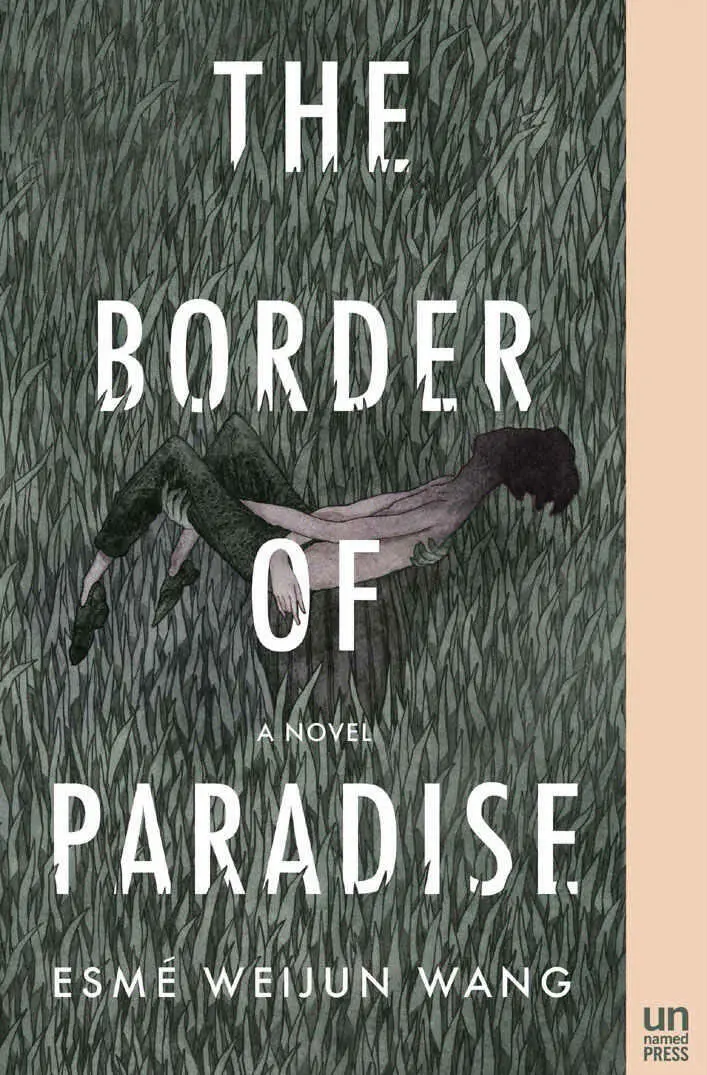
Esmé Wang - The Border of Paradise
Здесь есть возможность читать онлайн «Esmé Wang - The Border of Paradise» весь текст электронной книги совершенно бесплатно (целиком полную версию без сокращений). В некоторых случаях можно слушать аудио, скачать через торрент в формате fb2 и присутствует краткое содержание. Год выпуска: 2016, Издательство: The Unnamed Press, Жанр: Современная проза, на английском языке. Описание произведения, (предисловие) а так же отзывы посетителей доступны на портале библиотеки ЛибКат.
- Название:The Border of Paradise
- Автор:
- Издательство:The Unnamed Press
- Жанр:
- Год:2016
- ISBN:нет данных
- Рейтинг книги:3 / 5. Голосов: 1
-
Избранное:Добавить в избранное
- Отзывы:
-
Ваша оценка:
The Border of Paradise: краткое содержание, описание и аннотация
Предлагаем к чтению аннотацию, описание, краткое содержание или предисловие (зависит от того, что написал сам автор книги «The Border of Paradise»). Если вы не нашли необходимую информацию о книге — напишите в комментариях, мы постараемся отыскать её.
transports readers into the world of an iconoclastic midcentury family.
In booming postwar Brooklyn, the Nowak Piano Company is an American success story. There is just one problem: the Nowak’s only son, David. A handsome kid and shy like his mother, David struggles with neuroses. If not for his only friend, Marianne, David’s life would be intolerable. When David inherits the piano company at just 18 and Marianne breaks things off, David sells the company and travels around the world. In Taiwan, his life changes when he meets the daughter of a local madame — beautiful, sharp-tongued Daisy. Returning to the United States, the couple (and newborn son) buy an isolated country house in Northern California’s Polk Valley.
As David's mental health deteriorates, he has a brief affair with Marianne, producing a daughter. When Marianne appears at their doorstep, the couple's fateful decision to take the child as their own determines a tragic course of events for the entire family. Told from multiple perspectives,
culminates in heartrending fashion, as the young heirs to the Nowak fortune must confront their past and the tragic reality of their future.
The Border of Paradise — читать онлайн бесплатно полную книгу (весь текст) целиком
Ниже представлен текст книги, разбитый по страницам. Система сохранения места последней прочитанной страницы, позволяет с удобством читать онлайн бесплатно книгу «The Border of Paradise», без необходимости каждый раз заново искать на чём Вы остановились. Поставьте закладку, и сможете в любой момент перейти на страницу, на которой закончили чтение.
Интервал:
Закладка:
At some point during our drive, when the road suddenly develops a bulging bit of dirt on its right edge, Ma makes a turn off the road and parks the car.
“Get out,” she says.
Nobody moves.
Ma says, “Listen. There will be things to stop us ahead. There will be policemen and fire fighters. So get out.”
Gillian is now in keening hysterics. I briefly consider whipping open the door, getting out of the car, and running away. All we need to do is run in the opposite direction. Gillian may doubt this about me, but I have no death wish.
Yet I can’t bring myself to run. If I ran, would Gillian follow? If we ran, what would happen to our mother? If we ran, and she gave chase, what would happen if she came on us like a wave, and grabbed us by our collars? Already she’s brought us to Sycamore Road. The familiar dirt banks and signs make this much clear. Perhaps she’s bringing us back because there are things that she wants to rescue. Items of sentimental value. The hatbox. The photograph of my parents beneath the TSINGTAO sign. Perhaps she knew from that moment that she might end up here with us; that the fire might get this bad; that she wanted to share with us, by showing us the hatbox, the only part of her history that she felt comfortable revealing. Perhaps she is only after sentiment. Or she can’t imagine rebuilding the house that she and David bought together, can’t fathom living a new life after an incineration. An impulse or instinct to go home, unplanned. Gillian is sitting and crying with snot slick down her face, sobbing, her sobs interrupted by sharp, shuddering inhalations, and she does not bother to cover her face with her hands. Ma gets out of the car and walks around the rear to Gillian’s side. A nauseated fear grips my guts as she opens the door; Ma reaches over Gillian’s body and unbuckles the seat belt. Ma yanks her out and Gillian doesn’t fight, but plops onto the ground, and oh, she cries. She still cries.
I open my door and go to Gillian. I tell her to come with us. To defend my choice I think of home and Ma, and of how we know nothing else.
But Gillian says that she won’t. She’d rather die here, with people watching, rather than at home alone with us. “It’s not safe,” she says. (The smell of the gray air.)
Ma grabs her by the arm and skids her a foot along the dirt, dusting up her dress. Her soft thighs scrape against pebbles and earth. I say, “Ma, please, don’t.” Gillian’s unwillingness is not like her occasional unwillingness to succumb to my ministrations, or her unwillingness to play the piano after David’s death, but something more difficult than that. What she means by playing this particular card, this still-stuck statue, is to say that she will not climb up into those trees and run toward the house, but neither will she scream for help or run toward the town that she’s so long considered a splendid possibility; she will choose nothing.
No one stops to help us, and why would they, those concerned, terrified Polk Valley citizens fleeing from a fire that might swallow up their beloved cabins and homes? Our drama goes on. My beautiful girl is on the ground, blood smearing her dress, and forgive me, Gillian, forgive me, but I go to her with Ma’s voice in my ears. I wrap one arm around the back of her neck and the other beneath her knees, but she doesn’t fight me. She is taller than I am, and I think stronger, but as she cries and convulses I find myself growing quieter between the ears. Somehow, I manage to lift her.
In my arms she goes limp and heavy, pressing her damp face against my chest.
“Up here,” Ma says.
We have no choices. We never have. I thought I was choosing for Gillian, but I had no choice myself. Nowhere to go — and Gillian, poor thing, knew this long before I did. She throws her arms around my neck. Weeps into my breast. I find my footing in the dirt, in the rocky slope with stones like steps. I carry her up and into the trees. Ma is saying, “Hurry, hurry, hurry…” Is this how David felt at the end of it, his briefcase in his lap, his hunting knife, the shades drawn? Here the smoke burns my eyes. The smoke makes them water and tear.
WHIMPER. GILLIAN (1972)
I’m sure it’s the dog from the trailer park coming over the horizon. I believe the word is brindled. It trots over the clean line, because all a dog with stocky legs like that can do is trot, a white-chested, broad-shouldered silhouette that rises and falls and stops right under the birch tree a few yards from me. With needle in hand I’m mending a yellow sundress that’ll be too small for me in a few months, with dry grass pressed against my legs. In a few months I’ll have to stop wearing this dress, as well as the green gingham one, or I’ll suffer William giving me that peculiar look with his wheedling eyeballs; never mind that I like the feeling of limbs dangling everywhere and the sun’s heat on me, too. What and now here’s this dog, watching me with its paws crossed and its head resting on crossed paws. Looking at me like I have something it wants, but I’m used to that look by now.
We didn’t lose the house — not that I ever thought we would, simply because it would have been too easy. The flames spread in such a miraculous manner that they curved exactly to the edge of our property and then just stopped. I mean, they didn’t stop on their own — the uniformed men stopped the fire, the same men who found us in the brush and brought us by force to St. Joseph’s Church till we were allowed to go home — but the fire surrendered right at the border of our land, as though even the fire wanted me stuck. I feel a softness for the dog, set free by someone, I assume, unto death but now just free. In the field I’m alone because, post-fire, Ma and I have struck a bargain. If I do what she tells me, and if I content myself with good behavior on twice-monthly town outings, I am now also permitted to roam the property for exactly one hour every day without oversight. This bargain strikes me as to my advantage, and I am pleased that I’ve behaved well enough to have my restrictions loosened, although my gut is full of sourness, and even the quiet can’t shut down the noise in my brain that tells me, You were all so close, you were all so close to being obliterated for some purpose no one will explain.
I weave the needle into the hem and my hands fold. In the middle of Polk Valley August it’s hot, but soon the air will turn sharp and clean. The dog is in the shade and I can’t see it well enough, but I call out, “C’mere, c’mere, pup, small pup,” even though it is not actually small, and its ears rise. It comes up on all its legs and walks toward me. Comes closer and I see that it’s a lady dog, and she’s been scrapping with something that delivered a torn ear and scratches along her muzzle. The dog has no collar or tags. I name her Sarah. I will bring her home and mend her, too. It doesn’t take a genius to figure that, in a way, I’m both the most and the least powerful person in the house, though the thing that makes me strong makes me weak. So I name her and I try to get her to follow me with my yellow dress draped over my arm. The guai baobao has been through a fight, but she doesn’t whine. She suffers her wounds without a whimper.
At the porch William is sitting in the rocker, brushed-hair and barefoot. He’s not doing anything in particular — not translating, not reading — just staring out, waiting for me. “I see you have a friend,” he says, and he gets up from the chair to wrap his arms around me. He holds me close and he kisses me on the neck, and then in the hollow of my sticky collarbone. His kisses are inexplicably wet always, and I always want to wipe them away, but how rude would that be?
“She’s in bad shape,” I say.
Читать дальшеИнтервал:
Закладка:
Похожие книги на «The Border of Paradise»
Представляем Вашему вниманию похожие книги на «The Border of Paradise» списком для выбора. Мы отобрали схожую по названию и смыслу литературу в надежде предоставить читателям больше вариантов отыскать новые, интересные, ещё непрочитанные произведения.





Обсуждение, отзывы о книге «The Border of Paradise» и просто собственные мнения читателей. Оставьте ваши комментарии, напишите, что Вы думаете о произведении, его смысле или главных героях. Укажите что конкретно понравилось, а что нет, и почему Вы так считаете.