Ingo Schulze - New Lives
Здесь есть возможность читать онлайн «Ingo Schulze - New Lives» весь текст электронной книги совершенно бесплатно (целиком полную версию без сокращений). В некоторых случаях можно слушать аудио, скачать через торрент в формате fb2 и присутствует краткое содержание. Год выпуска: 2008, Издательство: Knopf, Жанр: Современная проза, на английском языке. Описание произведения, (предисловие) а так же отзывы посетителей доступны на портале библиотеки ЛибКат.
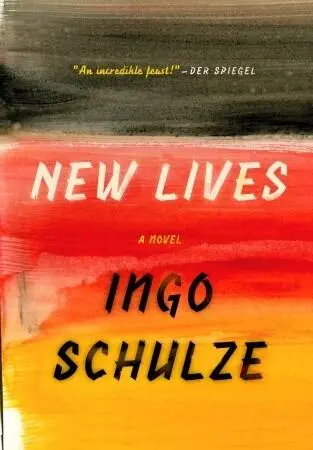
- Название:New Lives
- Автор:
- Издательство:Knopf
- Жанр:
- Год:2008
- ISBN:нет данных
- Рейтинг книги:4 / 5. Голосов: 1
-
Избранное:Добавить в избранное
- Отзывы:
-
Ваша оценка:
New Lives: краткое содержание, описание и аннотация
Предлагаем к чтению аннотацию, описание, краткое содержание или предисловие (зависит от того, что написал сам автор книги «New Lives»). Если вы не нашли необходимую информацию о книге — напишите в комментариях, мы постараемся отыскать её.
This upheaval in our hero’s life, mirrored in the vaster upheaval gripping Germany itself after the fall of the Berlin Wall and the birth pangs of a reunified nation, is captured in the letters Enrico writes to the three people he loves most: his sister, Vera; his childhood friend Johann; and Nicoletta, the unattainable woman of his dreams. As he discovers capitalism and reports on his adventures as a businessman, he peels away the layers of his previous existence, in the process creating the thing he has dreamed of for so long — the novel of his own life, in whose facets contemporary history is captured. Thus Enrico comes to embody all the questionable aspects not only of life in the old Germany, but of life in the Germany just taking form.
Once again Ingo Schulze proves himself a master storyteller, with an inimitable power to reconjure the complete insanity of this wildest time in postwar German history. As its comic chronicler, he unfurls a panorama of a world in transformation — and the birth of a new era.
New Lives — читать онлайн бесплатно полную книгу (весь текст) целиком
Ниже представлен текст книги, разбитый по страницам. Система сохранения места последней прочитанной страницы, позволяет с удобством читать онлайн бесплатно книгу «New Lives», без необходимости каждый раз заново искать на чём Вы остановились. Поставьте закладку, и сможете в любой момент перейти на страницу, на которой закончили чтение.
Интервал:
Закладка:
Election Sunday was May weather at its finest. We got out our bikes and set out for an excursion. I can’t begin to give you any notion of the terror that used to accompany me on the way to my polling place. Or of how you always tried to conceal from yourself — just as everyone else was doing, and each well aware that he was — that your path led to the ballot box. Standing in line at the polls was like standing in a pillory.
We picnicked beside a lake near Frohburg and didn’t start back until well into the afternoon, when hardly any voters were still out and about. We had just stretched out when the doorbell rang. Robert answered. I thought it was his friend Falk. A woman and a man wanted to speak with us, Robert said. We got dressed again.
I felt up for a fight! I would take care of the matter with a few explicit words.
The woman was around fifty and was bouncing up and down on our landing as if on a diving board. Her bright red lipstick held an old smile in place. He was in his mid-thirties, had scraggly yolk yellow hair, and wore a black leather jacket. In order to prop his left elbow casually on the railing he had to lean ridiculously to one side. A ballpoint pen was thrust up out of his fist. He was holding a satchel in his right hand.
He spoke, she observed our game of Q-and-A.
No, I said, we had no intention of heading for the polling place before six o’clock, no, our reason had nothing to do with local politics, no, we didn’t know the people on the ballot, they didn’t interest us, we had a very different notion of what an election is.
I worked hard telling myself not to smile. But first Michaela and then the yolk-haired fellow himself began to grin. And even the woman tried to no avail to prevent her bright red lips from breaking into a smile. By now his elbow had slipped off the railing.
Did they need any other information, Michaela asked in such a friendly voice that it sounded as if she were offering them a glass of water. No, he said, they had no further questions. They were grateful for our being so candid with them, and they could now inform the polling place that the volunteer staff wouldn’t have to stay on and that the mobile ballot box needn’t stop by at our place.
“Well then, your visit hasn’t been completely in vain,” I said. And Michaela added, “So at least you can enjoy the rest of your Sunday.”—“Ah, wish we could,” Herr Yolk-Yellow exclaimed, laughing and rapping his satchel with his pen. We came close to extending our hands in farewell.
Michaela had to calm down Robert, who had been listening and was afraid he would be called out of class at school because of us. He was crying, threw himself on his bed and shouted, “Why can’t you be like everybody else?” When the doorbell rang again, he cringed. This time it was his friend Falk.
I’m not sure I can make you understand. But the wretchedness of one side made the wretchedness of the other all the more obvious. From that day on I was overcome with a sense of absolute futility. Wasn’t it absurd to sit down to work on my novella again? Wasn’t it a kind of unintentional parody? Just as in the scene on the landing, everything took on an undertone that provoked laughter. Every accentuation ended up vacuous, every gesture, every protest was superfluous. And my cool observer’s eye seemed equally incongruous. It was the most ridiculous thing of all, the purest kitsch. 260
I sat down at my Rhinemetall and hammered away. I didn’t comprehend what I was writing. But I did suspect that it no longer had anything to do with literature.
It was a kind of farewell; I was driving myself out of paradise. Or maybe I should say, was driving it out of myself — sacrificing my individuality, my own distinctive voice, to the extent that I had ever had one.
I thought what I was doing was a necessary infliction of self-punishment. And by doing so, I was castigating all the others, the whole country, the whole system. What I was fabricating here was crap, but I, this nation, this society deserved nothing but crap. Maybe, I thought, this was a little like what Duchamp had felt in declaring his urinal to be a work of art. Just as he was perhaps tortured by the certainty that he could never again pick up a brush, never step up to his easel or smell the paints on his palette — that’s what this eruption felt like to me. It was a brutal exorcism I felt forced to perform. With each sentence of my election story, of my primitive fecal orgy, I was moving farther and farther away from Arcadia. 261
I was outraged not by the revolting and disgusting facts, but by the realization that these revolting and disgusting facts could no longer be communicated in any traditional way, as if every attempt to tell the truth and to call lies “lies” made distinguishing among them all the more difficult.
For me the massacre on Tiananmen Square in Peking 262was above all a signal that the world would remain just as it was. That it would roll along like this for an eternity. I had not expected anything else, or had I? I couldn’t understand why such horrible news left me with a sense of relief.
During the summer theater break we loaded a tent into the car and drove to Bulgaria. In Achtopol on the Black Sea — where Robert burst into tears when he saw a dolphin stranded on the beach — I was struck with the idea of using Nikolai Ostrowski’s How Steel Is Tempered 263 as the basis for a truly caustic work.
What all had actually happened that summer didn’t become clear to me until the start of the new season. We in dramaturgy laid bets as to who would be returning to work and who had already exited. Max, our Jean, and his family had traveled to Hungary. He was generally viewed as the favorite for clearing out. Max returned too late to attend the opening general meeting and couldn’t understand why he was greeted so effusively in the lobby. It was a strange mixture of joy and disappointment — yes, maybe there was even a little disdain involved too, as if people had expected more of him.
At the same time Michaela and I had been having arguments, or better, disagreements. Although Michaela had now turned thirty-five, we wanted a child of our own. 264It used to be, she said, that it was a relief to see the blood, but nowadays she just got more depressed every time. Each new menstruation ended up as a reproach to me. Michaela insisted I get a checkup. I found that humiliating, but to have argued the point would only have made things worse. The checkup was exactly how I’d pictured it. I stood there in a toilet cubicle reeking of disinfectants and suddenly didn’t even know what woman I was supposed to be fantasizing about. A week later I handed Michaela my certificate. “Funny,” she said, and that was her only comment about the matter.
Your Enrico T.
Monday, May 21, ’90
Dear Jo,
Gale warnings were sounded here early this morning. Waiting at the door were Black and Blond, two policemen I recognized. I asked if they wanted to search our apartment. 265“Last night,” they said without any change of facial expression, “someone broke into your newspaper.”
Black and Blond weren’t authorized to give me any further information, including an answer to the most crucial question: Were the computers still there?
I would have loved to hug and kiss that big screen. I turned on one machine after the other as if inquiring after their health, and stood there happy amid the humming. Everything else, I thought, is secondary. The metal cabinet in my office had been broken open, Ilona’s box containing last Friday’s cash take was missing — not more than three hundred marks. In Fred and Kurt’s office the petty cash had been plundered. It all looked more like a prank by some kids. Black and Blond took their leave.
Читать дальшеИнтервал:
Закладка:
Похожие книги на «New Lives»
Представляем Вашему вниманию похожие книги на «New Lives» списком для выбора. Мы отобрали схожую по названию и смыслу литературу в надежде предоставить читателям больше вариантов отыскать новые, интересные, ещё непрочитанные произведения.









Обсуждение, отзывы о книге «New Lives» и просто собственные мнения читателей. Оставьте ваши комментарии, напишите, что Вы думаете о произведении, его смысле или главных героях. Укажите что конкретно понравилось, а что нет, и почему Вы так считаете.