Ingo Schulze - New Lives
Здесь есть возможность читать онлайн «Ingo Schulze - New Lives» весь текст электронной книги совершенно бесплатно (целиком полную версию без сокращений). В некоторых случаях можно слушать аудио, скачать через торрент в формате fb2 и присутствует краткое содержание. Год выпуска: 2008, Издательство: Knopf, Жанр: Современная проза, на английском языке. Описание произведения, (предисловие) а так же отзывы посетителей доступны на портале библиотеки ЛибКат.
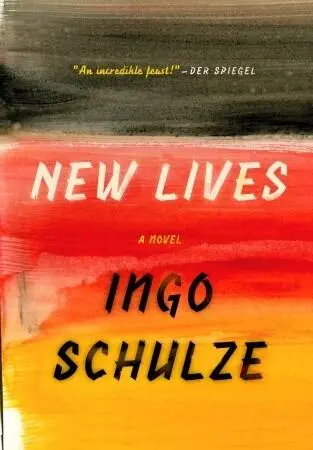
- Название:New Lives
- Автор:
- Издательство:Knopf
- Жанр:
- Год:2008
- ISBN:нет данных
- Рейтинг книги:4 / 5. Голосов: 1
-
Избранное:Добавить в избранное
- Отзывы:
-
Ваша оценка:
New Lives: краткое содержание, описание и аннотация
Предлагаем к чтению аннотацию, описание, краткое содержание или предисловие (зависит от того, что написал сам автор книги «New Lives»). Если вы не нашли необходимую информацию о книге — напишите в комментариях, мы постараемся отыскать её.
This upheaval in our hero’s life, mirrored in the vaster upheaval gripping Germany itself after the fall of the Berlin Wall and the birth pangs of a reunified nation, is captured in the letters Enrico writes to the three people he loves most: his sister, Vera; his childhood friend Johann; and Nicoletta, the unattainable woman of his dreams. As he discovers capitalism and reports on his adventures as a businessman, he peels away the layers of his previous existence, in the process creating the thing he has dreamed of for so long — the novel of his own life, in whose facets contemporary history is captured. Thus Enrico comes to embody all the questionable aspects not only of life in the old Germany, but of life in the Germany just taking form.
Once again Ingo Schulze proves himself a master storyteller, with an inimitable power to reconjure the complete insanity of this wildest time in postwar German history. As its comic chronicler, he unfurls a panorama of a world in transformation — and the birth of a new era.
New Lives — читать онлайн бесплатно полную книгу (весь текст) целиком
Ниже представлен текст книги, разбитый по страницам. Система сохранения места последней прочитанной страницы, позволяет с удобством читать онлайн бесплатно книгу «New Lives», без необходимости каждый раз заново искать на чём Вы остановились. Поставьте закладку, и сможете в любой момент перейти на страницу, на которой закончили чтение.
Интервал:
Закладка:
I advised them to drive to the Great Pond, where the procession would turn right down Teich Strasse. You remember Teich Strasse, I’m sure, one dilapidated ruin after the other, the epitome of devastation. They would also have to close off Teich Strasse at the far end, I said.
All three agreed with me, and the blond asked if I wanted to ride with them. “Yes, please, come along,” the fat one shouted, squeezing onto the backseat while I was allowed to take a seat up front. With blue lights flashing we zoomed up Frauen Gasse. It was too late now to turn off at the little bridge. We couldn’t turn onto Worker Unity until we were between the Small Pond and Kunst Tower, and then raced with sirens blaring to the intersection at the Great Pond. I tried to calm the three of them down. Even if we were too late to block off Teich Strasse from the other side, I said, they would be able to drive at the head of the demonstration. In Leipzig, I filled them in, that had never been a problem. Only the blond, who as the driver was also in charge of the radio, stayed with the car while the other two went to block off Kollwitz and Zwickauer Strasse — which was absurd, since those two streets were the only ones that offered a detour around the paralyzed center of town. I told the blond that. He nodded, grabbed for his cap, and dashed off to the others.
In the quiet of a sunny afternoon I leaned against the squad car and listened to the chants.
And suddenly there it was — a pistol. Or better: a white leather belt with a holster with the pistol in it, right below the driver’s door. And just as suddenly I knew: It’s yours! I bent down, picked up the belt, took out the pistol, shoved it casually inside my waistband, and pulled my sweater down over it. With a kick I slid the empty holster under the car.
I think I smiled, as if I had cracked a joke. The blond returned, plopped into the driver’s seat, called some code into the radio mic, looked up, and said, “Hunky-dory.”
My dear Nicoletta, I should have been at the office long ago. 323To be continued. With warm greetings as always,
Your Enrico T.
Monday, June 11, ’90
Dear Jo,
I’m so sorry that you had to learn about it the way you did. Of course I should have been the one to tell you about our separation. I simply couldn’t bring myself to put it to paper, as if that would make the loss irrevocable, as if it would mean giving up my last hope. I wanted to talk with you about it here, it was going to be the first thing you would hear from my lips. And then you go and run straight into the new couple… 324
My dear Jo, what can I say?
Last year during those long weeks while I lay buried alive in bed, I was forced to watch Michaela go crazy watching me. I was empty and numb, and yet every fiber in me could sense how her love for me was draining away, day by day, bit by bit.
Believe me: when I awoke from that nightmare I was full of hope and full of love. And I knew what I had to do. Michaela has never understood that it was for her sake that I gave notice at the theater. Yes, I did it for Michaela and Robert, for us three.
It was during a walk the three of us took at the beginning of the year — it had snowed, and we had taken off across the fields — that I suddenly saw how wonderful my life could be. I realized how wretched, calculating, and loveless my behavior had been. It was no longer possible to go on living as I had — and it was impossible for me to write. Instead of breathing life into my characters, I had let my own life wither in the pestilent air of art. All of which came to me as Robert was leading me across the field — I had gotten a splinter in my eye. I wanted to save myself and thus Michaela as well, and above all the boy. I hoped for a new life that would bring us happiness. Michaela and I even started sleeping together again, and I was certain she would soon be pregnant.
In my despair I sometimes think Michaela’s love would have had to last only a few more weeks, so that if Barrista were to arrive in town now, his sorcery could no longer accomplish anything. And yet it was I who prepared the soil for him, I literally led Michaela to him. I spin these cobwebs in my darkest hours. I still don’t want to believe it’s true: Michaela and Barrista! He simply took her by surprise. He’s the surprise attack in person.
Michaela sees things differently, of course. In her opinion our separation has followed an inner logic. She had fought for me to the point of self-destruction. And then who had left her in the lurch? I had, by betraying her and the theater. She was left behind alone, her back to the wall. She claims we were already no longer a couple when the baron showed up. That isn’t true, of course, along with a lot of other things she now claims. Michaela saw very clearly what all a relationship with the baron would make possible — and couldn’t resist. He not only rescued her, he has also provided her a sense of gratification, maybe even of retribution. With one swift move, she eclipsed everyone — including, last but not least, me. As she gazes down from the heights now, I’m just one of a host of clumsy tyros. Even her larger-than-life Thea is now merely one of many people forced to prostitute themselves onstage. Michaela told you, I’m sure, about flight school. She doesn’t talk about anything else now. To circle the town on high, while all other earthbound creatures creep to their labors, is for her the epitome of her triumph.
Her bad conscience, however, leaves her testy, especially since Robert has taken my side. Presumably Michaela told you about Nicoletta — the woman who was sitting beside me when I had the car accident last March. Michaela read some letters I wrote her 325—and of course found nothing improper in them. But she has managed to magnify into grounds for separation her conviction that I confided things to a “woman who’s a total stranger” that I had “held back” from her. Ah, Jo, I actually wish her accusations were true, because it would probably make it easier for me to deal with the separation. It’s so absurd. I don’t even know if Nicoletta has a boyfriend, or if she lives alone or with someone or even what she thinks of my epistles, which I write early in the morning when I can’t sleep. Nicoletta is the ideal person — at least the Nicoletta I imagine when I’m writing — for me to tell about the past. By picturing her, I can understand what has happened to us.
Nicoletta didn’t believe me when I told her that I had voluntarily left the theater to put together a provincial newspaper. Her ideas about writers and artists are similar to those my mother entertains — even though she now sees the world with “businesslike objectivity.” Besides which, Nicoletta has read ten times more Marx and Lenin than all of us put together. She’s not like Roland, Vera’s old admirer, but she still goes on and on about exploitation and capitalism, even concepts like “aggressive imperialism” or “the military-industrial complex” (allegedly a term first used by former U.S. president Eisenhower) flow from her lips with no problem.
I suffered irredeemable loss of status in her eyes when I began “working in tandem” with Barrista. To her Barrista is unadulterated evil. I am not going to try to convince her otherwise, but I have every intention of making clear to her why I have chosen this life. And someone can only understand that if they know how we used to live.
I’m really not talking about love. I’m not in any condition yet for that either.
Besides which — and up until now it wasn’t even a possibility — I want love between equals, between people who act on the same assumptions. I want love without quirks and contortions. I want an alarm clock ringing in the morning and supper at the same time every evening, I want vacations and Sunday outings. I want a family. Yes, I long for a bourgeois life, for order, both within me and around me. Nicoletta would probably run for cover if I confessed that to her.
Читать дальшеИнтервал:
Закладка:
Похожие книги на «New Lives»
Представляем Вашему вниманию похожие книги на «New Lives» списком для выбора. Мы отобрали схожую по названию и смыслу литературу в надежде предоставить читателям больше вариантов отыскать новые, интересные, ещё непрочитанные произведения.









Обсуждение, отзывы о книге «New Lives» и просто собственные мнения читателей. Оставьте ваши комментарии, напишите, что Вы думаете о произведении, его смысле или главных героях. Укажите что конкретно понравилось, а что нет, и почему Вы так считаете.