Rafik Schami - Damascus Nights
Здесь есть возможность читать онлайн «Rafik Schami - Damascus Nights» весь текст электронной книги совершенно бесплатно (целиком полную версию без сокращений). В некоторых случаях можно слушать аудио, скачать через торрент в формате fb2 и присутствует краткое содержание. Год выпуска: 2011, Издательство: Interlink Books, Жанр: Современная проза, на английском языке. Описание произведения, (предисловие) а так же отзывы посетителей доступны на портале библиотеки ЛибКат.
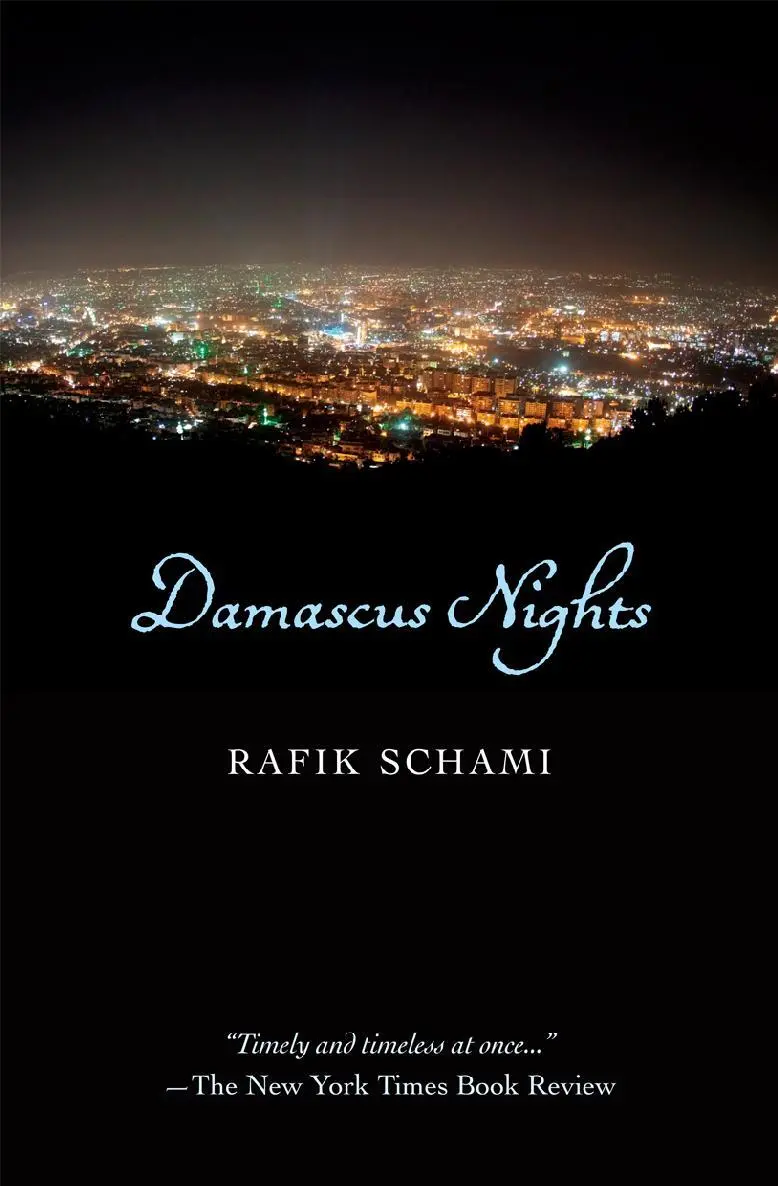
- Название:Damascus Nights
- Автор:
- Издательство:Interlink Books
- Жанр:
- Год:2011
- ISBN:нет данных
- Рейтинг книги:4 / 5. Голосов: 1
-
Избранное:Добавить в избранное
- Отзывы:
-
Ваша оценка:
Damascus Nights: краткое содержание, описание и аннотация
Предлагаем к чтению аннотацию, описание, краткое содержание или предисловие (зависит от того, что написал сам автор книги «Damascus Nights»). Если вы не нашли необходимую информацию о книге — напишите в комментариях, мы постараемся отыскать её.
Damascus Nights — читать онлайн бесплатно полную книгу (весь текст) целиком
Ниже представлен текст книги, разбитый по страницам. Система сохранения места последней прочитанной страницы, позволяет с удобством читать онлайн бесплатно книгу «Damascus Nights», без необходимости каждый раз заново искать на чём Вы остановились. Поставьте закладку, и сможете в любой момент перейти на страницу, на которой закончили чтение.
Интервал:
Закладка:
"Well, two days later, the police not only surrounded the house, they occupied the whole street. They arrested Omar and carried off his entire workshop from the cellar. When an officer asked him rudely what son of a whore had taught him to do that, Omar answered with a smile, 'The Sultan.'
"The next day I hurried to the Damascus prison to see him, but since he was being held as a traitor, he was forbidden to speak with anyone until his sentencing half a year later. I had fake papers made up to change my name and show that I was his nephew since then I've been called Junis. As a relative, I was the first one allowed to see him. I was trembling at the idea of meeting him, but he just beamed at me. I told him I was ashamed to death to have betrayed the one man in Damascus who had given me his love, that I would rather die than see him languish here in prison. Omar laughed. 'Instead of dying and being ashamed for the rest of your life,' he told me, you should use your head and learn: never tell everything you know.'
"Every day I visited him and brought him fruits and snuff. In order to bring him things without being searched, I had to bribe a series of guards. He secretly gave me letters to deliver to various addresses in Damascus. They were all elegant homes, and from them I received answers, which I would smuggle back into the prison. I was exhausted, since at the time I was working in a large cafe where I waited on tables for very little money. I saved every piaster of my wages and tips. I stole from the owner whenever I could, and bought Omar fruits and snuff.
After a month, Omar asked me what I intended to do with myself. I answered: 'I'm not thinking about myself until you're out of here.'
" 'I will be out of here in ten days,' he answered with a laugh. 'So, then, what will you do with yourself eleven days from now?'
" 'I'd like to open a cafe.'
" 'Now listen closely to me. Go down into the cellar and you'll find a big marble slab underneath the wood stove. Lift it up and you'll find a box. Inside this box are two sacks, a big one, filled with hay, which belongs to me, and a small one, in which you'll find two hundred gold liras of the best counterfeit. No man on earth can tell them from the real thing. You'll be safe from the slightest suspicion. They're yours, if you promise me you'll never let any guest leave your cafe hungry or dissatisfied. Ten days from now is Thursday, understand? On Thursday night, bring the sack of hay to the coffeehouse next to the fountain near the Umayyad Mosque. Sit in the first row, listen to the hakawati's story, and then leave. God have mercy on you if you can't keep this to yourself. And woe to you if you open the sack of hay. I will kill you. Do you hear? Kill you.'
"I hurried home and shoved the marble slab aside, and there were the two sacks, but the big sack was so heavy that when Thursday came I had difficulty carrying it. I found the cafe, and no sooner had an old hakawati begun telling the love story of Antar and Abla but Omar walked in. He was wearing a white robe with a wonderful, black cloak and an embroidered silk vest, such as only the most elegant people in Damascus wore back then. He sat down next to me without a word of greeting, and when the hakawati had finished his tale, I stood up and started to leave, just as he had ordered. He grabbed me by my sleeve. 'What's in this sack?' he asked.
" 'Heavy hay,' I answered. He laughed, then hoisted the sack and walked out. He climbed on his horse, which he had tied in front of the cafe, and rode alongside me. I walked slowly down the street.
" 'The police are bound to make a raid tonight. Where are you planning to spend the night?' he asked.
" 'I already have a hiding place for the next few years,' I answered.
" 'Yes, but where can I see you? Tell me where you'll be!' he whispered.
" 'O sir, two mountains will never meet, but two people will find each other if they look,' I answered.
" 'You have learned well. The time in prison was a fair price to pay for that. Keep your word, never let anyone leave your table hungry or dissatisfied!' he called out, then laughed and rode away under a mantle of darkness.
"And as for me, I came to your neighborhood and bought a dilapidated dump. The money allowed me to make it into the coffeehouse that all of you know. But I saw that the food was not enough to keep my guests satisfied. I saw how they would go back home with all their cares and worries. Then one night a guest happened to tell a beautiful story, and the people stayed longer and went home happier. From then on I hired a hakawati every night."
"My God, and did you ever meet Omar again?" Musa asked.
"No," answered Junis, but a smile played around his lips.
"You heard it," said Isam, "the master taught him
— he's never supposed to tell everything he knows."
Junis nodded, relieved. Isam pulled out five cards, and
just as on the previous evening, the
locksmith wanted to be the last
to draw. It was the emigrant
who drew the ace.
8 How one person's true story was not believed, whereas his most blatant lie was
Tuma the emigrant was a vigorous, wiry man of slight build. His gait was more a skip, despite the seventy-five years he carried on his back. He would bound up stairs as if he were a love-stricken fourteen-year-old on his way to see his sweetheart. None of the other gentlemen looked as young and strong as Tuma, whose entire philosophy of health consisted in taking an ice-cold shower every morning, in winter as well as summer. He always said he felt reborn after his shower.
Tuma came from a village on the coast, not far from Latakia. When he returned from America, not one member of his family was still living in the port city: some had died, and the rest had either moved to different cities or left the country. Tuma and his wife, Jeannette, decided to settle in Damascus. She was a second-generation emigrant, born in California; her mother came from Mexico. Her father, on the other hand, came from the mountains of Lebanon; an only child, he had lost his parents in the massacres of 1860. Sixty years later, shortly before his death, he made his only daughter swear never to return to Arabia, neither by land nor by sea. So when she did return, she insisted on a city with an airport, and Damascus did indeed boast an airport.
Tuma rented a very small house on Lazarists Street. If his wife Jeannette hadn't been so petite and thin, the two of them would never have been able to move at the same time inside the tiny rooms of their doll-house. Nevertheless, in his forty square feet of courtyard Tuma was not to be deterred from constructing the pride and joy of every Arabian palace: what he had been raving to his wife about for thirty years — a fountain… in this case, no larger than a soup bowl. Surrounding this treasure was a miniature jungle of plants growing out of a thousand tiny flowerpots, which Tuma's clever hands had first fashioned from tin cans and then painted and arranged with such skill that the plants actually made the courtyard appear larger than it was. The only thing that bothered his friends was a plastic penguin, which spat water into the soup bowl in an uninterrupted noisy stream; if it hadn't come from America, then Salim, Mehdi, or Junis would have suggested to Tuma that he throw it in the trash. Or else Isam would have smashed the plastic bird into a thousand and one pieces. Faris and Musa, on the other hand, both agreed that the presence of the ice dweller in the middle of Damascus had a cooling effect on the soul.
Jeannette spoke a broken Arabic, but she said what she thought directly and without the slightest embellishment. Whenever he visited, Salim couldn't get enough of her. He liked the freshness of her language. The neighbors appreciated — and even envied — this petite, gentle woman, for although she spoke so softly she was nearly inaudible, she never had to repeat a word she said. Jeannette had not been eager to leave America, if for no other reason than it meant leaving behind their grown-up children. But Tuma had promised her heaven on earth if she came with him to Syria: she would be his queen, he her slave. At least that's how the neighbors told it. The strong-willed Tuma was never in his life anybody's slave, but even in public he showed his spouse great respect. He was the only man in the neighborhood who walked hand in hand with his wife.
Читать дальшеИнтервал:
Закладка:
Похожие книги на «Damascus Nights»
Представляем Вашему вниманию похожие книги на «Damascus Nights» списком для выбора. Мы отобрали схожую по названию и смыслу литературу в надежде предоставить читателям больше вариантов отыскать новые, интересные, ещё непрочитанные произведения.












Обсуждение, отзывы о книге «Damascus Nights» и просто собственные мнения читателей. Оставьте ваши комментарии, напишите, что Вы думаете о произведении, его смысле или главных героях. Укажите что конкретно понравилось, а что нет, и почему Вы так считаете.