Rafik Schami - Damascus Nights
Здесь есть возможность читать онлайн «Rafik Schami - Damascus Nights» весь текст электронной книги совершенно бесплатно (целиком полную версию без сокращений). В некоторых случаях можно слушать аудио, скачать через торрент в формате fb2 и присутствует краткое содержание. Год выпуска: 2011, Издательство: Interlink Books, Жанр: Современная проза, на английском языке. Описание произведения, (предисловие) а так же отзывы посетителей доступны на портале библиотеки ЛибКат.
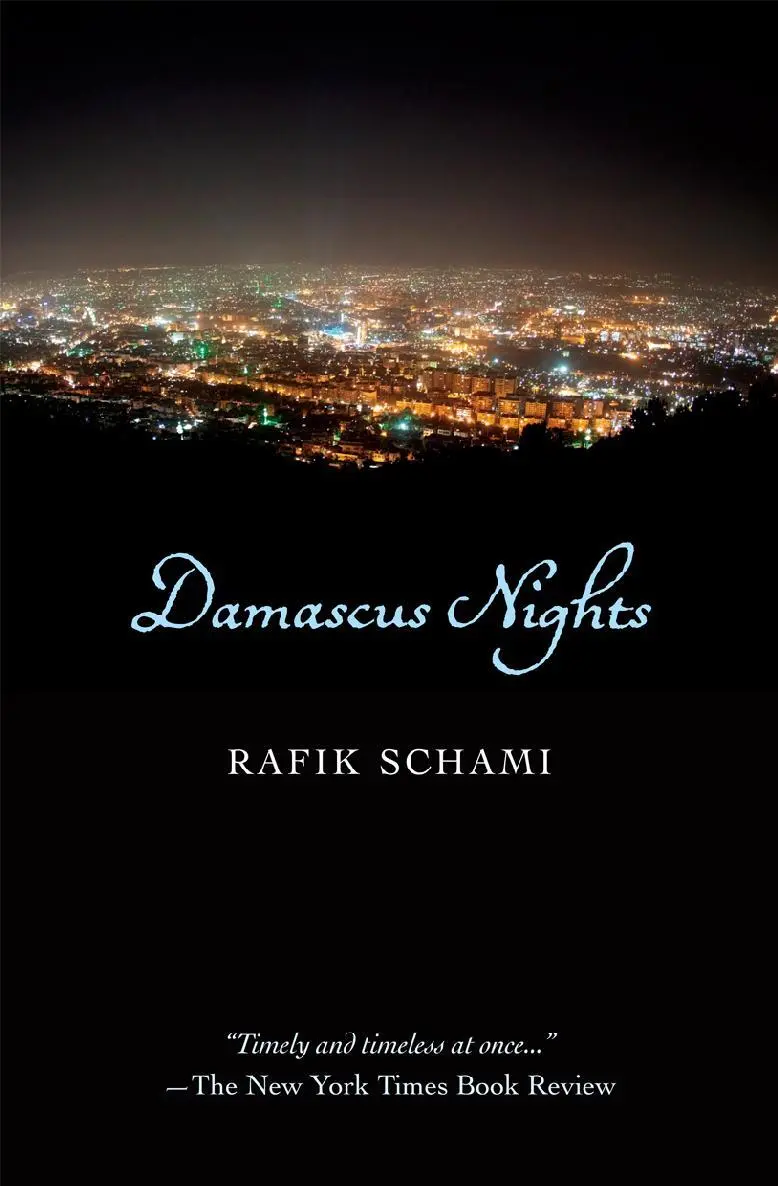
- Название:Damascus Nights
- Автор:
- Издательство:Interlink Books
- Жанр:
- Год:2011
- ISBN:нет данных
- Рейтинг книги:4 / 5. Голосов: 1
-
Избранное:Добавить в избранное
- Отзывы:
-
Ваша оценка:
Damascus Nights: краткое содержание, описание и аннотация
Предлагаем к чтению аннотацию, описание, краткое содержание или предисловие (зависит от того, что написал сам автор книги «Damascus Nights»). Если вы не нашли необходимую информацию о книге — напишите в комментариях, мы постараемся отыскать её.
Damascus Nights — читать онлайн бесплатно полную книгу (весь текст) целиком
Ниже представлен текст книги, разбитый по страницам. Система сохранения места последней прочитанной страницы, позволяет с удобством читать онлайн бесплатно книгу «Damascus Nights», без необходимости каждый раз заново искать на чём Вы остановились. Поставьте закладку, и сможете в любой момент перейти на страницу, на которой закончили чтение.
Интервал:
Закладка:
"Also, in Latakia we lived like bees — the individual didn't count, the clan was everything. It gives you a feeling of security, but it also ties your hands and feet up. In America people live like gazelles, everyone for himself, even if they travel together. You're on your own, but you're also free to try something new. Over there you get in a boat and row across the river all by yourself. Here if you want to cross the river to some new shore you have to pack everyone in the boat first: two grandfathers and two grandmothers, your father and mother, brothers and sisters, aunts and uncles, not to mention all the in-laws."
"You're forgetting preacher and imam," Faris added, nodding his head in agreement.
"If I can't take along our waterpipe and our Arabian mocha as well," Isam added with a serious expression, "I couldn't care less about any new shores."
"Okay, that's not a bad idea, but unfortunately it's impossible. But let me get back to America! In Latakia I might have met a few foreigners working on the boats, but in America I lived with Greeks, Chinese, Africans, Poles, Jews, Italians, and you name it — from any country in the world. There you meet people who had lived completely different lives before. And not just poor devils, either. You meet distinguished people working on the docks right next to you — people who'd never lifted a thing in their life. I even met Kahlil Gibran."
"You mean the famous poet Gibran?" Faris asked incredulously.
"Yes, Gibran. We were both living in New York. I met him in 1921 at a reading. He was a good man whose language and voice just streamed into my heart the first moment I heard him and filled it with peace. But while he was still alive there were many jealous people who attacked him and tried to smear his reputation. They wouldn't even leave his private life alone. But what harm can a fly's shit do to an elephant? And in his soul Gibran was as big as an elephant. One day we were in a small bar. He was very sad and he asked me how he should defend himself against his enemies. They wouldn't give him a single day of peace. Imagine, the great scholar Gibran asking me, a simple dockhand, what he should do. I told him to do just what my grandfather had done: my grandfather confounded his enemies because he kept going straight ahead.
"I bought all of Kahlil's books and had him write a fine dedication. 'To my friends Jeannette and Tuma,' he wrote. My wife loved him as much as I did. When he died of cancer in 1931, many Arabs and Americans mourned his passing. To this day my wife shows the books to every guest, and I agree with her when she says they're the greatest treasure we have.
"Okay, so what did I get out of living abroad and what did I lose? You know, before I went to America, I used to love to talk. I can still remember how I lost two jobs in Latakia because I talked and sang too much. I didn't know what a word was really worth until I traveled abroad and lost my voice. Words are invisible jewels; the only people who can see them are the ones who've lost them. Salim knows this better than anyone."
The old coachman nodded pensively.
"But losing your voice in a foreign country is worse than never having had one. Salim understands exactly what I mean. It's a particularly bitter form of dumbness, for those who are born dumb can speak with their hands, their eyes, their head. In fact, they speak with everything but their tongue. But we foreigners have it as bad as the hero of Mehdi's story. What was his name again? Shafik?"
"No, Shafak," Mehdi corrected.
"At first everything is dead, just like with Shafak. I hadn't learned to talk with my hands any more than Salim. Then suddenly I was in America. But I stayed voiceless for a long time, even after I could speak English."
"Why was that?" Mehdi wanted to know.
"How are you going to talk to people who don't have the faintest idea about the things that really matter to you? I went to America with the heart of a lion and the patience of a camel, but courage and patience were no cure for being mute. Being abroad gave me the tongue of a child, and soon it gave me a child's heart to match. You know that heart and tongue are made from the same flesh. And I spoke with the heart and tongue of a child and the patience of a camel. But no matter what I told them, they treated everything I said as a fairy tale. The Americans have a huge country, but they know very little about the rest of the world. They called me a Turk, even though I explained a thousand times that Syria is a separate country, that it only borders on Turkey. What's the difference, most of them said, you're all Turks; On the other hand, they insisted that I know exactly where they came from, down to the side of the street where they were born. In New York, bitter foes sometimes live jammed right next to one another, and woe unto you if you confuse one side of the street in Harlem with another. Or try to explain to an American that you're both an Arab and a Christian. They'd find it easier to swallow Aladdin's lamp.
"Once I was taking the train on my way to visit a friend named Mahmoud el-Haj. He was an engineer at an electrical appliance plant."
"El-Haj from Malula?"
"No, Mahmoud came from southern Lebanon. Okay, so the trip takes thirty hours by train. At one point this American comes into my compartment. He gives me a friendly nod, and I'm looking forward to a conversation that will make the trip a little shorter. But that was too much to hope for. 'Are you a Turk?' he asked.
" 'No,' I said, 'I'm an Arab.'
" That doesn't matter, as long as you're a Muslim. I've recently converted to Islam. Ashhadu anna la ilaha ilia Allahu wa anna Muhammadan Rasulu Allah.' The American recited the words of his creed to me, but that one sentence was all the Arabic he knew.
" 'Okay, that's fine for you, but I'm not a Muslim. I'm Christian, you know?'
" 'Hmm,' he says. The young American was confused and thought for a long time. Then he gave me a disapproving look. 'So you're not really an Arab, you're a Mexican!'
" 'No, I'm not, I'm as Arab as they come. There's a poet in every generation of my family.'
" 'Hmm,' he said again, sighing, and was again silent for a long time. 'But if you're an Arab, then you have to be a Muslim, that is for sure!'
" 'No, nothing is for sure. In Arabia there are Jews, Christians, Muslims, Druses, Baha'is, Yezidis, and many other religious groups besides.'
" 'Hmm,' he repeated and looked at me. By now he was completely unnerved. 'No, all Arabs are Muslims. After all, they're the ones who invented Islam!' He was very disappointed, as if the Arabs had left him in the lurch with his Islam."
"Are Americans stupid, or was this man's deck just missing a few cards?" Isam wanted to know.
"No. You know, Americans are no more stupid and no more smart than Arabs. You won't believe it when I tell you about the skyscrapers in New York!"
"And why not? I've seen pictures in the paper!" Junis said reassuringly.
"Okay, but I'm positive you won't believe me when I tell you that Americans don't haggle when they buy things!"
"What do they do, swat flies?" Isam sounded indignant.
"No, but when you go into a store, you just look at the price tags, you pay, and leave."
"Now you're making fun of us," Isam objected.
"No, I didn't believe it at first, either, but after I had learned the language, I went into a big store, six stories high. You could find everything you wanted: clothes, food, toys, material, paint, radios."
"So it was a bazaar. All in one building?" Musa asked amazed.
"That's right, a bazaar all in one building, except you can't haggle. I can tell you don't believe me, even the eyes of my dear friend Salim are accusing me of lying."
Salim felt he had been caught and smiled.
"Okay, so I went in. I wanted to buy a jacket. I found one I liked and took it to a saleslady. 'How much does this jacket cost?' I asked.
Читать дальшеИнтервал:
Закладка:
Похожие книги на «Damascus Nights»
Представляем Вашему вниманию похожие книги на «Damascus Nights» списком для выбора. Мы отобрали схожую по названию и смыслу литературу в надежде предоставить читателям больше вариантов отыскать новые, интересные, ещё непрочитанные произведения.











Обсуждение, отзывы о книге «Damascus Nights» и просто собственные мнения читателей. Оставьте ваши комментарии, напишите, что Вы думаете о произведении, его смысле или главных героях. Укажите что конкретно понравилось, а что нет, и почему Вы так считаете.