Rafik Schami - Damascus Nights
Здесь есть возможность читать онлайн «Rafik Schami - Damascus Nights» весь текст электронной книги совершенно бесплатно (целиком полную версию без сокращений). В некоторых случаях можно слушать аудио, скачать через торрент в формате fb2 и присутствует краткое содержание. Год выпуска: 2011, Издательство: Interlink Books, Жанр: Современная проза, на английском языке. Описание произведения, (предисловие) а так же отзывы посетителей доступны на портале библиотеки ЛибКат.
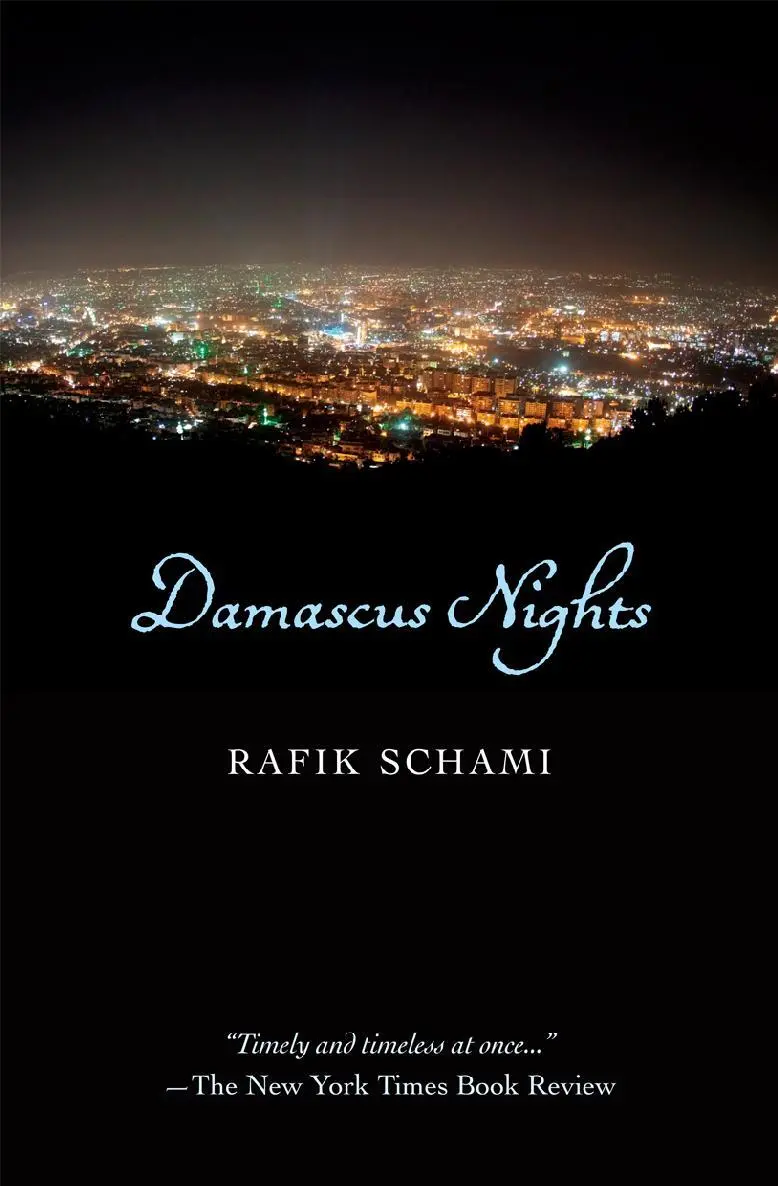
- Название:Damascus Nights
- Автор:
- Издательство:Interlink Books
- Жанр:
- Год:2011
- ISBN:нет данных
- Рейтинг книги:4 / 5. Голосов: 1
-
Избранное:Добавить в избранное
- Отзывы:
-
Ваша оценка:
Damascus Nights: краткое содержание, описание и аннотация
Предлагаем к чтению аннотацию, описание, краткое содержание или предисловие (зависит от того, что написал сам автор книги «Damascus Nights»). Если вы не нашли необходимую информацию о книге — напишите в комментариях, мы постараемся отыскать её.
Damascus Nights — читать онлайн бесплатно полную книгу (весь текст) целиком
Ниже представлен текст книги, разбитый по страницам. Система сохранения места последней прочитанной страницы, позволяет с удобством читать онлайн бесплатно книгу «Damascus Nights», без необходимости каждый раз заново искать на чём Вы остановились. Поставьте закладку, и сможете в любой момент перейти на страницу, на которой закончили чтение.
Интервал:
Закладка:
"Well, there was one thing I hated worse than the plague, I can tell you, and that was the wheat harvest. The cutter's work is a living hell for back and hands. The cut wheat had to be carried to the village threshing floor and threshed there. We had no good sickles and no good rope; we didn't even have a donkey— although I would have preferred to be one myself so I wouldn't feel the pain so much. The damned chaff burned my eyes and throat. The sun beat down on us without mercy. I would have given the world for a little bit of shade and a drop of cool water.
"My mother was often sick. She was sick the whole time I knew her, but she wouldn't hear of our going out into the field alone, and even when she was so frail she could barely walk, she would sit in the middle of the field and sing us songs, to cheer us up a little. They were funny songs, and I can remember we sometimes laughed so hard we cried. We were concerned for her health and always pleaded with her to stay home, but she didn't want to leave us alone. 'As long as I can see, I want to fill my eyes with the sight of you,' was the way she always answered.
"After the harvest she would go with us to the threshing floor and sit there despite the heat. There wasn't a single tree on the hill where the village did its threshing. When one of us children grew tired we could go to her and lay our head in her lap for a little while. She would bend over us and shade us.
"My mother died in the spring of the year I turned twelve. I ran around the fields like mad, screaming out loud for her. I cried and cried and cursed heaven. I stayed outside in the fields. Today I'm sure that the pain I felt that night made me crazy for a while. The next morning I started running; I ran through villages I had never seen before. I stopped people on the street and asked, 'Do you really think my mother's dead?' Most people just pushed me away, but finally someone took me in, although who it was I have no more idea today than I did then. The only thing I remember is being terribly afraid of the way the room looked, with this dim oil lamp glowing and flickering. It was practically empty — just a mattress and a stool — and the ceiling had a large, strangely crooked beam running through the center. I sat huddled in a corner and stared at the beam for a long time before I fell asleep. I don't know when I came back to our village, half starved and completely filthy. My sisters said that it was a month after our mother's death.
"When it came time to harvest the wheat that year, I built a small tent of twigs and foliage on the threshing floor, which my sisters and I called 'Mother.'
"Well, my oldest sister had married at the age of sixteen, shortly before my mother's death. The second-oldest was fifteen at the time and had to take care of the household all alone. That left the youngest of my sisters — who was only one year older than I was — and myself to do all the work in the field. It was my job to turn the wheat and guard it until sunset. Then my father would relieve me, without saying a word, and spend the night on the threshing floor. Unbelievable! He would come, sit down, and stare into the distance. I would always kiss his hand, but he would shove me away and wipe off the back of his hand. Every day I was very fearful of our meeting, and every day, when I kissed his hand, he would shove me away.
"The wheat took time to dry; one rainshower meant putting the threshing off for days. We had to keep watch over the wheat around the clock, until it was safely stored in sacks inside our house. Times were very bad; people were starving. We heard the wildest stories about thieves stealing wheat in broad daylight, while the farmer was taking his midday nap
"I had to stay with the threshing the whole day. But a few boys from the village who were somewhat better off met every day and took a short hike to the village spring. I watched them go, and inside I was boiling over with envy and rage because I was not allowed to play with them.
"Well, once I saw the boys sitting around the village spring. My sister was in a good mood that day. She let me go down to the boys and play for an hour. When I reached the spring, they were sitting in a circle, drinking tea that they had made over a small fire and taking turns telling stories.
"I sat down beside the boys, and sooner or later it was my turn and I started to tell a nice story. They just laughed. 'We don't want to hear a story, we want to hear what you dreamt last night!' I was terrified — I had never even heard the word dream before. It took me some time to figure out why each one began his story with the words I was … I told the children that I had never dreamed.
" 'No wonder!' said the son of the village elder. 'How could you have, you poor devil. You sleep ten to a room, and you're up at the crack of dawn. A dream needs time and space!' I'll never forget those words as long as I live. That night I couldn't sleep. I took my blanket and sneaked out of the room. I went to the threshing floor, and lay down next to my father. He didn't notice anything, but that night I dreamt for the first time in my life. When I woke up, my father had already gone off to work. But I felt different the whole day, and from then on I was glad that I could dream just like the other boys. Night after night I would sneak off to my father, and one morning I was awakened by the stubble of his beard as he kissed me. He hugged me tightly to his breast and cried.
"On that day the world became a piece of heaven. Before noon I had turned the wheat three times. You didn't have to do it that often, once in the afternoon was enough. But a new power was flowing through my veins. And then came the catastrophe.
'The children came as usual to play at the spring, and waved to me to join them. I was afraid of leaving the wheat unattended. My sister had to help with the wash that day, so I was alone. My fear held me back, but my joy at the dreams I could tell the boys kept drawing me to them. I felt torn in two. Well, finally, when I saw them sitting in a circle, my desire won out. I went over to them, sat down, and told them several dreams. The children were fascinated. They said my dreams were wilder than anything they had ever dreamed.
"Well, after I had listened to the dreams of the other boys, I said goodbye and walked slowly back. You had to cross through a large vineyard and then spiral up the bald hill like around a snail's house. It was then I remembered the wheat. I looked up, but I couldn't see the large pile that had covered the middle of our floor. First I thought I had confused our floor with another, but then I recognized the tent I had made, the one we called 'Mother,' standing on the bare floor. My heart was pounding, and my legs began to wobble. I ran as fast as I could. When I reached the floor, I almost died: not a single hull was left. The neighbors all said they hadn't noticed a thing. They hurried with me to our place and couldn't believe their eyes. We looked far and wide but saw neither beast nor rider. For a long time I just sat there and cried, until finally, before the sun went down, I left. I couldn't bear to face my father.
"I had no idea where to go. I started off toward Damascus until at last it got dark. Then I saw a coachman who was still trying to make it to Damascus, despite the late hour. He was goading his horses on and they were galloping like mad. I ran after the coach and with one great leap was able to grab on to the back bar. The coachman could tell that someone was hanging on his coach. But he didn't have time to stop and look, so he just cracked his whip in back of him, and that goddamn whip was long and hit my arms and legs like spears of fire. Never again did I see a whip as long as that. He kept on flogging both his horses and me. More than anything I wanted to jump off, but the ground beneath me had turned into a whirring grindstone. Whenever I tried to put my foot down, the road tore open my naked toes. The whip was searing me from above and the road from below. It was a hell. When the coach reached Damascus, my arms were bleeding. I climbed down, staggered away on shaky legs, and cursed the bones of this coachman's ancestors.
Читать дальшеИнтервал:
Закладка:
Похожие книги на «Damascus Nights»
Представляем Вашему вниманию похожие книги на «Damascus Nights» списком для выбора. Мы отобрали схожую по названию и смыслу литературу в надежде предоставить читателям больше вариантов отыскать новые, интересные, ещё непрочитанные произведения.












Обсуждение, отзывы о книге «Damascus Nights» и просто собственные мнения читателей. Оставьте ваши комментарии, напишите, что Вы думаете о произведении, его смысле или главных героях. Укажите что конкретно понравилось, а что нет, и почему Вы так считаете.