Jonis Agee - The Bones of Paradise
Здесь есть возможность читать онлайн «Jonis Agee - The Bones of Paradise» весь текст электронной книги совершенно бесплатно (целиком полную версию без сокращений). В некоторых случаях можно слушать аудио, скачать через торрент в формате fb2 и присутствует краткое содержание. Год выпуска: 2016, Издательство: William Morrow, Жанр: Современная проза, на английском языке. Описание произведения, (предисловие) а так же отзывы посетителей доступны на портале библиотеки ЛибКат.
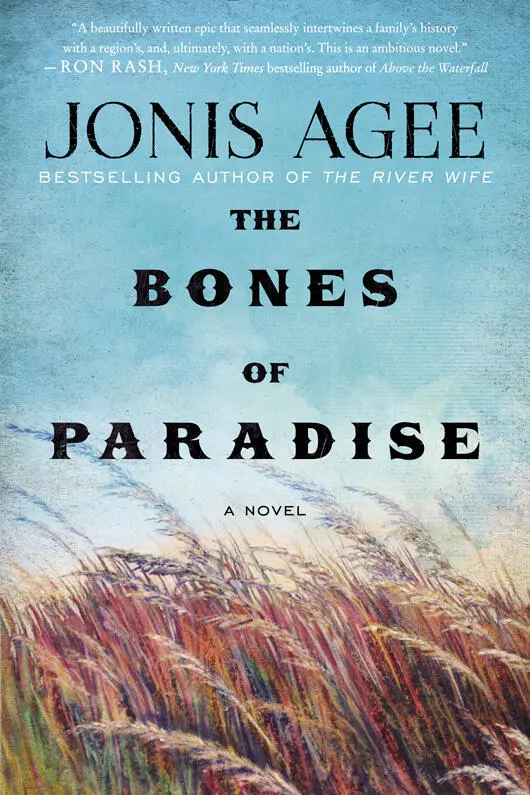
- Название:The Bones of Paradise
- Автор:
- Издательство:William Morrow
- Жанр:
- Год:2016
- ISBN:нет данных
- Рейтинг книги:3 / 5. Голосов: 1
-
Избранное:Добавить в избранное
- Отзывы:
-
Ваша оценка:
The Bones of Paradise: краткое содержание, описание и аннотация
Предлагаем к чтению аннотацию, описание, краткое содержание или предисловие (зависит от того, что написал сам автор книги «The Bones of Paradise»). Если вы не нашли необходимую информацию о книге — напишите в комментариях, мы постараемся отыскать её.
returns with a multi-generational family saga, set in the unforgiving Nebraska Sandhills in the years following the massacre at Wounded Knee—an ambitious tale of history, vengeance, race, guilt, betrayal, family, and belonging, filled with a vivid cast of characters shaped by violence, love, and a desperate loyalty to the land. Ten years after the 7th Calvary massacred more than 200 Lakota men, women, and children at Wounded Knee, J. B. Bennett, a white rancher, and Star, a young Native American woman, are murdered in a remote meadow on J. B.’s land. The deaths bring together the scattered members of the Bennett family: his cunning and hard father, Drum; his estranged wife, Dulcinea; and his young sons, Cullen and Hayward. As the mystery of these twin deaths unfolds, the history of the dysfunctional Bennett’s and their damning secrets are revealed exposing the conflicted heart of a nation caught between past and future.
At the center of
are two remarkable women. Dulcinea, returned after bitter years of self-exile, yearns for redemption and the courage to mend her broken family and reclaim the land that is rightfully hers. Rose, scarred by the terrible slaughters that have decimated and dislocated her people, struggles to accept the death of her sister, Star, and refuses to rest until she is avenged.
A kaleidoscopic portrait of misfits, schemers, chancers, and dreamers, Jonis Agee’s bold new novel is a panorama of America at the dawn of a new century. A beautiful evocation of this magnificent, blood-soaked land—its sweeping prairies, seas of golden grass and sandy hills, all at the mercy of two unpredictable and terrifying forces, weather and lawlessness—and the durable men and women who dared to tame it. Intimate and epic,
is a remarkable achievement: a mystery, a tragedy, a romance, and an unflagging exploration of the beauty and brutality, tenderness and cruelty that defined the settling of the American west.
The Bones of Paradise — читать онлайн бесплатно полную книгу (весь текст) целиком
Ниже представлен текст книги, разбитый по страницам. Система сохранения места последней прочитанной страницы, позволяет с удобством читать онлайн бесплатно книгу «The Bones of Paradise», без необходимости каждый раз заново искать на чём Вы остановились. Поставьте закладку, и сможете в любой момент перейти на страницу, на которой закончили чтение.
Интервал:
Закладка:
When Drum Bennett was found, barely alive, the next morning, the sun was well up, and the day promised to be the hottest of fall, the air filled with the pounding of nails into boards to replace broken windows and voices calling up and down Main Street reporting damage. Drum lay in a narrow alley between the hotel and the boot maker. He was discovered by a gang of boys searching the debris of the night’s revelries for anything they could find, which thus far had produced only a pocket knife with a broken blade, a couple of whiskey bottles with a drop or two in the bottom, and a silver dollar they fought over.
CHAPTER FORTY-FOUR
It was Dun Riggins, owner of the livery stable, who woke Hayward with the news of his grandfather’s injuries and the demise of Percival Chance from a collision with a runaway wagon. Hayward sat, blinking in the dusty light, unclear where he was. Then the fight flooded back, followed by other confusing images, and he stood, confirmed the Bennett horses were still in their stalls, and lurched toward the almost unbearable light beyond the big double stable doors.
He was horribly thirsty and unsteady on his feet, and some part of him knew his presence was required at Drum’s bedside. When thoughts of his mother came, he found it easy to push them behind the pain that sat like a skullcap behind his eyes, crushing his head as it moved to the back of his neck. He was halfway to Doc’s when he thought he heard someone call his name. He didn’t slow. Then he heard it again, along with a thumping, irregular boot step. He stopped and turned to face Stubs, Drum’s ranch hand.
The man tilted his head for them to continue without speaking, and they were almost there before Stubs paused and turned toward the street, watching as the riders from the Box LR, led by Larson Dye looking worse for the wear, walked past. Across the street, Stillhart the banker spoke with Harney Rivers, both staring and nodding toward Doc’s place.
“Gonna be a lot of that,” Stubs said. “Smart man sticks to his relations, keeps his mouth shut till he know the lay of the land.”
Hayward felt an old anger rise in chest. “Like Cullen did?”
Stubs shook his head and rubbed the knee that always ached. “Not saying do what he did. Sometimes he knew enough to sit quiet and wait to see how the game played out.” He glanced at Hayward, took in the bruises, cuts, and blood, and nodded with satisfaction. “You’re carrying the name now. It’s up to you.”
Hayward opened his mouth, about to ask the old cowboy what he was talking about, when the sudden weight of the words caught in his throat so dry he couldn’t even cough. He shook his head and walked on until he reached the door to the clinic built onto the side of a tidy brown house. The small rooms housed the doctor, his old-maid daughter, and a strange young girl from Ireland whose passage was to be paid as an indentured servant. She puzzled Hayward even now as she pulled open the door before he had a chance to knock. Standing slightly behind him, Stubs whispered, “Them crows are circling, boy, better make tracks.”
Hayward jerked as if stung by a wasp, then explained who he was. She led them through the entryway, down a hall, into the kitchen, and through another door to a room large enough for six beds with a wooden chair beside each; a tall cabinet with glass doors and shelves that held jars, bottles, and stacks of cloth for bandages; and a narrow harvest table littered with scraps of paper and a ledger book. Although every bed held a patient, including the dentist-sheriff, the last bed against the back wall drew their attention.
Graver stood at the foot, hat held at waist, while Dulcinea sat beside Drum, holding his hand—a sight so strange Hayward almost took a step back. As he approached, he saw that his grandfather’s face was white and drained. “Cullen?” the old man whispered in a weak voice. “You fighting again? Soon as I’m up and around, I’ll see to you—”
Hayward snatched off his cowboy hat and shook his head.
His mother was focused on Drum, and brushed the hair off his forehead with a light touch. “I decided you’re right. You’ll be better soon, and we can combine our two ranches, live in my house, rent out the other or let the men use it. Hayward will take over in a few years.”
“I’ll build a new house for us, and the boys.” Drum gazed at her and smiled, his eyes filled with tears. “I never meant harm to any of you—J.B.—wasn’t me—” His voice slid away as he struggled to breathe against a wave of pain.
Dulcinea glanced over her shoulder and didn’t seem to notice the condition of her son’s face and clothes. Without dropping Drum’s hand, she tilted her head to beckon him over. Hayward leaned back like an unbroken colt tied to a post, then stepped forward as soon as Graver put a hand on his shoulder. The old man lifted his free hand as if to wave them closer.
The confusion on the wounded man’s face rendered him harmless, even childlike, something no living person had ever seen. It unnerved him.
“We’re glad you’re here.” Dulcinea patted Drum’s hand.
Hayward was about to bolt. Graver stepped back to give him room to breathe, then eased over and took the chair beside the dentist’s bed as Hayward sat at his grandfather’s side.
“How’s he doing?” Hayward asked. The harsh glare that usually shone from Drum’s eyes was gone, replaced by benign confusion. Brain stroke? He had seen cowboys fall off their horses and wake with this expression, but he’d never expected to see it on Drum Bennett.
Dulcinea released Drum’s hand, placed it on his chest. He hesitated to touch his grandfather. When Judge Foote walked through the doorway, Dulcinea’s lips parted and Drum’s breathing became labored.
The judge glanced at the family, paused at the foot of the dentist’s bed, and nodded to the room. He cleared his throat, then reached out, grabbed the dentist’s foot, and gave it a good shake. Receiving no response, he cleared his throat loudly as Doc entered the room.
“Here now, stop that!” Doc pulled the judge away from the bed, then dropped his voice. “He’s sleeping, for Christ’s sake.”
“Dying?” The judge squinted with a nearsighted expression and lifted his chin at the patient.
“You keep bothering him.” Doc shook his head and moved to the far side of Drum’s bed with the judge fast on his heels.
“Drum Bennett going to make it?” The judge’s voice seemed to bang against the walls like a gunshot, making the family jump.
“What’s wrong with you?” Doc shook his head and peered over his glasses at Drum’s face as he checked the old man’s wrist for a pulse. He shook his head again and released the hand while Drum watched without interest.
“How you doing, sir?” The judge’s booming voice ratcheted around the room again. The other patients muttered and tossed in their sleep.
“Heard Lawyer Chance didn’t make it. You have his body here?” The judge looked at the doctor, who shook his head and moved to the next patient. “That’s a hard way to go, trampled by a runaway team, especially your own. Too late to appreciate your own irony.” His bright eyes swept the group around Drum’s bed. Dulcinea’s face paled at the news and she glanced at her son. Hayward didn’t respond. He’d never had any use for the lawyer. He reckoned she’d have to hire Rivers now. It had nothing to do with him. She hesitated, then stood and motioned the judge to follow as she swept past Graver and Hayward, across the room and out the door. Hayward gazed after her until they were out of the room, then he slipped into her chair and peered closely at the old man, his last living Bennett relative.
Hesitantly, he reached for his hand, touched it with trembling fingers, and jerked away when the back of it twitched like a horse ridding itself of a fly. “Grandfather? Drum? Sir?”
Читать дальшеИнтервал:
Закладка:
Похожие книги на «The Bones of Paradise»
Представляем Вашему вниманию похожие книги на «The Bones of Paradise» списком для выбора. Мы отобрали схожую по названию и смыслу литературу в надежде предоставить читателям больше вариантов отыскать новые, интересные, ещё непрочитанные произведения.






Обсуждение, отзывы о книге «The Bones of Paradise» и просто собственные мнения читателей. Оставьте ваши комментарии, напишите, что Вы думаете о произведении, его смысле или главных героях. Укажите что конкретно понравилось, а что нет, и почему Вы так считаете.