Jonis Agee - The Bones of Paradise
Здесь есть возможность читать онлайн «Jonis Agee - The Bones of Paradise» весь текст электронной книги совершенно бесплатно (целиком полную версию без сокращений). В некоторых случаях можно слушать аудио, скачать через торрент в формате fb2 и присутствует краткое содержание. Год выпуска: 2016, Издательство: William Morrow, Жанр: Современная проза, на английском языке. Описание произведения, (предисловие) а так же отзывы посетителей доступны на портале библиотеки ЛибКат.
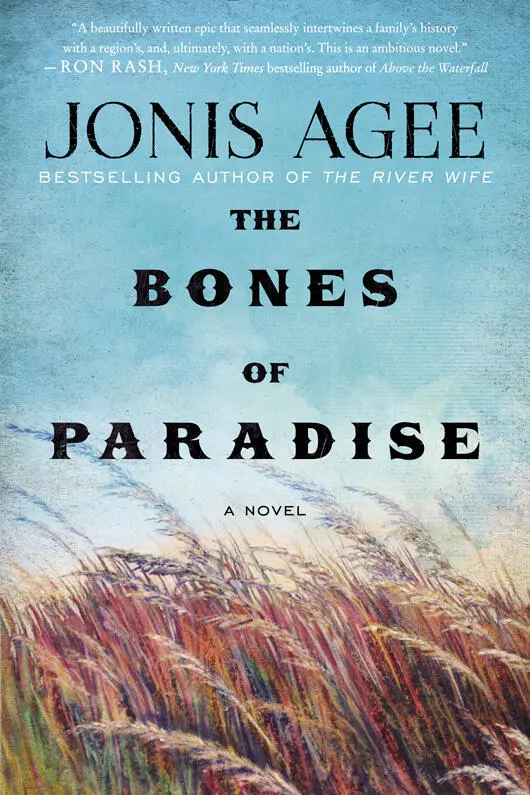
- Название:The Bones of Paradise
- Автор:
- Издательство:William Morrow
- Жанр:
- Год:2016
- ISBN:нет данных
- Рейтинг книги:3 / 5. Голосов: 1
-
Избранное:Добавить в избранное
- Отзывы:
-
Ваша оценка:
The Bones of Paradise: краткое содержание, описание и аннотация
Предлагаем к чтению аннотацию, описание, краткое содержание или предисловие (зависит от того, что написал сам автор книги «The Bones of Paradise»). Если вы не нашли необходимую информацию о книге — напишите в комментариях, мы постараемся отыскать её.
returns with a multi-generational family saga, set in the unforgiving Nebraska Sandhills in the years following the massacre at Wounded Knee—an ambitious tale of history, vengeance, race, guilt, betrayal, family, and belonging, filled with a vivid cast of characters shaped by violence, love, and a desperate loyalty to the land. Ten years after the 7th Calvary massacred more than 200 Lakota men, women, and children at Wounded Knee, J. B. Bennett, a white rancher, and Star, a young Native American woman, are murdered in a remote meadow on J. B.’s land. The deaths bring together the scattered members of the Bennett family: his cunning and hard father, Drum; his estranged wife, Dulcinea; and his young sons, Cullen and Hayward. As the mystery of these twin deaths unfolds, the history of the dysfunctional Bennett’s and their damning secrets are revealed exposing the conflicted heart of a nation caught between past and future.
At the center of
are two remarkable women. Dulcinea, returned after bitter years of self-exile, yearns for redemption and the courage to mend her broken family and reclaim the land that is rightfully hers. Rose, scarred by the terrible slaughters that have decimated and dislocated her people, struggles to accept the death of her sister, Star, and refuses to rest until she is avenged.
A kaleidoscopic portrait of misfits, schemers, chancers, and dreamers, Jonis Agee’s bold new novel is a panorama of America at the dawn of a new century. A beautiful evocation of this magnificent, blood-soaked land—its sweeping prairies, seas of golden grass and sandy hills, all at the mercy of two unpredictable and terrifying forces, weather and lawlessness—and the durable men and women who dared to tame it. Intimate and epic,
is a remarkable achievement: a mystery, a tragedy, a romance, and an unflagging exploration of the beauty and brutality, tenderness and cruelty that defined the settling of the American west.
The Bones of Paradise — читать онлайн бесплатно полную книгу (весь текст) целиком
Ниже представлен текст книги, разбитый по страницам. Система сохранения места последней прочитанной страницы, позволяет с удобством читать онлайн бесплатно книгу «The Bones of Paradise», без необходимости каждый раз заново искать на чём Вы остановились. Поставьте закладку, и сможете в любой момент перейти на страницу, на которой закончили чтение.
Интервал:
Закладка:
As if he were the ringleader, the fighting mob followed, men staggering in and out of contact, trading blows and sometimes just hugging each other, refusing to give up the battle as they collapsed from the beating and were later found in each other’s arms like drowned lovers. Hayward was dimly aware of the commotion at his back as he entered the stable and walked down the long line of cheap straight stalls toward the back, where four box stalls held his mother’s stallion and the chestnut, the lawyer’s mare and the stable owner’s personal animal, an ancient gelding he’d had since a young man.
At first Hayward thought he was still groggy from the fight, wiped his face with his hand, shook his head to clear it, and then accepted it as true—his mother and Graver were in each other’s arms, kissing.
“What the hell,” he murmured, took a step toward them and stopped. Graver stepped back first and glanced at the lawyer’s mare dozing in the corner of the stall. His mother pressed her fingers against her lips. Hayward almost rushed to her then, thinking Graver’s kiss unwanted, but stopped when he saw her tiny smile. She spoke in a low voice he couldn’t quite hear and Graver lifted his gaze to her. She spoke again and the man shook his head, paused, half turned to leave, then turned back and swept her into his arms. It was like a scene from one of the dime novels the hands traded in the bunkhouse.
He couldn’t interrupt them now, Hayward realized. A funny ache gripped his gut and spread its fingers up his spine until his shoulders and neck stiffened and hurt from holding his head upright. His father hadn’t made her stay, and the blame had grown into hate until he was almost relieved when his father died and his mother returned. He wasn’t sure how he felt now, things had changed. He heard the brawl move slowly down Main Street, away from the sound of broken glass, and the shouts of fighters and onlookers. That would be the store, where Haven Smith ruled their lives like petty cash, and would now discover the mob looting each freed bag of flour or pair of socks with the kind of malicious glee reserved for tyrants and bankers. One by one, Hayward heard the windows shatter along the street, followed by triumphant cries from the rioters. His brother would have joined them, no doubt, but he didn’t feel the same enthusiasm for destruction. Truth be told, as he watched his mother and Graver embrace, he felt only one thing, the familiar sense of longing for comforting arms he’d had his entire life.
A gunshot rang out, followed by the explosion of a shotgun, more breaking glass, screaming and yelling and people running. A saddled horse galloped by the open door of the stable, eyes flashing, broken reins flapping in the air while the stirrups banged its sides, urging it to go faster, faster, faster. The joyfulness of the crowd changed into panic, and then to outrage as they spun and hurried back toward the source of the shots. Hayward half turned to watch through the open doors as the last building at the far end of the street burst into flames. The fire quickly dissolved into thick gray-white smoke more like heavy fog than burning as it billowed along the street, briefly blanketing the crowd, then passed beyond, leaving the figures shrouded in what seemed a mist as they coughed and straggled away. He knew the horses would panic if the cloud of smoke entered the stables, but if he moved, his mother and Graver would know that he watched. The horses in the straight stalls shifted and sniffed the air. Ironclad hooves banged against the wood sides and a horse sent a high questioning call into the darkness, to be answered by several low, reassuring nickers.
The stallion sensed Hayward’s presence, and recognized his scent. He had been watching the melee, too. He recognized the smoke as from a smothered fire, and stood calmly as wisps entered the stable and disappeared into the blanketing darkness.
It was calmer now, business owners were tidying up, and the sound of tinkling glass could be heard in concert with the swishing of broom bristles against sidewalk boards. Here and there, men staggered together down the street toward one of the bars, arms across shoulders or hands locked like children struggling to reach home in a storm.
The dentist-sheriff, mysteriously absent during the riot, appeared with his hat slightly askew and his shirttail, untucked, hung over a large gun belt slung much lower than usual, as if he’d dressed in a hurry. His gait as he patrolled the sidewalk had a slight hitch and weave to the side that he struggled to straighten. It would be two hours before he was discovered in his office, near death with a knife wound in his back, the victim of an angry husband or dental patient, it was never determined which.
It would not have surprised Hayward that Dulcinea’s skirt brushed his leg as she walked past on Graver’s arm, oblivious of her sleeping son or the fray that had swept through town, or of the figure who watched them from the dark alley as they crossed the street and made their way to the hotel.
CHAPTER FORTY-THREE
They hurried up the stairs, without noticing the sleeping desk clerk, down the second-floor hall to the large room at the end that was always saved for a Bennett, a courtesy passed from one year to the next, one generation to another. If Dulcinea felt any hesitation as she turned the filigreed brass knob, if she noted the floral design under her palm, it was impossible to tell, there was such confidence, such certainty in her movements. Standing to one side, Graver removed her dead husband’s hat and scuffed the toe of her dead husband’s boot across the cabbage rose carpet, as if smudging away a recent stain or clot of mud.
Inside the room, he shut the door as she assessed the chaos of clothing she’d abandoned in her haste. The mauve satin bedcover she ordered all those years ago was faded and bore dark holes from cigarette ash and stains from careless eating and drinking in bed. She remembered only the exhilaration of the first night she’d slept here with her husband, newlyweds even after three months. Then she felt Graver’s hands on her hips as he lifted and placed her on his lap. She buried her face in the matted hair of his chest, her fingers finding the new ridge of scar over the bullet hole in his shoulder. She thought she smelled the green sunlight of the hills as she held her breath, then felt the brush of his lips at her ear. “J.B.,” she whispered.
She didn’t realize she’d closed her eyes until she felt the empty cooling space and heard the door click shut behind him. When she reopened her eyes, she saw the shabbiness of the room, the glow of J.B. had dissolved, and Graver was gone. Maybe it wasn’t possible to recover the past, she thought, or to find a true present. She could only live in this shadow version of both, without love and purpose.
With her cheek against the cover, Dulcinea imagined her breath was like a breeze caressing silk drapes at an open window, creating a strange music like someone running their fingers across satin. When she held it, she swore she could still hear it, and began to breathe in tandem with the sound, unsure whether she created it or it created itself. Whether she imagined J.B. or Graver with her that night, she could not say, for it seemed they were one. She felt the terrific weight of her husband alive outside this small vial of present time, and she also felt Graver breaking into her world, shattering every window and flinging the door off its hinges each time he was near, until the more drawn she was to him, the more alive J.B. became.
Everything was silent and black when she rose sometime during the night and knelt at the window. She looked down at the two figures in the shadows, struggling, cursing, and saw the taller one stab the shorter, thicker man. He wrenched the knife upward and lost his grip when the victim staggered and fell. The attacker looked down the alley each way, drew his pistol, nudged the body on the ground, seemed to decide against the noise it would make, and put it away. He searched the victim’s pockets, withdrew a packet of papers and money before sliding into darkness. When she awoke in the morning, she was convinced it was a nightmare.
Читать дальшеИнтервал:
Закладка:
Похожие книги на «The Bones of Paradise»
Представляем Вашему вниманию похожие книги на «The Bones of Paradise» списком для выбора. Мы отобрали схожую по названию и смыслу литературу в надежде предоставить читателям больше вариантов отыскать новые, интересные, ещё непрочитанные произведения.












Обсуждение, отзывы о книге «The Bones of Paradise» и просто собственные мнения читателей. Оставьте ваши комментарии, напишите, что Вы думаете о произведении, его смысле или главных героях. Укажите что конкретно понравилось, а что нет, и почему Вы так считаете.