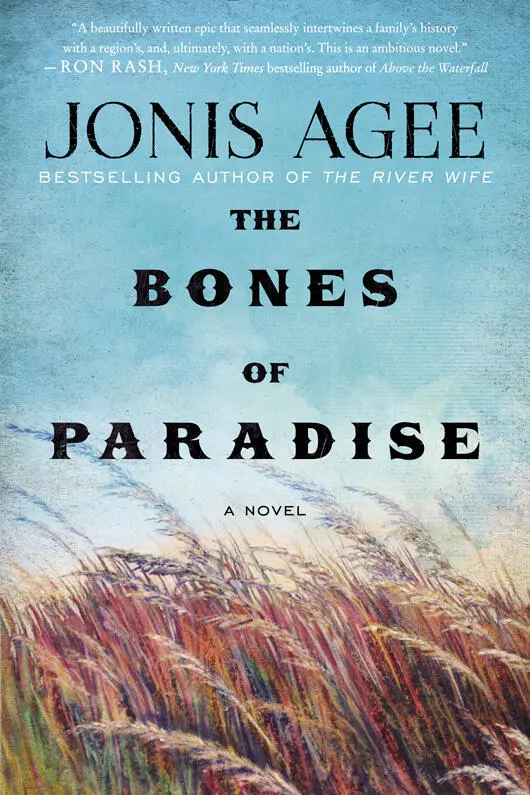
Jonis Agee - The Bones of Paradise
Здесь есть возможность читать онлайн «Jonis Agee - The Bones of Paradise» весь текст электронной книги совершенно бесплатно (целиком полную версию без сокращений). В некоторых случаях можно слушать аудио, скачать через торрент в формате fb2 и присутствует краткое содержание. Год выпуска: 2016, Издательство: William Morrow, Жанр: Современная проза, на английском языке. Описание произведения, (предисловие) а так же отзывы посетителей доступны на портале библиотеки ЛибКат.
- Название:The Bones of Paradise
- Автор:
- Издательство:William Morrow
- Жанр:
- Год:2016
- ISBN:нет данных
- Рейтинг книги:3 / 5. Голосов: 1
-
Избранное:Добавить в избранное
- Отзывы:
-
Ваша оценка:
The Bones of Paradise: краткое содержание, описание и аннотация
Предлагаем к чтению аннотацию, описание, краткое содержание или предисловие (зависит от того, что написал сам автор книги «The Bones of Paradise»). Если вы не нашли необходимую информацию о книге — напишите в комментариях, мы постараемся отыскать её.
returns with a multi-generational family saga, set in the unforgiving Nebraska Sandhills in the years following the massacre at Wounded Knee—an ambitious tale of history, vengeance, race, guilt, betrayal, family, and belonging, filled with a vivid cast of characters shaped by violence, love, and a desperate loyalty to the land. Ten years after the 7th Calvary massacred more than 200 Lakota men, women, and children at Wounded Knee, J. B. Bennett, a white rancher, and Star, a young Native American woman, are murdered in a remote meadow on J. B.’s land. The deaths bring together the scattered members of the Bennett family: his cunning and hard father, Drum; his estranged wife, Dulcinea; and his young sons, Cullen and Hayward. As the mystery of these twin deaths unfolds, the history of the dysfunctional Bennett’s and their damning secrets are revealed exposing the conflicted heart of a nation caught between past and future.
At the center of
are two remarkable women. Dulcinea, returned after bitter years of self-exile, yearns for redemption and the courage to mend her broken family and reclaim the land that is rightfully hers. Rose, scarred by the terrible slaughters that have decimated and dislocated her people, struggles to accept the death of her sister, Star, and refuses to rest until she is avenged.
A kaleidoscopic portrait of misfits, schemers, chancers, and dreamers, Jonis Agee’s bold new novel is a panorama of America at the dawn of a new century. A beautiful evocation of this magnificent, blood-soaked land—its sweeping prairies, seas of golden grass and sandy hills, all at the mercy of two unpredictable and terrifying forces, weather and lawlessness—and the durable men and women who dared to tame it. Intimate and epic,
is a remarkable achievement: a mystery, a tragedy, a romance, and an unflagging exploration of the beauty and brutality, tenderness and cruelty that defined the settling of the American west.
The Bones of Paradise — читать онлайн бесплатно полную книгу (весь текст) целиком
Ниже представлен текст книги, разбитый по страницам. Система сохранения места последней прочитанной страницы, позволяет с удобством читать онлайн бесплатно книгу «The Bones of Paradise», без необходимости каждый раз заново искать на чём Вы остановились. Поставьте закладку, и сможете в любой момент перейти на страницу, на которой закончили чтение.
Интервал:
Закладка:
Graver nodded. “He’d want you to ride him. Give the men something to feel good about.”
Hayward looked at the horse, then his boots, then the stallion. For a long minute Graver thought the boy wouldn’t bite, then he nodded. Larabee handed him the reins.
“Go light on his mouth, hold him to the pack till you round the last turn, then set him loose and hang on. And don’t whip him. He’ll get you there.” Graver patted the horse’s neck and watched the boy mount, settling lightly in his mother’s flat saddle. He’d do.
Hayward gave them a curt nod, bit his lip, and shrugged to loosen his shoulders as the chestnut danced and tossed its head.
“Your pa’d be proud of you,” Larabee called and spit again. Then he turned his head to the side and muttered, “Hope he stays on.”
They found the other hands waiting for the race, exchanging bets. Graver looked over the gathering crowd for Dulcinea and was relieved to find her occupied with Tookie and Evan Edson from the Crooked Post 8. She was drinking lemonade and smiling at something the other woman said as her son rode by on his father’s horse, and missed his anxious search for her.
There were more than twenty riders and horses, including Percival Chance’s long-legged Thoroughbred mare, Rose on their Indian pony, as well as other locals and several cowboys who traveled on the rodeo circuit. At the end of the ragged line, Graver spotted Irish Jim bareback on a rough-looking bay horse he’d never seen before. The horses pranced and shook their heads and pawed in response to the noise and rising tension of the onlookers until finally the announcer read the rules and fired a pistol in the air.
Two horses bolted, and a couple spun and tried to run the other direction. By then the dust rose in clouds and someone with a spyglass shouted, “They’re off and running, a bay and chestnut in the lead.” Chance’s Thoroughbred was behind the leaders, and two others paced behind them with the main bunch back a ways.
Graver saw the boy had listened and held the chestnut in check. Let the others run the legs off their horses. The distance was too far for a front-runner to win. As the swirling dust settled, he removed his hat and waved the air in front of his face, then wiped his mouth with his hand and spit. The horses were spread out now, a long dark string pulled by the small bunch in front, like a child’s toy. Squinting against the dust, Graver could make out the figure of Irish Jim hunched low on the rough bay’s neck, and what looked like Hayward at his side while a big gray paced Chance’s Thoroughbred in front. Behind, a horse in the middle of the pack stumbled and nearly fell, scattering those that followed and driving several up against Irish Jim’s bay, who held on, switching leads as it absorbed the bump and leapt forward.
Then suddenly they were there, the wall of horseflesh pounding, shaking the ground, foam and dirt flung against the spectators, great lungs heaving for air, a rhythmic roar rising over the crowd’s shouts, absorbing and annihilating, and it wasn’t until the front-runners were well beyond that it was possible to sort their order again. Half the horses slowed after the first mile, chests labored, legs wooden, clumsy, heads flung, eyes wide, nostrils flared red, teeth bared against the bit, riders foam flecked, faces masked with dirt, already rising upright as their beasts faltered beneath them, broke into a trot, and pulled up in front of the spectators. Jumping down, the riders quickly dragged their horses off the raceway as the leaders neared the far turn.
Graver noticed Rose’s spotted pony maintained a steady pace the whole time and now passed those in front, picking them off one by one as more slowed. A white horse staggered to a walk, then halted while the rider kicked uselessly. Graver started out there at a fast walk, but a man on horseback passed him, saying, “I got it.” He hurried back before he was caught as the horses headed into the last quarter mile.
The gray, Hayward, Irish Jim, and Rose were neck and neck, thundering down on the people that pressed back at the vision: Would they make the final turn or simply run headlong into the crowd?
That was when Hayward made a young man’s mistake. In his eagerness to win he flailed the horse with the end of his reins. The animal, already full out, slowed, which drove Hayward to slash him again and the horse stopped, tossed his head and humped his back. If he weren’t exhausted, he would’ve bucked at the injustice. Instead he whipped his head around and bit the boy’s leg, hard enough that he yelped in surprise and stopped flailing, sat back, and rubbed the spot. The chestnut, satisfied, picked up a trot, then a lope, and joined the stragglers.
The gray slowed and dropped into a choppy lope, head burrowing toward the ground, and the race came down to Irish Jim and Rose. The bay Jim rode was still game, but it foamed pink from its mouth and blood streamed from its nose. The lean spotted horse that had maintained the same rhythmic pace, unaltered for nearly two miles, surged ahead and swept over the finish line to a stunned silence. The Indians grouped to the side glanced nervously at the white crowd, nodded to each other and smiled, then quickly dispersed. The paint pony passed Graver with enough energy left to cast a malevolent eye and snap its teeth at the silent mass. Graver and Larabee laughed and the noise that followed was like a giant’s breath, expelled in guffaws and hoots and applause. For a time it looked as if the temperature of the day had suddenly cooled.
Dulcinea pushed through the crowd as Hayward led the horse to where they stood. Grinning, the boy shook his head and rubbed the chestnut’s neck. Graver stepped forward and patted him on the back. Lesson learned. Hayward looked at him, eyes shining with pride and newfound humility. This boy would do. Graver touched the brim of his hat.
“Son . . .” Dulcinea stepped closer, and Hayward stepped back.
“Have to see to the horse,” he mumbled and walked on.
Dulcinea spun on Graver. “You simply must obey my orders!” She was all drawn up, like a dog on point, almost quivering in anticipation of the explosion.
“No, ma’am, I cannot obey orders that go against good sense.”
She stared at him for a good long minute, then something shifted in her eyes. “You were right. He rode a wonderful race, didn’t he?” She reached out for his arm. “I have to go congratulate my son.”
Graver watched her ease through the crowd, and smiled despite himself.
“Guess we been skunked,” Larabee drawled. “Never guessed that spotted pony had bottom. A woman riding it, too. Put us all to shame.” A tall, white-haired stranger on the other side of Larabee spat and looked them over before he turned his bland face away and shouldered through the crowd. Graver searched for Hayward among the horses with heaving sides walking in circles, their backers disputing what went wrong in loud voices.
Irish Jim, next to the water trough, poured buckets over his little bay, which stood spraddle-legged and shaking. Jim stopped, took off his shirt, soaked it in a bucket, and then covered the animal’s head with it. The horse groaned and Jim removed it, squeezed water between its ears so it ran down its face, and gently sponged the nostrils, crooning and murmuring to it the whole while, “There’s a stout lad.” He dipped the shirtsleeve in the bucket and dribbled water in the horse’s mouth.
“Need help?” Graver asked. When Irish Jim looked up, there were tears in his eyes.
The horse sighed and slowly collapsed, sat down like a dog for a moment before folding his front legs and rolling to its side, eyes closed.
“No!” Jim knelt, panicked. The horse answered with a deep rattling snore and smack of its lips.
Читать дальшеИнтервал:
Закладка:
Похожие книги на «The Bones of Paradise»
Представляем Вашему вниманию похожие книги на «The Bones of Paradise» списком для выбора. Мы отобрали схожую по названию и смыслу литературу в надежде предоставить читателям больше вариантов отыскать новые, интересные, ещё непрочитанные произведения.







Обсуждение, отзывы о книге «The Bones of Paradise» и просто собственные мнения читателей. Оставьте ваши комментарии, напишите, что Вы думаете о произведении, его смысле или главных героях. Укажите что конкретно понравилось, а что нет, и почему Вы так считаете.