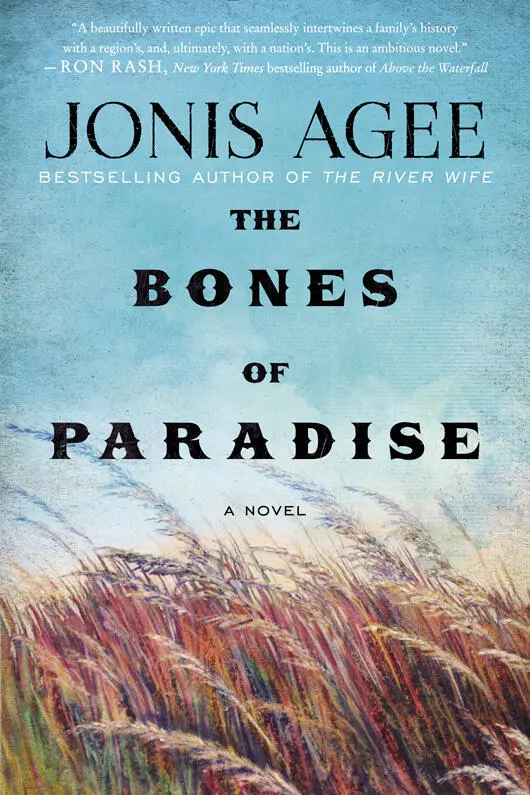
Jonis Agee - The Bones of Paradise
Здесь есть возможность читать онлайн «Jonis Agee - The Bones of Paradise» весь текст электронной книги совершенно бесплатно (целиком полную версию без сокращений). В некоторых случаях можно слушать аудио, скачать через торрент в формате fb2 и присутствует краткое содержание. Год выпуска: 2016, Издательство: William Morrow, Жанр: Современная проза, на английском языке. Описание произведения, (предисловие) а так же отзывы посетителей доступны на портале библиотеки ЛибКат.
- Название:The Bones of Paradise
- Автор:
- Издательство:William Morrow
- Жанр:
- Год:2016
- ISBN:нет данных
- Рейтинг книги:3 / 5. Голосов: 1
-
Избранное:Добавить в избранное
- Отзывы:
-
Ваша оценка:
The Bones of Paradise: краткое содержание, описание и аннотация
Предлагаем к чтению аннотацию, описание, краткое содержание или предисловие (зависит от того, что написал сам автор книги «The Bones of Paradise»). Если вы не нашли необходимую информацию о книге — напишите в комментариях, мы постараемся отыскать её.
returns with a multi-generational family saga, set in the unforgiving Nebraska Sandhills in the years following the massacre at Wounded Knee—an ambitious tale of history, vengeance, race, guilt, betrayal, family, and belonging, filled with a vivid cast of characters shaped by violence, love, and a desperate loyalty to the land. Ten years after the 7th Calvary massacred more than 200 Lakota men, women, and children at Wounded Knee, J. B. Bennett, a white rancher, and Star, a young Native American woman, are murdered in a remote meadow on J. B.’s land. The deaths bring together the scattered members of the Bennett family: his cunning and hard father, Drum; his estranged wife, Dulcinea; and his young sons, Cullen and Hayward. As the mystery of these twin deaths unfolds, the history of the dysfunctional Bennett’s and their damning secrets are revealed exposing the conflicted heart of a nation caught between past and future.
At the center of
are two remarkable women. Dulcinea, returned after bitter years of self-exile, yearns for redemption and the courage to mend her broken family and reclaim the land that is rightfully hers. Rose, scarred by the terrible slaughters that have decimated and dislocated her people, struggles to accept the death of her sister, Star, and refuses to rest until she is avenged.
A kaleidoscopic portrait of misfits, schemers, chancers, and dreamers, Jonis Agee’s bold new novel is a panorama of America at the dawn of a new century. A beautiful evocation of this magnificent, blood-soaked land—its sweeping prairies, seas of golden grass and sandy hills, all at the mercy of two unpredictable and terrifying forces, weather and lawlessness—and the durable men and women who dared to tame it. Intimate and epic,
is a remarkable achievement: a mystery, a tragedy, a romance, and an unflagging exploration of the beauty and brutality, tenderness and cruelty that defined the settling of the American west.
The Bones of Paradise — читать онлайн бесплатно полную книгу (весь текст) целиком
Ниже представлен текст книги, разбитый по страницам. Система сохранения места последней прочитанной страницы, позволяет с удобством читать онлайн бесплатно книгу «The Bones of Paradise», без необходимости каждый раз заново искать на чём Вы остановились. Поставьте закладку, и сможете в любой момент перейти на страницу, на которой закончили чтение.
Интервал:
Закладка:
They were down to the last five calves and despite the odd haziness of the sky, Dulcinea thought the weather would hold long enough for her to ride to the line shack that had been Cullen’s while the others finished the work. The boundary between the two ranches was nearby, and she could follow the barbed wire fence to the cabin. Over the past few weeks she’d started to piece together the fragments of his life after he was taken by Drum. Everything she found made her feel closer to her son. When she reached the windmill, she stopped to allow the stallion a drink. Soon she would have her men tear down the fence dividing the land. A breeze from the north pushed the windmill blades around with an uneven squeal that ground in her ears like she was chewing sand. She and J.B. had always laughed about this one. The memory brought tears to her eyes, and she vowed never to replace it no matter how much it irritated.
She thought back to the moment she finally understood what the ranch meant to J.B. and what it had cost them all.
It was early spring after Drum took Cullen, and before she left. She couldn’t eat or sleep, paced days and nights, searching for the reason J.B. allowed this to happen, and why he wouldn’t do a thing to bring back her son. She took to getting up in the night once she heard his light snoring, and thought nothing could allow her to sleep as naturally as he did. One night she hoped a glass of brandy would help close her eyes, and went to his office. She never sat in his chair, it hadn’t seemed right, but she did that night. She sat too low to command the desk the way he did, and poured a glass of their wedding brandy. The thick, sweet bite threatened to turn her stomach. She clenched her teeth, drank until her throat grew numb, her head light, and her body unsteady. She decided that night that she would leave in two weeks as Drum had ordered.
She had married Drum to secure the ranches for Hayward, but she also did it to save herself, to save something for herself—these hills, this dream, when for a short, lovely time she believed that her life, their life, meant this place and what they did here, what they learned by living and loving each other. It was because she still felt him here, J.B., he touched her, and nothing could change this place, this land, lest he and Cullen were left alone in their separate graves.
It was how she understood the Indians like Rose and Some Horses who mourned the land, not as wealth but as the place where all was alive, all living, in one form or another. The whites took it but the dead still walked it, the spirits, whatever they were. Her faith had removed God, dispersed him like seed or gravel. It was not that God didn’t exist. It was that he wasn’t alone, but in pieces, parts, always whole, sufficient, always multiple. So like the ancient Greeks she trod lightly, carefully, tried to give no offense to the land, the sacred grass her feet crushed, the ants hurriedly preparing caverns for the winter, pushing tiny yellow boulders out of a hole the size of a bee’s leg. Oh the offense, to walk so clumsily through the world, to crush and bring havoc, that they couldn’t help. But to give no recognition to the cost of their being alive, to the price paid for their dreams by everything else? J.B., Cullen, now Drum.
She turned the stallion back toward the dim path that led to the line shack and thought of Hayward. He was seeing Pearl Stryker now. She was too old and experienced for him. He was also seeing the new schoolteacher from Ohio. And a girl from Rosebud Reservation. And several others. In a dream J.B. told her he would love many women, unable to resist them, but he’d marry and live a long life, have a son and send him to military school in Missouri, position him to inherit the Bennett fortunes, and though she would not live to see it, a long line of children followed. There was a red smear on the white tile wall of the future. People couldn’t help the pain that rode them like overbroke ponies and tired them too soon for the length of a life.
Lost in her thoughts, she didn’t notice the weather change until the cold breeze made her shiver and she realized the hazy sunlight had thinned and the air turned gray-blue. She put her heels to the stallion to hurry him. Overhead heavy gray-white clouds eased back and forth, casting dark shapes across the valley. To the north a wall of gray-white, a mile away and several miles wide, rolled toward them, sent by the sudden gusty wind that lifted the stallion’s mane and scattered it, breaking the sky to pieces. He stopped and danced sideways, swinging his haunches into the wind, and called long and loud into the empty hills, ears pricked, waiting for a reply that didn’t come. She looked at the empty horizon and saw she was the only vertical thing for miles. The wind, filled with bits of sand, stung the skin and threatened to fill their eyes. They’d never make it home; she’d have to try for the line shack though it meant riding straight into the storm. She turned the stallion and slapped him with the reins.
The sun disappeared and the wind became a roaring whirlwind and she couldn’t tell direction anymore. After a while, she understood that it was snow and ice that pelted her bare skin, not sand. Her chest hurt as she held her breath against the cold that encased her in her soaked clothes, and trembling waves rose up her legs into her arms and teeth that she clenched to keep from chattering. Don’t stop, she urged the stallion, keep moving. They were in one of those early blizzards that came sweeping across the hills without notice, stranding cattle and killing people. She looked into the white walls of whirling snow and called for help, but the wind whipped her words away with a loud roar. Her eyes were heavy with ice, and she decided it was better to close them than have them freeze open. She pulled her hair from the bun and tried to wrap it around her neck, but the wind caught it, filled it with snow and ice and flung it back like a club beating against her shoulders and head. She buried her hands in the stallion’s snow-filled mane, fought to keep her fingers tight on the reins. She should knot them around her hands, she thought, she should knot the reins so they didn’t slide over his head, she should knot them, and put the end in her mouth, or under her thigh, she should stop, remove the saddle, wrap herself in the blanket and ride bareback so his body would keep her warm, but how to remount, he was too tall, so she lay on his neck for protection. The stallion lifted his head to push her back, and she was forced to open her eyes. When he whinnied, the sound started deep in his belly and shook his body, again no answer. Dulcinea became aware of parts she rarely thought about, the tops of her thighs that burned and then grew numb, her knees that felt as if she knelt on a frozen lake, her elbows so sharp with cold they rubbed raw where the frozen cloth of her shirt touched.
In her delirium, she saw a picture of J.B. and herself and their old dog Jesse James, named after a distant relative in Missouri, caught in a blur of motion in front of their half-finished house. They were so young and handsome and the snow turned the world white around them. She saw J.B. reflected in the window of their completed house, fingerprints from his hand on the glass as he called to her. She startled awake. “I’m here! Help!” The wind snatched her words.
She saw him gather his old buffalo hide coat, hat and scarf, and horsehide mittens lined in rabbit fur, and pull out the bag he kept at the ready for winter mishaps when stranded cattle and folks on the road needed rescuing. She was trapped between alternating wind shears and storms, and felt snow crisscrossing in front of her face. “Keep moving,” she heard J.B. say. “Don’t stop.”
Then she was sure he was there beside her, reaching for the ice-encased rein, pulling the stumbling horse along, rubbing the horse’s shoulder and speaking low words of praise, telling the stallion he was brave and strong, calling him his night horse, blowing his own breath into his nostrils dripping with ice, stroking his nose and heating the ice until his face dripped and his large eyes gained brightness and he fought fiercely onward, lifting his legs high above the gathering drifts, marching to the music of his words. She felt him rest his hand on her small boot. The leather warmed and a sigh escaped her lips. He moved his hand up her ankle, calf, knee, and thigh, and his extraordinary heat relieved the numbness of her muscles, the bitter cold that had begun to settle in her bones. His heat pushed beneath her skin, deep into her flesh. She imagined he could feel her blood as he swam up onto the horse’s back, settled behind her, wrapped his coat and arms around her, and held her in the saddle. All he wanted was her forgiveness, she realized. The horse stumbled to a stop, nose pressed against the door of the old line shack. When the door unlatched, the animal stepped inside to the warmth of a small fire and a candle flickered in the sudden gust of blown snow.
Читать дальшеИнтервал:
Закладка:
Похожие книги на «The Bones of Paradise»
Представляем Вашему вниманию похожие книги на «The Bones of Paradise» списком для выбора. Мы отобрали схожую по названию и смыслу литературу в надежде предоставить читателям больше вариантов отыскать новые, интересные, ещё непрочитанные произведения.




Обсуждение, отзывы о книге «The Bones of Paradise» и просто собственные мнения читателей. Оставьте ваши комментарии, напишите, что Вы думаете о произведении, его смысле или главных героях. Укажите что конкретно понравилось, а что нет, и почему Вы так считаете.