Jonis Agee - The Bones of Paradise
Здесь есть возможность читать онлайн «Jonis Agee - The Bones of Paradise» весь текст электронной книги совершенно бесплатно (целиком полную версию без сокращений). В некоторых случаях можно слушать аудио, скачать через торрент в формате fb2 и присутствует краткое содержание. Год выпуска: 2016, Издательство: William Morrow, Жанр: Современная проза, на английском языке. Описание произведения, (предисловие) а так же отзывы посетителей доступны на портале библиотеки ЛибКат.
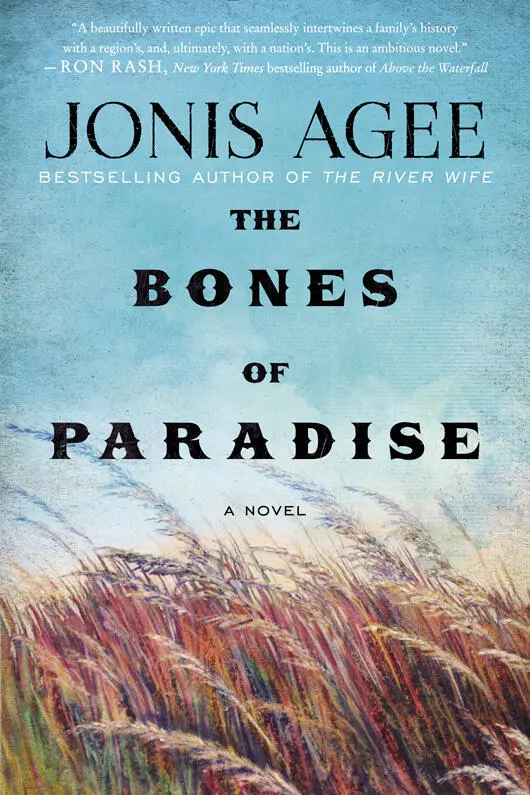
- Название:The Bones of Paradise
- Автор:
- Издательство:William Morrow
- Жанр:
- Год:2016
- ISBN:нет данных
- Рейтинг книги:3 / 5. Голосов: 1
-
Избранное:Добавить в избранное
- Отзывы:
-
Ваша оценка:
The Bones of Paradise: краткое содержание, описание и аннотация
Предлагаем к чтению аннотацию, описание, краткое содержание или предисловие (зависит от того, что написал сам автор книги «The Bones of Paradise»). Если вы не нашли необходимую информацию о книге — напишите в комментариях, мы постараемся отыскать её.
returns with a multi-generational family saga, set in the unforgiving Nebraska Sandhills in the years following the massacre at Wounded Knee—an ambitious tale of history, vengeance, race, guilt, betrayal, family, and belonging, filled with a vivid cast of characters shaped by violence, love, and a desperate loyalty to the land. Ten years after the 7th Calvary massacred more than 200 Lakota men, women, and children at Wounded Knee, J. B. Bennett, a white rancher, and Star, a young Native American woman, are murdered in a remote meadow on J. B.’s land. The deaths bring together the scattered members of the Bennett family: his cunning and hard father, Drum; his estranged wife, Dulcinea; and his young sons, Cullen and Hayward. As the mystery of these twin deaths unfolds, the history of the dysfunctional Bennett’s and their damning secrets are revealed exposing the conflicted heart of a nation caught between past and future.
At the center of
are two remarkable women. Dulcinea, returned after bitter years of self-exile, yearns for redemption and the courage to mend her broken family and reclaim the land that is rightfully hers. Rose, scarred by the terrible slaughters that have decimated and dislocated her people, struggles to accept the death of her sister, Star, and refuses to rest until she is avenged.
A kaleidoscopic portrait of misfits, schemers, chancers, and dreamers, Jonis Agee’s bold new novel is a panorama of America at the dawn of a new century. A beautiful evocation of this magnificent, blood-soaked land—its sweeping prairies, seas of golden grass and sandy hills, all at the mercy of two unpredictable and terrifying forces, weather and lawlessness—and the durable men and women who dared to tame it. Intimate and epic,
is a remarkable achievement: a mystery, a tragedy, a romance, and an unflagging exploration of the beauty and brutality, tenderness and cruelty that defined the settling of the American west.
The Bones of Paradise — читать онлайн бесплатно полную книгу (весь текст) целиком
Ниже представлен текст книги, разбитый по страницам. Система сохранения места последней прочитанной страницы, позволяет с удобством читать онлайн бесплатно книгу «The Bones of Paradise», без необходимости каждый раз заново искать на чём Вы остановились. Поставьте закладку, и сможете в любой момент перейти на страницу, на которой закончили чтение.
Интервал:
Закладка:
“It was you people and your Ghost Dance. I’m not going through that whole story again, so yes, I strangled her. Happy?”
He stood over her, hands on his hips. “I never understand why people want every last detail. She’s gone. Finie. Done.” He chopped at the air with his hands. “Now let me get on with my tale. Please.” He took a deep breath and brushed back his hair. When he began again, his tone was one of exaggerated patience.
“First, you find the locket with the photos of my parents. Yes, I saw Hayward looking at it. Your sister Star paraded it around. I had to put a stop to it. It doesn’t want to stay put, though. You have it now?”
Rose clutched the front of her shirt.
“Good. When we’ve completed our transaction, I’ll have it back. There aren’t any more of you, are there? I trust Lily will never know what happened to her mother, aunt, and grandmother. I’d hate to have dealings with another of your family. Three’s enough.”
His eyes twinkled as he reached into his pocket and brought out a little tanned leather drawstring pouch with what appeared to be a brown button at the bottom. Upon closer inspection, Graver realized with horror that it was a nipple, withered hard as bone. “Do I need a new change purse?” He dangled it in front of Rose, who kept her eyes down.
“Now where’s my necklace?” He reached in her calico blouse, but it wasn’t around her neck. “Where is it?”
“We have to trade,” she said, her eyes on the pouch now.
Chance pretended to toss it into the fire, and then revealed it was still in his hand. “Just playing with you. I know how much Indians love a trade. Okay, my family for yours.”
She stood and opened her hand to reveal the chain and locket.
He snatched it, and then tossed the pouch in the fire. Rose’s shoulders slumped as she watched the flames take the last of her mother’s flesh.
“You bastard,” Dulcinea growled.
He frowned. “Not very polite, Mrs. Bennett.”
He opened the locket, clicked it closed, and held the chain up to the light. “You Indians don’t like gold, do you? I’m beginning to see your point.” He rubbed his chin. “So much would’ve been different if I hadn’t dropped this twice. Almost as if Mama and Papa wanted me to be punished for what I did.” He slipped the locket in his vest.
Graver heard Chance’s voice drop, bemused. He glanced at Dulcinea.
Chance turned to face the others. “It’s always an interesting problem, what to do with hostages. You see, you’re held by them as much as you hold them. The question is who can let go first. Because that person wins.” He smiled and limped across the room and back, appraising each of them.
“You didn’t really think I could marry you, did you?” He stopped beside Dulcinea and lifted her chin with a finger. “I was indulging myself. I do that, especially when I spend too much time alone, as I have of late. If the earl were here, we’d concoct an entertainment with you, but I’m afraid I’m growing weary of this business. As soon as the storm abates, I need to be off. You understand that I can’t leave you alive.” He made another circuit of the room, took the time to peer out the window and place an ear to the wall. “Still blowing,” he announced.
Dulcinea said, “I’ll sign. If you let us live.” Chance grabbed the knife from the table, sliced through the rags holding her arms, and dragged the chair so she sat before the papers. He uncapped the bottle of ink and handed her the pen, keeping his eye on the other two. Dulcinea dipped the pen, scratched at the edge of the paper he’d used to practice their signatures, dipped and tried again, this time producing ink. He tapped his forefinger, indicating where she should sign, and she leaned over the paper. Despite the wind and crackling fire, the slow scratch of her signature whispered along the cabin walls.
As she finished, and he leaned down to inspect it, Rose sprang to her feet, pounced on his back, and pressed her skinning knife against his throat. They staggered and fell, breaking Dulcinea’s chair into pieces. Chance grabbed at Rose’s arms, and she steadied the tip of the blade with her left hand, hacking and sawing at his throat as if castrating a bull. Dulcinea flew at him and struck him in the chest to no effect, while his arms flailed and dropped and his struggle against the knife slowed. Then with one last burst, he yanked at Rose’s arms, pried one away and loosened the other. Dulcinea hit him in the face with the chair’s leg, which only enraged him more. Graver slid closer, drew back his legs, and kicked him in the knee, dropping him, his shirt an apron of blood from the deepening cut as Rose rode his back.
“You can’t kill me!” he rasped, a bright bubble at the corner of his mouth.
Rose leaned close and whispered in his ear, “Why not? You’re already dead.” Her right hand on the hilt, her left, gloved in red, wrapped around the blade’s point, she hauled hard on the knife. There was a pop and a bright hissing spray. “Hestovatohkeo’o,” she murmured as he fell forward into the blooming pool of his own blood.
CHAPTER FORTY-NINE
Dulcinea sat on the porch with a cup of coffee and her first attempt at doughnuts. The pastry was so heavy it thunked against the saucer after she took a bite.
J.B. was gone, she knew from the shifting gravity of the air, a missing weight, as it was when someone left a room, like a veil torn for an instant, and a sharpness appeared around the objects and people, then slowly dissolved again.
Despite the early blizzard, the winter had been mild with the right amount of snow and then spring rains brought the hills alive again with wildflowers and new grass. She woke early on these fine May mornings to watch her two mares graze with their foals in the pasture. One of the old cottonwoods behind the barn fell when the rains softened the ground in spring and settled across the creek, forming a natural bench at the far end that Hayward would lie on late afternoons when the work was done. The small purple knobs on the mulberry trees offered a fine harvest and a sparrow hopped down a branch a few feet, tested one, then another, and let them drop to the ground where more trees would sprout. In years to come a large grove of mulberry trees would provide pleasure to children and grandchildren, who would take handfuls of ripe berries and smear their faces and arms and run to show the adults. There would be Bennetts, as well as the families of the men who worked among them. J.B. always said they would prosper, and as she watched her son and Graver work horses that evening, she believed him.
Rose sat beside her on the porch while, in the corral, Graver showed Hayward how to halterbreak a filly without roughness. Her son let Graver rest an arm across his shoulders as they watched the long-legged bay filly gambol about wearing her new halter. When she had finally explained to her son about his grandfather’s bargains with both J.B. and her, he took a few days then decided to try to forgive.
Some Horses lifted Lily onto the spotted pony’s back and led her up and down the barnyard while Rose smiled at her daughter’s cajoling to be turned loose.
“She needs her own horse,” Dulcinea said.
“I’m sure she’ll have it, too, with all these men spoiling her,” she said with a laugh. Rose was her friend, the bravest woman she knew. They never spoke of it, what happened at the line shack. Rose’s family lived in the foreman’s house in the winter, and spent summer in the tipi behind the house.
Rose placed her fingertips on Dulcinea’s arm. “I have to go home,” she said. “It’s my sister. It’s time for her to go home, too.” Her eyes filled, and she bit her lip and looked out across the ranch yard to the hills beyond. “Jerome will come if Lily can stay with you. It won’t be long.”
Читать дальшеИнтервал:
Закладка:
Похожие книги на «The Bones of Paradise»
Представляем Вашему вниманию похожие книги на «The Bones of Paradise» списком для выбора. Мы отобрали схожую по названию и смыслу литературу в надежде предоставить читателям больше вариантов отыскать новые, интересные, ещё непрочитанные произведения.






Обсуждение, отзывы о книге «The Bones of Paradise» и просто собственные мнения читателей. Оставьте ваши комментарии, напишите, что Вы думаете о произведении, его смысле или главных героях. Укажите что конкретно понравилось, а что нет, и почему Вы так считаете.