Jonis Agee - The Bones of Paradise
Здесь есть возможность читать онлайн «Jonis Agee - The Bones of Paradise» весь текст электронной книги совершенно бесплатно (целиком полную версию без сокращений). В некоторых случаях можно слушать аудио, скачать через торрент в формате fb2 и присутствует краткое содержание. Год выпуска: 2016, Издательство: William Morrow, Жанр: Современная проза, на английском языке. Описание произведения, (предисловие) а так же отзывы посетителей доступны на портале библиотеки ЛибКат.
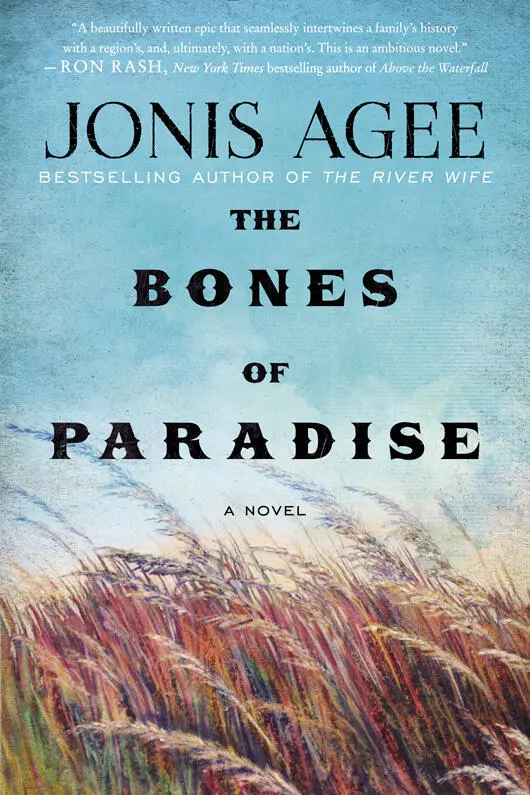
- Название:The Bones of Paradise
- Автор:
- Издательство:William Morrow
- Жанр:
- Год:2016
- ISBN:нет данных
- Рейтинг книги:3 / 5. Голосов: 1
-
Избранное:Добавить в избранное
- Отзывы:
-
Ваша оценка:
The Bones of Paradise: краткое содержание, описание и аннотация
Предлагаем к чтению аннотацию, описание, краткое содержание или предисловие (зависит от того, что написал сам автор книги «The Bones of Paradise»). Если вы не нашли необходимую информацию о книге — напишите в комментариях, мы постараемся отыскать её.
returns with a multi-generational family saga, set in the unforgiving Nebraska Sandhills in the years following the massacre at Wounded Knee—an ambitious tale of history, vengeance, race, guilt, betrayal, family, and belonging, filled with a vivid cast of characters shaped by violence, love, and a desperate loyalty to the land. Ten years after the 7th Calvary massacred more than 200 Lakota men, women, and children at Wounded Knee, J. B. Bennett, a white rancher, and Star, a young Native American woman, are murdered in a remote meadow on J. B.’s land. The deaths bring together the scattered members of the Bennett family: his cunning and hard father, Drum; his estranged wife, Dulcinea; and his young sons, Cullen and Hayward. As the mystery of these twin deaths unfolds, the history of the dysfunctional Bennett’s and their damning secrets are revealed exposing the conflicted heart of a nation caught between past and future.
At the center of
are two remarkable women. Dulcinea, returned after bitter years of self-exile, yearns for redemption and the courage to mend her broken family and reclaim the land that is rightfully hers. Rose, scarred by the terrible slaughters that have decimated and dislocated her people, struggles to accept the death of her sister, Star, and refuses to rest until she is avenged.
A kaleidoscopic portrait of misfits, schemers, chancers, and dreamers, Jonis Agee’s bold new novel is a panorama of America at the dawn of a new century. A beautiful evocation of this magnificent, blood-soaked land—its sweeping prairies, seas of golden grass and sandy hills, all at the mercy of two unpredictable and terrifying forces, weather and lawlessness—and the durable men and women who dared to tame it. Intimate and epic,
is a remarkable achievement: a mystery, a tragedy, a romance, and an unflagging exploration of the beauty and brutality, tenderness and cruelty that defined the settling of the American west.
The Bones of Paradise — читать онлайн бесплатно полную книгу (весь текст) целиком
Ниже представлен текст книги, разбитый по страницам. Система сохранения места последней прочитанной страницы, позволяет с удобством читать онлайн бесплатно книгу «The Bones of Paradise», без необходимости каждый раз заново искать на чём Вы остановились. Поставьте закладку, и сможете в любой момент перейти на страницу, на которой закончили чтение.
Интервал:
Закладка:
Dulcinea slid down, pushed the door closed, and stumbled to the fire to warm her hands as snow dropped off the horse and puddled on the hard-packed dirt floor. When she was warm, she stood, shook the last of the melting snow off her clothes, and glanced at the walls of the shack, surprisingly tight, the cracks filled with animal hair, grassy mud, and paper. A candle guttered on the table among several pieces of scattered paper and a dirty plate and cup, as if someone had just left the room. Who was living here? Her heart leapt. Cullen! She calmed herself. Of course not, but someone.
Curious, she lifted a page from the table and saw it was a deed for Drum’s ranch, with a shaky signature at the bottom that bore little resemblance to his firm block letters. She quickly scanned the other pages, which included the deed to J.B.’s and what appeared to be someone practicing Hayward’s and her signatures. Even though they were poor efforts, their intent was clear. She sank into one of the two straight-backed chairs. Who could this be? Whoever it was, it meant she and her son would have to disappear. A deeper chill came over her, and she began to shiver uncontrollably.
The stallion lifted his head and gave a deep guttural whinny as the door opened.
CHAPTER FORTY-SEVEN
Graver fought against the image of Dulcinea frozen beneath a ten-foot snowdrift that wouldn’t melt for another two weeks when one of those warm trade winds rode through the hills, melted everything in a day, and delivered the dead as casually as flowers in spring: cattle caught in fence corners, crowding each other, trapped by their own panic and blindness in the storm, people caught unawares when the winds shifted and the sun fled behind a wall of snow and ice. Sometimes a horse and rider were found together like lovers, belly to belly in a last frantic arrival at the end. Once, a whole family in their buckboard on the way home when it struck, somehow too blind and exhausted to move once the horses mired in a six-foot drift, and the family froze to death where they sat, as polite and still as worshippers on the splintered boards, reins still gripped in the father’s hands, his mouth open as if calling his last benediction upon the sleeping heads of his little ones.
At least he knew where she was headed, unless the stallion had lost its instinct for survival. He patted the chestnut, shouted encouragement, and kept his eye on the fence line as best he could in the whiteout. It couldn’t be much farther.
The chestnut nearly rammed the wall of the lean-to behind the shack. Graver had to turn him aside as he dismounted, then feel his way into the dark shelter. He unsaddled the horse, tossed some hay off the mound in back, and hooked the wire gate. With the saddle in his arms, he pushed a shoulder against the shack door and shoved it open. At least it wasn’t latched. He was surprised when the stallion greeted him like an old friend. Dulcinea stared at him in disbelief.
“It’s you ?”
Graver looked at her. “You expecting somebody else?” He dropped the saddle by the fire.
She eyed him, loathing on her face. “I trusted you. My son trusted you.”
Graver was confused. He’d followed her through a blizzard and this was how she greeted him? It didn’t make sense. “You want me to put your horse in the lean-to with mine?”
She gazed at the cabin walls as if searching for something, and he had a bad feeling it was a weapon. What had he ever done to her?
She picked up a paper from the table and waved it at him. “You think I don’t know what you’re doing? How long have you been living here?”
He shook his head and grabbed the stallion’s reins. “You know where I live. Think about it. How would I get back and forth without you noticing I was gone all the time? The men would say something. Your son would know. Rose and Jerome, too.” He lifted the reins and started to turn.
“I don’t know what to think.” She set the paper on the table, gathered the others into a neat stack, squaring the sides, and placed the ink bottle and pen on top.
“Try trusting me. I never did a damn thing but work to earn my keep. I’m beginning to think you want me gone.” As he unsaddled the stallion he felt the exhaustion he’d fought for months now. He was tired of this life he’d been leading since he came to Nebraska. It was no good, his trying with her. He should know better. “I’ll put him in the lean-to. Wait out the storm, be gone soon as it quits. I can stay out there with the horses if it suits you.”
“Don’t be ridiculous,” she said.
Graver led the horse outside, gathered more hay, and warned him not to fight with the chestnut gelding or he’d be standing out in the storm. He was fastening the gate when a tall black horse appeared out of the snow with a rider slumped on its back. He reached for the reins, pulled them from the man’s hand, and led the animal into the shelter. The horse nuzzled the chestnut and ignored the stallion as it grabbed hungrily at the hay after Graver pulled the bridle over its head. He wondered if the rider was alive; he appeared frozen, bent over the saddle horn the way he was. He shook the man’s leg, pressed his chest against the horse’s side, and eased him down as best he could. Gradually, the man slid off and Graver released his boot from the stirrup. Once on the ground, the man leaned on the horse and took several deep breaths before pushing off and nodding. Graver rested him against the fence while he unsaddled the animal. Then he fought the storm and drifts to the shack door with the saddle in one hand and the man’s arm in the other. Inside, he sat him beside the fire to warm. When he turned, Dulcinea stood glaring at them both with a rusty muzzle loader in her arms.
“Who is that?” she demanded. “Does he live here?”
Her questions struck Graver as odd. He ignored her and found a pot, filled it with snow and began to heat it over the fire.
The stranger sat with legs stretched out and shoulders slumped, hiding his face. He was dressed in a motley array of coats and pants, and his dirty blond hair hung in greasy strands. His new beard had grown in red and brown.
As soon as the water steamed, Graver poured a cup and handed it to him. When the man looked up and smiled, Graver was shocked.
“Chance. Thought you were dead.”
“Almost. Went out hunting and got caught by the storm. Same as you folks, I’d say.” He lifted the cup, drained it, and held it out for more.
Dulcinea edged forward, aiming the gun at the two men.
“Doesn’t fire,” Chance said. “Already tried it.”
Her eyes sharpened. “You live here?”
He nodded. “Not a bad place for a retreat. Cullen was right.”
She flinched at the mention of his name. Graver stepped toward her, and she swung the musket in his direction.
Chance laughed. “She doesn’t trust you either.”
Ignoring the drama, he unlaced his wet boots, slid them off, and a sweet stink oozed into the little room. “I’m afraid”—Chance looked apologetically at his feet—“they’re frostbit. Third time it’s happened. Slightest chill they split and bleed.” He shook his head.
“Let me see.” Graver knelt on the hearth and eased off the white silk dress socks stuck to the toes with dried blood. Chance looked on the verge of fainting. Graver poured warm water in a pail and eased his foot into it. As the cracks opened and released the material, he whimpered. Graver searched the room for bandages and finally settled on a mouse-chewed shirt from a box of clothes on the shelf.
As they thawed, the toes swelled and broke open, oozing yellow fluid Graver sponged away.
“Whiskey in my saddlebag by the bed,” the lawyer whispered.
Graver dragged the bag to the middle of the room. He put a hand inside and his fingers touched a smooth glass surface. He was about to remove it when he heard a whisper of cloth behind him, and Dulcinea cried out, “No!” as a blow to the back of his head drove him to the floor and another to the side dropped him into darkness.
Читать дальшеИнтервал:
Закладка:
Похожие книги на «The Bones of Paradise»
Представляем Вашему вниманию похожие книги на «The Bones of Paradise» списком для выбора. Мы отобрали схожую по названию и смыслу литературу в надежде предоставить читателям больше вариантов отыскать новые, интересные, ещё непрочитанные произведения.






Обсуждение, отзывы о книге «The Bones of Paradise» и просто собственные мнения читателей. Оставьте ваши комментарии, напишите, что Вы думаете о произведении, его смысле или главных героях. Укажите что конкретно понравилось, а что нет, и почему Вы так считаете.