Carmen Boullosa - Leaving Tabasco
Здесь есть возможность читать онлайн «Carmen Boullosa - Leaving Tabasco» весь текст электронной книги совершенно бесплатно (целиком полную версию без сокращений). В некоторых случаях можно слушать аудио, скачать через торрент в формате fb2 и присутствует краткое содержание. Год выпуска: 2002, Издательство: Grove Press, Жанр: Современная проза, на английском языке. Описание произведения, (предисловие) а так же отзывы посетителей доступны на портале библиотеки ЛибКат.
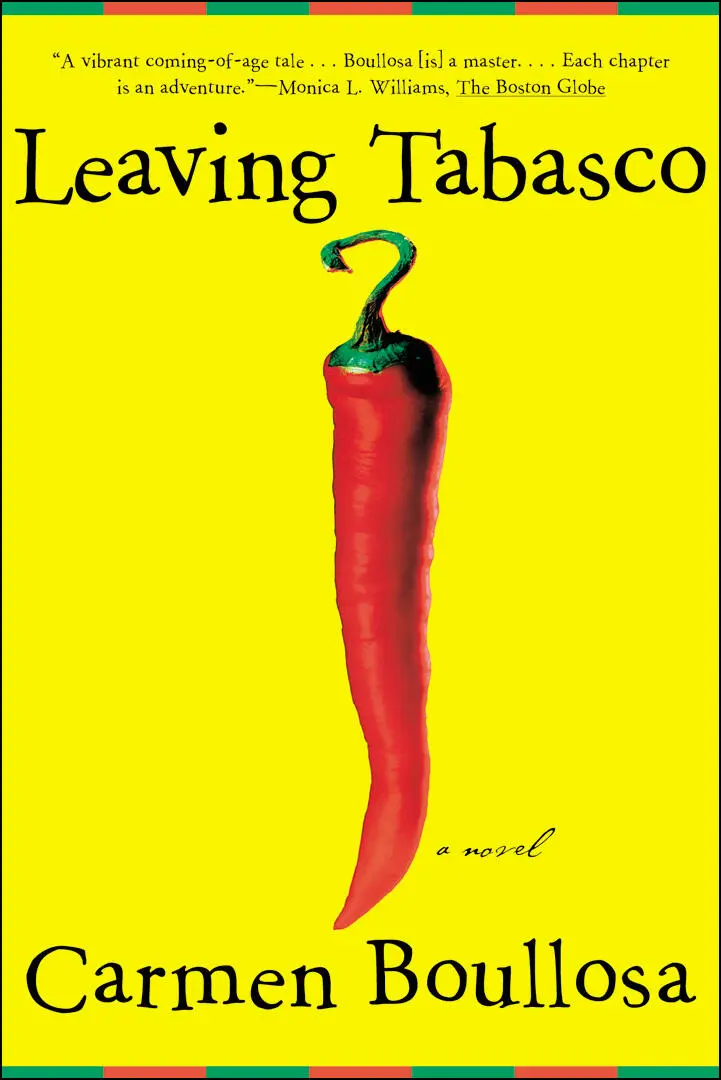
- Название:Leaving Tabasco
- Автор:
- Издательство:Grove Press
- Жанр:
- Год:2002
- ISBN:нет данных
- Рейтинг книги:4 / 5. Голосов: 1
-
Избранное:Добавить в избранное
- Отзывы:
-
Ваша оценка:
Leaving Tabasco: краткое содержание, описание и аннотация
Предлагаем к чтению аннотацию, описание, краткое содержание или предисловие (зависит от того, что написал сам автор книги «Leaving Tabasco»). Если вы не нашли необходимую информацию о книге — напишите в комментариях, мы постараемся отыскать её.
Leaving Tabasco — читать онлайн бесплатно полную книгу (весь текст) целиком
Ниже представлен текст книги, разбитый по страницам. Система сохранения места последней прочитанной страницы, позволяет с удобством читать онлайн бесплатно книгу «Leaving Tabasco», без необходимости каждый раз заново искать на чём Вы остановились. Поставьте закладку, и сможете в любой момент перейти на страницу, на которой закончили чтение.
Интервал:
Закладка:
Over time I had collected some information from my kindly teacher: my father was living in London, teaching at the university. He was a close friend of Gustavo, with whom he had studied in Italy, where my father came from. But he had abandoned his native country altogether, while Gustavo had returned to the capital of his. Papa had broken with Mama early on in their relations. My grandmother loathed him, principally because she didn’t know what to make of him. “He’s so different from the folks in Agustini. He’s not like anybody else.” But he hadn’t married again. I stretched a thread from London to Agustini. What a ridiculous name “Agustini” was! I suppose the only reason to call it that was to emphasize that it hadn’t been founded by the Indians, like neighboring Comalcalco, Cunduacan, Huimanguillo, Tenosique, Macuspana, Nacajuna, or Tacotalpa. I pulled out the thread carefully so as not to overstrain it, so that it could support the humming transit of my thoughts from one end of it to the other.
After I discovered Kafka, another debt I owe to my teacher, I stretched a line from my hometown to Prague. I then said goodbye to London and it was to Prague, to its terrible castle and handsome bridges and inviting alleyways, that I longed to go. I tightened the connection that I’d first left tentative, and it held. I made the connection even tighter, dreaming absurd dreams of going there as soon as I got the chance. I gathered my dreams together with the tireless patience I had seen modeled in the obsessive embroidering of the nuns. Prague had what it took to keep me fascinated. Not only did it offer the finest works of literature, not only did it enjoy a compelling beauty I had admired in Gustavo’s encyclopedias, but it belonged to a world with a different structure than mine, distinct from the one I knew, a socialist, well, a communist world, where by now everybody would be sure to have learned — so I told myself — to live as equals, where a new morality had been set in place, radically at odds with that of Agustini. I recall the shock I got one day at the beauty salon, where I’d gone for a trim, when I picked up a copy of Reader’s Digest and read an article about the hundreds of East Germans who risked life and limb to escape into the capitalist sector of Berlin. It had to be puerile Yankee propaganda. One more of the lies of capitalism. I read the piece with intense anxiety, I checked over the accounts of witnesses several times. Finally I consulted the teacher on the truth of it all. “I just don’t get what they could be thinking of!” I still said to myself. “Are they crazy or what?” Because at that time I’d have risked my own life to flee in the opposite direction, to escape from Agustini to Prague. So strong, so overstrong was the bond I’d forged just then between my city and that of Kafka.
But I soon went back to my link with London. In no time at all I was visiting it again in my imagination. It was the place for me. There lived the Rolling Stones, my father, and Twiggy, and in my jumbled understanding, they all met in Carnaby Street, rubbing shoulders with Joseph Conrad, the author of my beloved The Secret Agent , while Sherlock Holmes, Dickens, Wilkie Collins, and the Beatles strolled by.
The attraction of my London lay in the endless possibilities which gave it zestful new depths and a certain high-toned style. In Agustini, daily life licensed droll kinks and pious follies, but none of them was profound enough to stir the lower depths of its smugness. Underneath the screwy surfaces, events retained a grating sameness. People could fly, birds could plummet from the skies, but the social structure stayed intact. I was an Ulloa and I could swerve and pivot and dive forever, but I would always come up as an Ulloa. Just as Dulce would always be a nanny, and the boy who smelled of pee would never smell of anything different.
Once the bond that tied Agustini to London was snugly in place, I felt myself within striking distance of England, a promised land where I’d find both common sense and a freedom to nourish my fantasies and make them come true. There glowed my world of tomorrow. There young people were pulling down social institutions, shaking the establishment to its foundations, and in its place erecting a paradise of egalitarian dreams. But my fantasies lacked stamina and precision, fed only by their own fuzziness. The sole certainty that lasted for more than a brief while was the knowledge that I had to get out of Agustini. My time was up. I had to find another place to go if I was to keep on living. My miniskirts and I, my hopes for a more just world, my unspoken daydreams — we had to get away, find somewhere else to mint the new currency of our dreams.
Like anybody who discovers that the world is a lot bigger than she previously imagined, I wanted to leave my footprints across its newly discovered vastness and make it all mine. I couldn’t bear to know that the planet had so much length and breadth to offer me, and sit tight. I had to enter the larger world. I had to gobble up its distances. I had to feed right and left on what it had to offer. Driven by God knows what spiritual inheritance, I had to explore it all, a conquistador in a miniskirt.
But the desire that consumed my breast, more than a passion to travel and a hope of creating a better world, was the desire to become a writer. I was already, I assured myself, something of a writer, because I was so different from all those around me at home. And it didn’t take me long to see I was also different from those in my school. Social class, academic class, I was a loner. The advantage of jamming three grades into a single classroom was that a smart student who cared to eavesdrop could complete three years’ work in two. I finished my junior high education with good grades a year early, and the next step was to move to Mexico City, where I would finish senior high school and enter the university. At least that was the plan of Gustavo and my teacher. But it wasn’t what I had in mind. I wanted to cross the ocean, get to know other latitudes. I’d just discovered that the world was round, that Agustini was not the center of the universe, and I wanted to take full advantage of that knowledge. I had to escape, to travel, to see other horizons. I planned to live a grand variety of adventures in India, New Zealand, London, Sri Lanka, Prague, South Africa. Then I’d settle down and write my books. I had even decided exactly what it was I’d write. My magnum opus was to be a voluminous novel in which the characters revealed their personalities only by the way they walked. There was no plot, no anecdotes, no interaction, no narrative complication whatever. My characters walked from page to page and their gaits revealed their souls. My book, I can see now, was to be like a German herbology, with pictures of leaves and flowers of the itemized plant on each page. I would sketch in words the style and force of my characters’ movements, and my characters would number hundreds, even thousands, possibly encompass every person who lived in Agustini, all of them condemned to walk through my uncountable pages, strutting or sidling, strolling or striding, dragging their feet or swinging their arms, parading stiffly or rolling their hips, floppy and flaccid or rigid from head to toe. The opening lines of the book were to be: “If you creep, you walk. If you fly, you walk. If you jump, you walk. Whether you are man or woman, you walk. If you are a child, you walk. If you are somebody’s dog, you walk. If you are somebody’s lord and master, you walk. So walk on by, and I will paint your gait in words.”
I began to pile up notes in exercise books, on scraps of paper, in my head. Nobody, I knew, had ever done this before. I saw myself entering the literary heavens with my unprecedented text. I left out of account the deadly boredom I would be inflicting on my readers as well as the mental prison I was dooming myself to for years through my choice of this sterile, pretentious, nutty project.
Читать дальшеИнтервал:
Закладка:
Похожие книги на «Leaving Tabasco»
Представляем Вашему вниманию похожие книги на «Leaving Tabasco» списком для выбора. Мы отобрали схожую по названию и смыслу литературу в надежде предоставить читателям больше вариантов отыскать новые, интересные, ещё непрочитанные произведения.

Обсуждение, отзывы о книге «Leaving Tabasco» и просто собственные мнения читателей. Оставьте ваши комментарии, напишите, что Вы думаете о произведении, его смысле или главных героях. Укажите что конкретно понравилось, а что нет, и почему Вы так считаете.