J. M. Le Clézio - Terra Amata
Здесь есть возможность читать онлайн «J. M. Le Clézio - Terra Amata» весь текст электронной книги совершенно бесплатно (целиком полную версию без сокращений). В некоторых случаях можно слушать аудио, скачать через торрент в формате fb2 и присутствует краткое содержание. Год выпуска: 2008, Издательство: Penguin Books Ltd, Жанр: Современная проза, на английском языке. Описание произведения, (предисловие) а так же отзывы посетителей доступны на портале библиотеки ЛибКат.
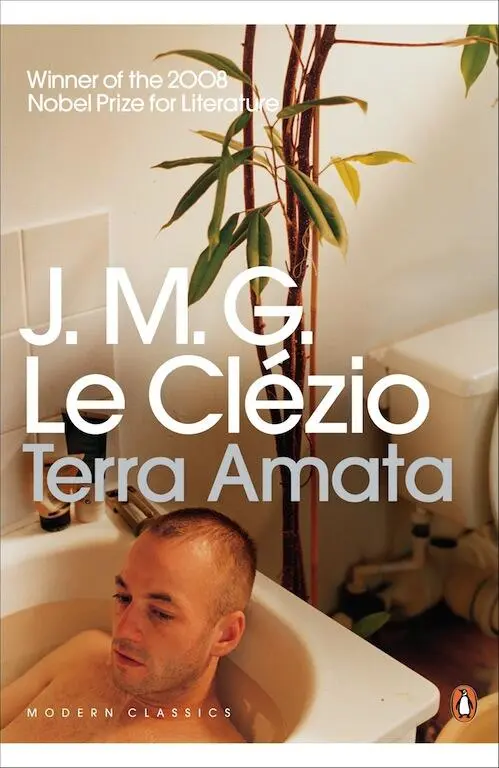
- Название:Terra Amata
- Автор:
- Издательство:Penguin Books Ltd
- Жанр:
- Год:2008
- ISBN:нет данных
- Рейтинг книги:5 / 5. Голосов: 1
-
Избранное:Добавить в избранное
- Отзывы:
-
Ваша оценка:
Terra Amata: краткое содержание, описание и аннотация
Предлагаем к чтению аннотацию, описание, краткое содержание или предисловие (зависит от того, что написал сам автор книги «Terra Amata»). Если вы не нашли необходимую информацию о книге — напишите в комментариях, мы постараемся отыскать её.
brilliantly explores humankind's place in the universe, the relationship between us and the Earth we inhabit and, ultimately, how to live.
Terra Amata — читать онлайн бесплатно полную книгу (весь текст) целиком
Ниже представлен текст книги, разбитый по страницам. Система сохранения места последней прочитанной страницы, позволяет с удобством читать онлайн бесплатно книгу «Terra Amata», без необходимости каждый раз заново искать на чём Вы остановились. Поставьте закладку, и сможете в любой момент перейти на страницу, на которой закончили чтение.
Интервал:
Закладка:
And now the last dream of the night, the dream Chancelade has always had as far back as he can remember. It’s the strangest dream of all and the most desperate, because what happens in it is nothing . Perhaps it’s merely the face of truth, inexpressible, impossible to understand, the realest of all dreams. Here in a topsyturvy world there are no more years or days or minutes. When you wake up it will be 9.30 or noon or one o’clock in the morning. You’ll be called Chancelade or Tonibaldi or Brogger. You’ll be twelve years old or thirty-five or ninety-seven. It will be 1966 or 2640 or 722 B.C. Anything’s possible. And, tonight as every night, he’ll have this inspired and terrifying dream, this empty dream. Stretched out on the bed with his face in the pillow and his legs drawn up, Chancelade dreams that he is conscious. He is submerged in consciousness, consciousness without form, without colour, without sound, without words. He sees himself see himself, simply, indefinitely, as if he’d suddenly put his head into the prison of a three-sided mirror. However far into the distance he looks all he meets is his own gaze reflected through space and back again. Body and mind, all is strained to the limit, caught in the vertigo of consciousness. Paralysed, drained, annihilated. And yet in all this deserted kingdom of which it is the centre, his own gaze lives and feeds on itself. Nothing can be done to forget or to escape. There’s no word, like ‘Fire’ or ‘Ocean’, to get hold of. Not an image with which to get away, not a thought with which to distract oneself. There is nothing but this atrociously extended knowledge, this invisible eye ceaselessly photographing its own life and wiping out at the same moment as it creates, as if what it showed was too bright and pure to be anything but darkness. Then, after these centuries of infinity and fury, after these long years and endless seconds of consciousness silently spinning on its own axis, Chancelade wakes, turns over, and pushes the sheet down a bit because he’s bathed in sweat.
I PLAYED ALL THOSE GAMES
You’d never done playing all the games there were. A prisoner on the flat face of the earth, standing on your two legs with the sun beating down on your head and the rain falling drop by drop, you had all these extraordinary adventures without really knowing where you were going. A pawn — you were no more than a pawn on the giant chess-board, a disc that the expert invisible hand moved about in order to win the incomprehensible game.
In the streets of the town a sort of ant-hill swarmed during the day and sparkled during the night. Each insect hurried without thinking towards its goal, following in the mysterious furrow traced by others. Each had his own life hermetically sealed up inside him, and desired nothing else. Each had his nest, his store of provisions, his eggs, his domestic rites. He had sketched out his own kingdom without realizing it, and it was always the same. Inside each shell, if you had looked, you would always have found the same things: a planet that resembled the earth, a bottle of wine or a glass of beer, a woman with dark hair or fair, a car, a refrigerator, a garden with a wire fence round it, a street, a cinema, two or three newspapers, and a packet of cigarettes, with or without tips. It was quite easy to be alive: all you had to do was be there, standing on the earth, breathing and staring vaguely at something. All the rest followed.
To be alive like Chancelade, all you had to do was go on playing all those games: dominoes, lotto, bridge, casino, truth, twenty questions, beggar-my-neighbour, gallows, drawing lots, draughts, ordinary roulette, blind man’s buff, tag, double or quits, Russian roulette. Nothing else mattered. Nothing else was really serious. You had to play and keep on playing with everything you saw, everything you touched, and with yourself. At forfeits, crossword puzzles, Go. At backgammon, hopscotch, crap, strip poker. At noughts and crosses, blow-football, poor Jenny, heads or tails, basketball, football, volleyball. Anything to stay alive:
You make a shape with some matches and say ‘Guess what it is’.
You drill a hole in the wall and see what’s going on next door.
You hold a piece of paper against your forehead and write your name backwards.
You smoke twenty cigarettes one after the other.
You eat 129 apricots.
You follow a woman in the street.
You kill flies with a piece of elastic.
You stick paper cockroaches on the wall.
You fly to Baghdad.
You drive on the left side of the road (or the right if it’s in England).
You go to the post-office and send yourself a telegram.
You go six days without sleeping.
You go five days without eating.
You go two days without drinking.
You go twenty-four hours without relieving yourself.
You go three minutes without breathing.
You go twenty seconds without thinking.
You light your cigarettes with travellers’ cheques.
You nurse a sick cat.
You write a novel.
You walk twenty-five miles.
You fire shots into the crowd.
You dangle a coin on a piece of string and make it tinkle, then watch people looking for it.
You throw bits of toilet-paper in the air when there are swallows about.
You play the saxophone.
You teach a chimpanzee to draw.
You improvise an election speech on a tape-recorder.
You watch an eclipse of the sun.
Everywhere there are people collecting things. There are the petrophiles who collect stones, the nicophiles who collect cigarette packets, the vitolphiles who collect cigar-bands. The tyrosemiophiles who collect cheese-labels. Some people collect postage-stamps, others coins, cups-and-balls, irons, lavatory chains, playing-cards, old cars, mats for beer-glasses, music-boxes, armour, picture postcards, Malay daggers, keys, typewriters, guns, cinema tickets, soda-water stoppers, door-knobs, comics, Hopi dolls, parking tickets, or matchboxes. There are the tubuniphiles who collect radiators, the azertyphiles who collect adding-machines, the gigantobibliophiles and the microbiblio-philes. There are the barbarologophiles who collect foreign languages, and the sanctusylvestrophiles who collect calendars. There are the transatlantonautophiles who collect ocean liners, the albinelephantophiles who collect white elephants, and the motoroscaphocadillacophiles who collect the engines of American cars adapted as outboard motors. There are the philopantophiles who collect collections. And there are also those who collect pencil-boxes, tea-pots, transistors, retractable ballpoint pens, guns with telescopic sights, forged banknotes, bath-towels advertising the Olympic Games, the autograph letters of George Washington, models of the Eiffel Tower in eighteen-carat gold, magic lanterns, lifts, false teeth, zip fasteners, IBM machines, Cambodian temples, Roman roads, obscene graffiti, Superior No. 2 drawing pins and albino cacti.
The games never end. Every second the wind shifts a blade of grass or the sea breaks on a crumbling rock and something in the world has changed. Everywhere, underfoot, overhead, to the left, to the right, in front, behind, the world seethes and swarms untiringly. Molecules move, microscopic particles jump nervously, waves come and go, meet, collide, part. There’s no peace anywhere. Nowhere any immobility or silence. Everywhere agitation, a kind of precise and mechanical madness. There’s no escaping the world, no thinking about something else instead. They’re ants, as I said, real ants imprisoned in their garden. Living inside their miniature world, dupers and dupes, without the power to withdraw, without the power to choose. They have words and signs for all the things around them, and a sort of thought to give them the illusion of being free. It’s really very funny. And not one of them can ever imagine what there is anywhere else, what extraordinary or sweet or terrible things there are just a few yards away. Not one of them will know what it is to be a jelly-fish for example, or an olive-tree with trembling leaves. Not one will have the least idea of what life is like on that grey planet only a few million light-years away. There on the other side of infinity there may be a world just like this one only as if reflected in an enormous mirror: a world where light is black and ants are white and the earth is soft and the sea hard as a slab of marble. A world where the sun is a sooty dot in the sky and volcanoes belch torrents of muddy ice. A world in which you start by dying and end by being born, with the clock-hands all turning frantically backwards. And somewhere in the middle of a big town built downwards into the earth there lives a man perhaps with eyes that look inwards into his head. And perhaps this man has a strange name that can only be said by stopping speaking. Edal-ecnahc.
Читать дальшеИнтервал:
Закладка:
Похожие книги на «Terra Amata»
Представляем Вашему вниманию похожие книги на «Terra Amata» списком для выбора. Мы отобрали схожую по названию и смыслу литературу в надежде предоставить читателям больше вариантов отыскать новые, интересные, ещё непрочитанные произведения.

Обсуждение, отзывы о книге «Terra Amata» и просто собственные мнения читателей. Оставьте ваши комментарии, напишите, что Вы думаете о произведении, его смысле или главных героях. Укажите что конкретно понравилось, а что нет, и почему Вы так считаете.