Alan Moore - Jerusalem
Здесь есть возможность читать онлайн «Alan Moore - Jerusalem» весь текст электронной книги совершенно бесплатно (целиком полную версию без сокращений). В некоторых случаях можно слушать аудио, скачать через торрент в формате fb2 и присутствует краткое содержание. Год выпуска: 2016, Издательство: Liveright Publishing Corporation, Жанр: Современная проза, на английском языке. Описание произведения, (предисловие) а так же отзывы посетителей доступны на портале библиотеки ЛибКат.
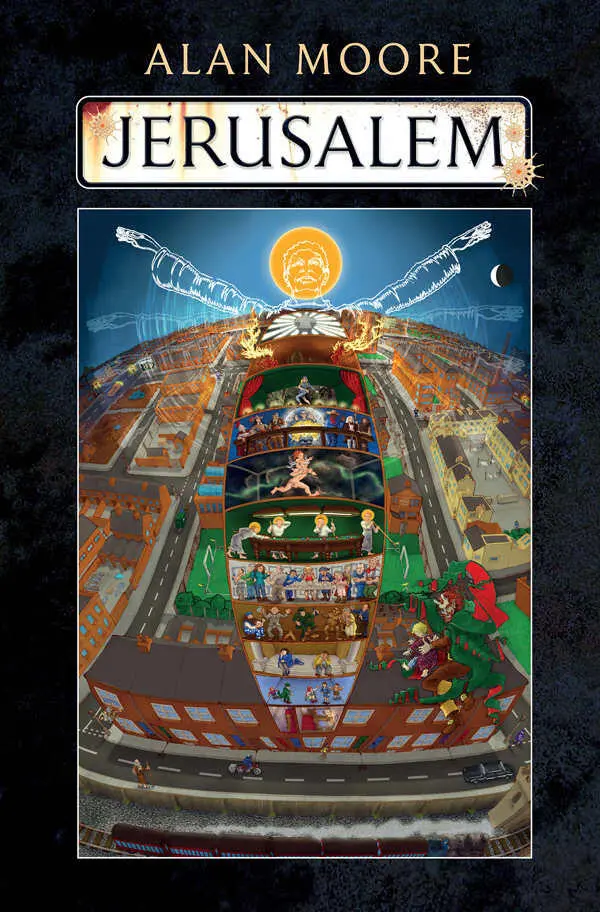
- Название:Jerusalem
- Автор:
- Издательство:Liveright Publishing Corporation
- Жанр:
- Год:2016
- ISBN:нет данных
- Рейтинг книги:4 / 5. Голосов: 1
-
Избранное:Добавить в избранное
- Отзывы:
-
Ваша оценка:
Jerusalem: краткое содержание, описание и аннотация
Предлагаем к чтению аннотацию, описание, краткое содержание или предисловие (зависит от того, что написал сам автор книги «Jerusalem»). Если вы не нашли необходимую информацию о книге — напишите в комментариях, мы постараемся отыскать её.
Disappeared lanes yield their own voices, built from lost words and forgotten dialect, to speak their broken legends and recount their startling genealogies, family histories of shame and madness and the marvellous. There is a conversation in the thunderstruck dome of St. Paul’s cathedral, childbirth on the cobblestones of Lambeth Walk, an estranged couple sitting all night on the cold steps of a Gothic church-front, and an infant choking on a cough drop for eleven chapters. An art exhibition is in preparation, and above the world a naked old man and a beautiful dead baby race along the Attics of the Breath towards the heat death of the universe.
An opulent mythology for those without a pot to piss in, through the labyrinthine streets and pages of Jerusalem tread ghosts that sing of wealth and poverty; of Africa, and hymns, and our threadbare millennium. They discuss English as a visionary language from John Bunyan to James Joyce, hold forth on the illusion of mortality post-Einstein, and insist upon the meanest slum as Blake’s eternal holy city. Fierce in its imagining and stupefying in its scope, this is the tale of everything, told from a vanished gutter.
Jerusalem — читать онлайн бесплатно полную книгу (весь текст) целиком
Ниже представлен текст книги, разбитый по страницам. Система сохранения места последней прочитанной страницы, позволяет с удобством читать онлайн бесплатно книгу «Jerusalem», без необходимости каждый раз заново искать на чём Вы остановились. Поставьте закладку, и сможете в любой момент перейти на страницу, на которой закончили чтение.
Интервал:
Закладка:
I keep up with the continuing argument over ‘Intelligent Design’, although if one subscribes to late twentieth-century ideas of consciousness as an emergent property, the disagreement vanishes. If self-awareness can emerge from systems that have passed a certain threshold of complexity, then is not the expanding universe of space and time, by definition, the most complex system that can possibly exist? Mark that I do not seek to trespass on the faiths or ideologies of others with this observation. I’m just saying.

I glimpse Alma Warren in her early sixties, standing at her easel in the house there on East Park Parade during the year 2016. She steps off from the canvas, squints and curls her lip, mugging for cameras that aren’t there. She angles her long body forward as if stooping over prey and slops a thick impasto curl of dirty cream along a splashing wave-top, then leans back again, considering.
The large acrylic image is one of a series that she’s working on at present, for an exhibition tentatively titled Landscapes? These are scenic views which would at one point have been in the category suggested by that title, but are in the process of transforming into something else, a more ambiguous state. The painting that Alma is currently engaged with shows a public house towards the north end of the Yarmouth seafront, an art-deco structure from the 1930s called the Iron Duke. Though semi-derelict as it’s depicted here, the pub retains a grandness and a generosity of spirit, vestiges of the brave, misplaced optimism typifying the decade of its inception.
A decaying beauty, in its salad days it stands adjacent to North Denes, the busy caravan camp where Alma and Michael are brought by their parents for a factory fortnight, almost every summer of their childhoods. They meet all their Spring Lane classmates and their Boroughs neighbours on the salty promenades, in bulb-lit pub yards carpeted with cockleshells, the greater part of working-class Northampton having relocated to the east coast for the same two long-anticipated weeks.
The pub is now positioned slightly right of centre, in the painting’s middle-ground. Its rear-yard walls of dark red brick are listing from the building’s central bulk, slowly collapsing, while the glass panes of the higher moulded windows are surprisingly intact. Surrounding the deteriorated edifice are only the North Sea’s expanded waters. Wavelets capped with grey detergent suds lap at the fan of steps that lead, beneath a crumbling portico, from the saloon bar to a submerged car park. The deserted terrace with its curving balustrade now looks more like the fo’c’sle of a foundered galleon. Barnacles have colonised the lower reaches of the flaking drainpipes.
Alma has applied a texture to the drowned pub’s scabby brickwork, speckling its distressed surfaces with minute dabs of purple that are almost black, so that the walls seem pitted as though by ancient corrosions. This technique, known as decalcomania, is borrowed from the great surrealist Max Ernst, and in this instance is a reference to his jewelled and eerie masterpiece, Europe after the Rain . Off in the distance of her painting’s background Alma has suggested ruined pleasure-beach attractions, decommissioned roller-coasters, skeletal Big Wheels looming above the waterline, their spidery lines just visible through scumbled morning haze that she’s created using a dry brush. She wants the work to be at once serene, sad and unsettling; intends to use the hostelry and its clean Bauhaus contours as a symbol of man’s fragile notions of modernity, succumbing to the old simplicities of time and tide. She wants the viewer to hear gulls, infrequent splashes, and an absence of machines or voices.
In the cluttered ground-floor front room that she uses as her studio, books and paintings in various stages of completion are arranged haphazardly. A creased and battered paperback edition of The Drowned World , J.G. Ballard’s lyric conjuring of watery apocalypse, rests open on one worn arm of an equally distressed leather settee. A hashish smog has gathered under the high ceiling. It’s been ten years since her exhibition in the Boroughs. She’s more famous, more ungrateful and withdrawn than ever. Alma finds herself identifying with the ruin in the painting, both of them falling to bits and jutting picturesquely and conspicuously from an otherwise flat and unruffled ocean, both of them still decent-looking in a good light, if you like that sort of thing.
She paints until the brink of dusk, then walks to Marks & Spencer’s on Abington Avenue to buy a ready-meal. Above the cricket ground the evening sky grades like over-diluted lemon squash.
I sit through all of the extinctions, all the species that have reached the natural end of their extension into the concealed direction.
Every other week, a human language dies. Beautiful, unique life forms with intricate skeletons of grammar, delicately hinged by syntax, they grow weaker and fold in their wings of adjectival gossamer. They make their last frail noises and then crumble into incoherence, into silence, no more to be heard.
A stilled tongue, every fortnight. A concluded song. Hark, the glad sound.
There is a television channel that is broadcast only to the nearly dead, transmitted on a disinfectant fug through care-home dayrooms, terminal ward twilights. Senile screens provide the best reception, signals sparking in corroded diodes, fraying synapses. The station’s logo, white upon closed-eyelid black, depicts a crudely rendered set of balances above the winding ribbon of a stylised path. Accompanying this there is a four-note trumpet flourish, serving as the channel’s theme-tune.
Albert Good sits in the armchair at his Duston home, having just woken from a nap to find the telly on and some sort of afternoon play in progress. Even though it’s all in black and white, Albert can tell immediately that it’s one of those modern dramas that he doesn’t care for much, one of those Wednesday-night things where somebody’s always either sleeping rough or pregnant. He’d get up and switch it off, but he’s been feeling so run-down just lately that he hasn’t got the energy, can only sit and watch.
There seems to only be one set involved in the production, with the audience looking at a broad flight of stone steps which rise beneath the huge porch of a church. Giant stone columns, more than likely made from painted plywood, rear up at each side, framing the scene. To Albert, it looks very like the front of All Saints Church here in Northampton, although he supposes that there must be lots of places throughout England that look similar, having been built around the same time and in the same style. Between the Gothic pillars it is night. The only lighting is positioned to resemble that of off-stage streetlamps, filtering into a pearly gloom beneath the portico.
Whichever town the play is set in, it appears to be almost deserted after dark. To Albert’s way of thinking this suggests it’s taking place some years ago, possibly just after the war, before midnight town centres were lit up like Christmas trees and full of drunken youngsters. All the props and scenery have that cosy post-war feel about them, something Albert only finds these days in local photograph collections or in reprints of the annual Giles editions, the authentic flavour of the air back then. He squints uneasily in the direction of the relatively tiny screen and tries to make sense of what’s going on.
A man and woman, both in middle age, are sitting on the cold stone steps, stage centre. Albert finds the pair familiar and is almost certain that he’s seen both actors previously, in something else. The man, who wears a loud checked jacket, might have been in Hi-de-hi , now Albert comes to think of it. The woman, with her coat pulled tight around her neck against the evening’s chill and weeping intermittently, is possibly Patricia Haynes when she was younger. Though they seem to be a married couple, there is too much space upon the step between them. When the husband shuffles closer to the wife she flinches and moves further off, away from him. Their dialogue is sparse and cryptic, with long silences between the questions and the answers. Albert can’t make head or tail of it.
Читать дальшеИнтервал:
Закладка:
Похожие книги на «Jerusalem»
Представляем Вашему вниманию похожие книги на «Jerusalem» списком для выбора. Мы отобрали схожую по названию и смыслу литературу в надежде предоставить читателям больше вариантов отыскать новые, интересные, ещё непрочитанные произведения.






Обсуждение, отзывы о книге «Jerusalem» и просто собственные мнения читателей. Оставьте ваши комментарии, напишите, что Вы думаете о произведении, его смысле или главных героях. Укажите что конкретно понравилось, а что нет, и почему Вы так считаете.