Alan Moore - Jerusalem
Здесь есть возможность читать онлайн «Alan Moore - Jerusalem» весь текст электронной книги совершенно бесплатно (целиком полную версию без сокращений). В некоторых случаях можно слушать аудио, скачать через торрент в формате fb2 и присутствует краткое содержание. Год выпуска: 2016, Издательство: Liveright Publishing Corporation, Жанр: Современная проза, на английском языке. Описание произведения, (предисловие) а так же отзывы посетителей доступны на портале библиотеки ЛибКат.
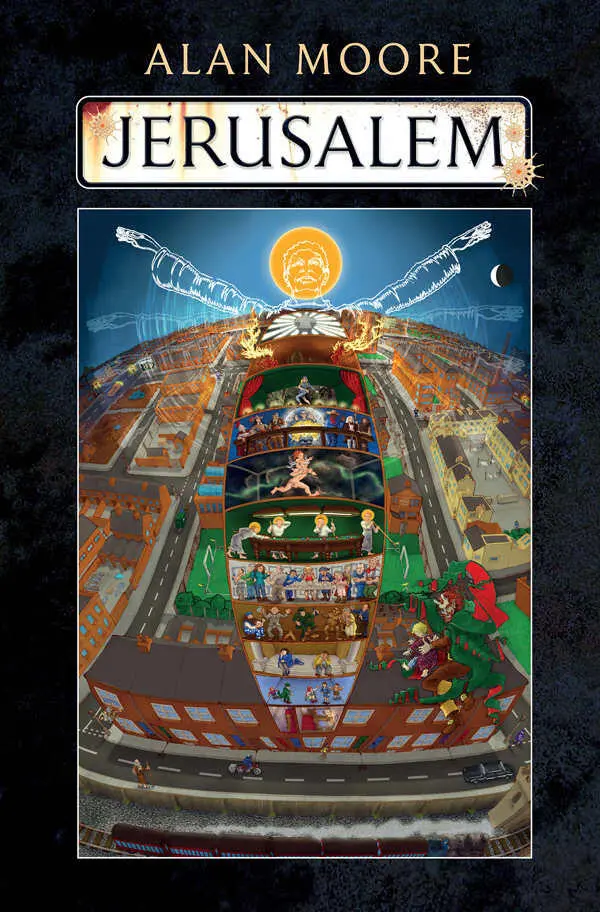
- Название:Jerusalem
- Автор:
- Издательство:Liveright Publishing Corporation
- Жанр:
- Год:2016
- ISBN:нет данных
- Рейтинг книги:4 / 5. Голосов: 1
-
Избранное:Добавить в избранное
- Отзывы:
-
Ваша оценка:
Jerusalem: краткое содержание, описание и аннотация
Предлагаем к чтению аннотацию, описание, краткое содержание или предисловие (зависит от того, что написал сам автор книги «Jerusalem»). Если вы не нашли необходимую информацию о книге — напишите в комментариях, мы постараемся отыскать её.
Disappeared lanes yield their own voices, built from lost words and forgotten dialect, to speak their broken legends and recount their startling genealogies, family histories of shame and madness and the marvellous. There is a conversation in the thunderstruck dome of St. Paul’s cathedral, childbirth on the cobblestones of Lambeth Walk, an estranged couple sitting all night on the cold steps of a Gothic church-front, and an infant choking on a cough drop for eleven chapters. An art exhibition is in preparation, and above the world a naked old man and a beautiful dead baby race along the Attics of the Breath towards the heat death of the universe.
An opulent mythology for those without a pot to piss in, through the labyrinthine streets and pages of Jerusalem tread ghosts that sing of wealth and poverty; of Africa, and hymns, and our threadbare millennium. They discuss English as a visionary language from John Bunyan to James Joyce, hold forth on the illusion of mortality post-Einstein, and insist upon the meanest slum as Blake’s eternal holy city. Fierce in its imagining and stupefying in its scope, this is the tale of everything, told from a vanished gutter.
Jerusalem — читать онлайн бесплатно полную книгу (весь текст) целиком
Ниже представлен текст книги, разбитый по страницам. Система сохранения места последней прочитанной страницы, позволяет с удобством читать онлайн бесплатно книгу «Jerusalem», без необходимости каждый раз заново искать на чём Вы остановились. Поставьте закладку, и сможете в любой момент перейти на страницу, на которой закончили чтение.
Интервал:
Закладка:
Bill, too, had been out visiting a grandparent who lived down in the Boroughs, though in Bill’s case it had been his granddad’s house in Compton Street. He’d been accompanied by a parent, just like Alma had, albeit by his mother rather than his dad, and there had been a miracle of nature in the kitchen, although nowhere near as charming as the Easter vision Alma had remembered. What it was, Bill’s granddad used to catch and jelly his own eel. On the occasion when five-year-old Bill and his mum had been visiting, the old man had just brought home a fresh load of elvers, baby eel he’d netted from the wriggling hordes that were then currently migrating up the River Nene. He’d got them in a big iron pot, its lid held down securely, and was taking them into the kitchen so that he could kill and skin them. Bill had only wanted to see all the little eel, and even though his mum and granddad had done their best to dissuade him, although they’d explained that the eel would be released in a sealed kitchen which would not be opened up until the job was done, he’d still insisted. Even at that age, he’d usually had his own way, and even at that age it had all usually ended up as something dreadful. This occasion had been no exception. He’d followed his grandfather into the little kitchen and his mum had shut the door behind him, from the other side. She wasn’t stupid, and knew what was coming next. Bill’s granddad had then cautiously removed the iron cover from the pot.
The slippery black question-marks had boiled up in a horrifying rush from the receptacle, desperate for liberty, and had gone everywhere. There must have been at least two hundred of the fucking things, slivers of inner-tube with tiny staring eyes, rippling across the worn tiles of the kitchen floor and somehow pouring themselves up the walls, the door, the table-legs, the screaming five-year-old. They’d been all over him, inside his clothes and in his ginger hair, and he had realised too late why no one would be opening the kitchen door to let him out until all this was over. Grim-faced and, with time, completely drenched in eel-blood, Bill’s grandfather had beheaded and then skinned the slithering abominations by the handful. It still took a good half-hour, by which time young Bill had been absolutely traumatised, standing there with the shakes, staring and mumbling, nowhere near as pleased with the experience as Alma had been by her lovely little chickens. But then that was what the Boroughs had been like, he thought now: fluffy sentiment next door to wriggling fear and madness.
The ghost-gang had by now reached the end of Broad Street and were flurrying in a smudged arc about the rounded building on the end. This place had once belonged to Monty Shine, the bookmaker, before it had become a night-spot and had undergone so many changes in identity that Bill thought it might be in some witness-protection programme, for its own good. It had been at one point a Goth hangout called MacBeth’s, and Bill knew that its curving front wall had been painted a vampiric lilac, although in the ghost-seam this appeared as a cool grey, which looked much better. Bill had often thought that giving this place a Goth makeover was over-egging the blood-pudding or gilding the funeral lily. Heads on spikes, witch burnings … just how Gothic did these people want it?
Crossing Sheep Street, walking straight through the unwitting mortal punters who were out that evening, the gang slipped in through the front wall of the Bird in Hand. The place was full of rowdies but, being the living, breathing sort, they were no problem when compared with their posthumous counterparts up at the Jolly Smokers. Shimmering through the cigarette smoke in the bar — Bill thought that indoor smoking had been banned later that year — the pint-sized poltergeists located Freddy Allen without difficulty. He was perched upon an empty stool beside a table at which two still-living men sat talking, which was unsurprising in itself: a lot of the rough sleepers liked to knock about in pubs, where there was more chance of a heavy drinker glimpsing them and where they could eavesdrop on mortal conversations for old times’ sake. What took Bill and his colleagues aback, however, was that Freddy wasn’t merely listening to the chatter of the living. He was joining in.
When Bill examined the two men that the ghost-tramp seemed to be talking to, he recognised the pair of them and had a partial answer to the question of how Freddy could be in debate with anyone who wasn’t among the departed. The man Freddy was addressing was the same peculiar individual that the kids had seen arriving home in Tower Street sublimely pissed, before they’d gone up to Mansoul to watch the angle-scrap. He’d been able to see the phantom children then, and so presumably could see and talk to Freddy now. The other chap, sitting across the table from the spectral moocher with his anxious eyes fixed firmly upon the warm-blooded drunk beside him, was a little fat man with curly white hair and glasses who Bill recognised as Labour councillor Jim Cockie. He looked quietly terrified, although Bill quickly realised that this wasn’t due to Freddy’s presence. Cockie couldn’t see the spectre he was seated opposite to, and was instead frightened by his table-mate, the chap with the repeated and demented laugh who was, as far as the plump councillor could tell, conversing with an empty stool.
Phyllis had taken a deep breath, if only for the way it sounded, and marched boldly up to the three seated men, two living and one dead. The moment Freddy spotted her he leapt up from his seat and clutched his weather-beaten hat close to his balding scalp.
“You keep away from me you little buggers! I’ve had quite enough o’ you lot for one day, with all that messin’ me about when you were up there in the twenty-fives.”
Phyllis had raised her palms towards the angry spirit in a calming and placating gesture.
“Mr. Allen, I know we’ve been rotten to yer, an’ I’m sorry. We wun’t do it anymore. I’d not ’ave bothered yer, except by all accaynts yer thought to be a decent sort, and there’s this young girl what’s in trouble.”
From the moment Freddy had stood up, the pissed-up and apparently clairvoyant chap beside him had begun to laugh uproariously, transferring his inebriate attentions to the clearly nervous councillor instead.
“Ahahaha! Did you see that? He just stood up like he’d got piles. He’s cross because a load of little blighters just come in.” The psychic drunk had turned his head to look directly at Bill and his dead confederates here. “You can’t come in! You’re underage! What if the landlord asks to see your death-certificates? Ahahaha!”
The rattled councillor glanced briefly in the same direction that the other man was looking, but appeared unable to see anything. Cockie looked back towards the chuckling boozer seated next to him, badly unnerved now.
“I don’t understand this. I don’t understand you people.”
Freddy, meanwhile, had become less furious and more puzzled at Phyll’s mention of a young woman in trouble.
“What young girl? And anyway, what’s it to me?”
The drunken, giggling bloke was turning to the councillor now, saying “I can’t hear ’em. Even when they’re right up next to you they sound faint, have you noticed? Ahaha.”
Phyllis persisted.
“I don’t know if you’ll ’ave seen ’er, just around and that, but she’s an ’alf-caste girl about nineteen, who’s got ’er ’air all done in plaits, like stripes. She wears one o’ them shiny coats, an’ it looks like she’s on the game.”
A glint of recognition came into the threadbare apparition’s sad eyes.
“I … I think I know the one you’re on about. She lives down Bath Street flats, in what used to be Patsy Clarke’s old place.”
Читать дальшеИнтервал:
Закладка:
Похожие книги на «Jerusalem»
Представляем Вашему вниманию похожие книги на «Jerusalem» списком для выбора. Мы отобрали схожую по названию и смыслу литературу в надежде предоставить читателям больше вариантов отыскать новые, интересные, ещё непрочитанные произведения.






Обсуждение, отзывы о книге «Jerusalem» и просто собственные мнения читателей. Оставьте ваши комментарии, напишите, что Вы думаете о произведении, его смысле или главных героях. Укажите что конкретно понравилось, а что нет, и почему Вы так считаете.